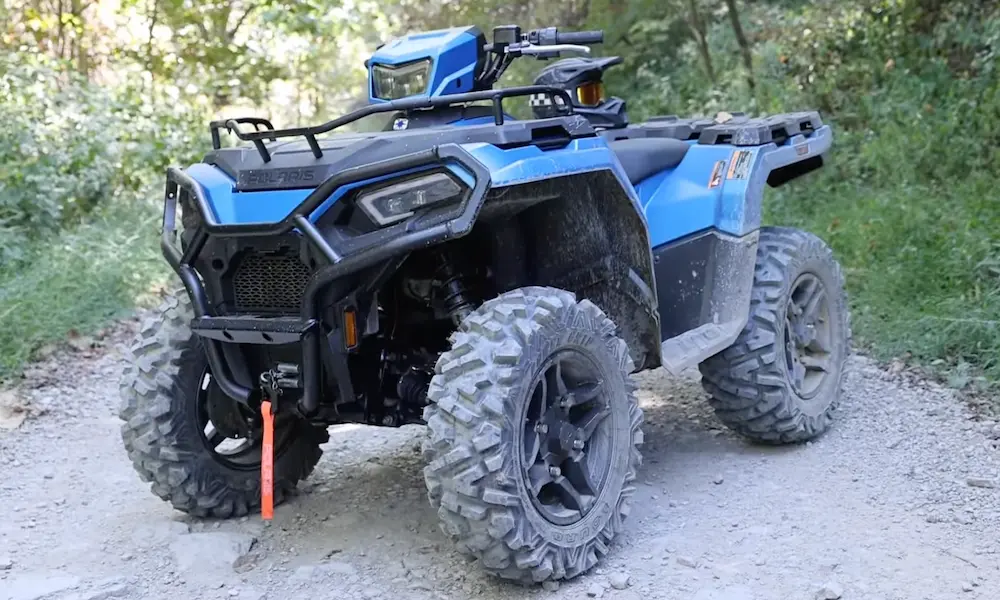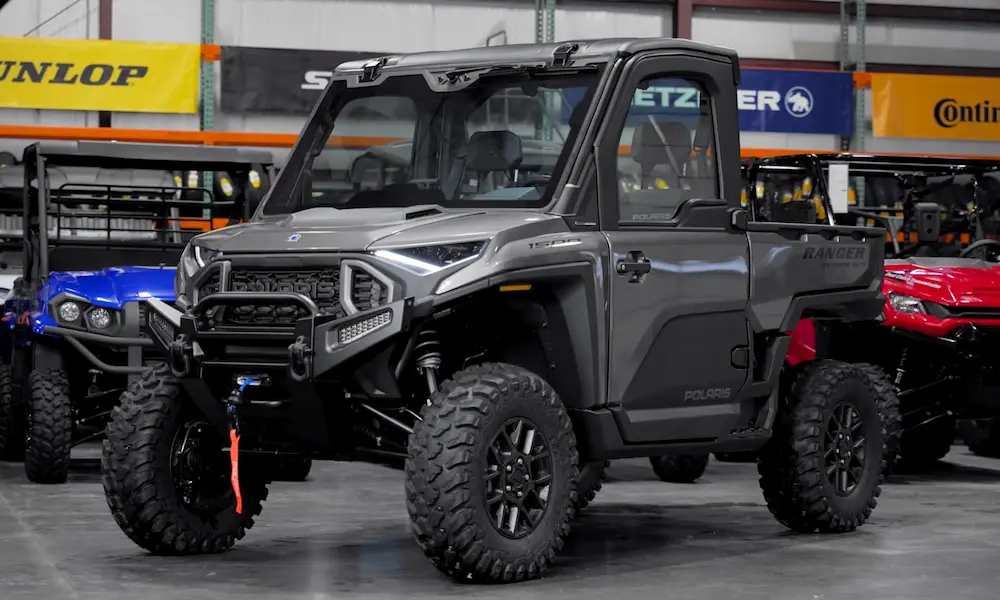
Got a Polaris and wondering if you can swap in something cheaper than OEM fluid? You might be able to — but get it wrong, and you’re looking at a wrecked front gearcase and a repair bill that’ll ruin your weekend. This guide breaks down exactly which substitutes work, which ones destroy your drivetrain, and what your Polaris actually needs to stay healthy.
What Makes Polaris Demand Drive Fluid So Specific?
Your Polaris front gearcase isn’t a standard differential. It uses a Hilliard electro-mechanical overrunning clutch system — a clever design that keeps you in two-wheel drive until you actually need traction.
Here’s the short version of how it works:
- Your front driveshaft spins constantly while you’re moving
- Steel rollers sit in neutral pockets inside the clutch housing
- When rear wheels slip, the internal hub accelerates and the rollers wedge against machined ramps — locking in four-wheel drive instantly
- When traction returns, the rollers release and you’re back to two-wheel drive automatically
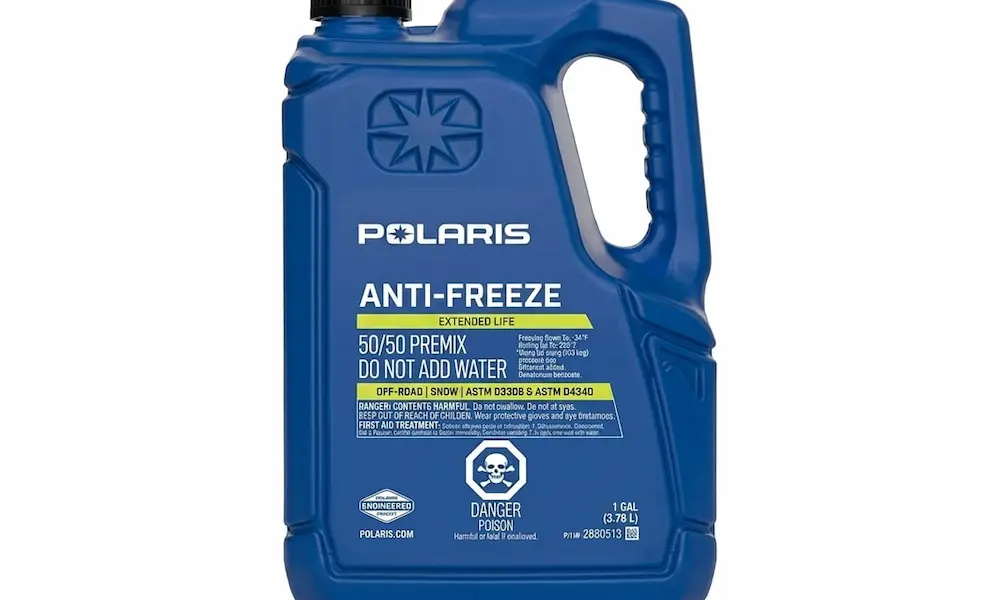
That engagement and release cycle happens fast. The fluid inside that gearcase has to manage both heavy gear lubrication and precise clutch friction at the same time. That’s a tough ask, and it’s exactly why Polaris Demand Drive fluid exists as its own dedicated product.
The Exact Properties Your Gearcase Fluid Must Have
Throw any old oil in there and you’ll likely find out why this matters the hard way. Here’s what the fluid actually needs to do.
Friction Balance
Too slippery, and the steel rollers skid across the hub ramps instead of wedging in. That means no four-wheel drive, or a violent slamming engagement that can shatter CV joints.
Too grippy, and the rollers won’t release when you regain traction. Your front differential stays locked, steering gets stiff, and you start destroying axle components through driveline wind-up.
The OEM Demand Drive fluid uses a proprietary additive system to hit that narrow friction window precisely. It prevents clutch slippage while limiting the vibrations that cause chatter and accelerated wear.
Viscosity Across Extreme Temperatures
Your Polaris might start in minus-twenty Minnesota winters or sit baking in Arizona July heat. The fluid has to handle both.
- Too thick in cold weather: Viscous drag mimics magnetic clutch drag, causing accidental four-wheel drive engagement even with the switch off. Steering becomes dangerous on icy roads.
- Too thin in heat: The protective film collapses between gear teeth. Metal meets metal. Gearcase destroyed.
Quality synthetic fluids maintain stable viscosity across that entire range — that’s a big reason synthetics outperform conventional options here.
Shear Stability and Oxidation Resistance
Ring and pinion gears physically tear fluid molecules apart under pressure. Low-quality fluids thin out permanently after hard use, losing protection right when you need it most.
Oxidation is the other enemy. Heat plus churning air turns fluid into sludge and varnish that coats the gearcase interior, traps heat, and attacks the electromagnetic coil’s wiring. Good front drive fluids carry robust antioxidant packages to prevent that chemical breakdown.
Fluids That Will Wreck Your Polaris Front Gearcase
This is the section people skip — until their gearcase explodes.
| Fluid Type | Why It Fails in a Polaris Front Drive |
|---|---|
| ATF (Automatic Transmission Fluid) | Lacks heavy-duty anti-wear protection for hypoid gears under shock load. Gear teeth wear rapidly, then catastrophic failure follows. |
| API GL-5 Gear Oil | Extreme pressure additives make surfaces too slippery. Rollers can’t grip ramps, AWD fails. Cold-weather viscosity causes permanent engagement and severe steering bind. |
| Tractor Hydraulic Fluid (J20C/J20D) | Friction profile designed for slow, massive ag clutches — not lightweight high-speed roller clutches. Causes erratic engagement and ADC chatter. |
Why ATF Looks Right But Isn’t
Polaris Demand Drive fluid measures roughly 7.4 centistokes at 100°C — similar to ATF. So people assume they’re interchangeable. They’re not.
ATF works fine for light engagement on easy trails. But it’s formulated for planetary gear transmissions that operate under totally different pressure profiles. Under hard off-road use, ATF’s protective film ruptures against your ring and pinion gears. You’ll see accelerated wear, metal spalling, and eventually total gearcase failure. The few dollars saved aren’t worth it.
Why GL-5 Gear Oil Is Actively Dangerous
This is the worst substitution you can make. GL-5 oils use heavy sulfur-phosphorus extreme pressure additives that deliberately create an ultra-slippery chemical layer on metal surfaces. That’s great for truck axles. It’s catastrophic for a Hilliard clutch.
That slippery coating prevents your steel rollers from gripping the hub ramps at all. Major aftermarket lubricant manufacturers explicitly warn against GL-5 fluids in Polaris front drive applications — and for good reason.
The Best Polaris Demand Drive Fluid Substitutes
There are three aftermarket options worth considering. All three are warranty-secure under U.S. law, meaning they won’t void your OEM warranty.
| Brand | Product | Standout Feature |
|---|---|---|
| AMSOIL | Synthetic ATV/UTV Powertrain Fluid | Replaces both Demand Drive AND AGL in one bottle |
| Lucas Oil | Synthetic SxS Command Drive | Purpose-built for Active Descent Control chatter elimination |
| Maxima Racing Oils | SXS Synthetic Front Drive Fluid | Ester chemistry clings to metal during long storage periods |
AMSOIL Synthetic ATV/UTV Powertrain Fluid
AMSOIL started with a dedicated front drive fluid, then took it further. Their Synthetic ATV/UTV Powertrain Fluid consolidates front gearcase and transmission fluid into one bottle — a huge convenience win for Polaris owners who previously juggled multiple different products.
What makes it worth considering:
- Pour point of -50°C (-58°F) — fluid flows immediately in extreme cold, preventing clutch drag and parasitic drivetrain loss
- Shear-stable synthetic base oils — resists permanent viscosity loss under shock loads from rock crawling, heavy towing, or accessory weight (winches, skid plates, roof panels)
- Clutch chatter prevention — friction modifiers balanced specifically for the Hilliard clutch system
- Easy-Pack flexible pouches — squeeze directly into the fill port without funnels, even in tight chassis spaces
The AMSOIL Powertrain Fluid replaces both Polaris Demand Drive Fluid and AGL, which simplifies maintenance for Polaris Sportsman, Ranger, RZR, and General owners significantly.
Lucas Oil Synthetic SxS Command Drive
Lucas built their Synthetic SxS Command Drive specifically as a direct Polaris Demand Drive substitute — and they paid close attention to Active Descent Control performance.
Key advantages:
- ADC-specific friction tuning — minimizes the harsh clutch chatter that plagues heavy Active Descent Control use on steep descents
- Permanent viscosity retention — synthetic polymers don’t shear thin over the fluid’s service life, maintaining consistent protection from the first mile to the last
- Ester and hydrocracked base oil blend — strong oxidation resistance under sustained heat from mud bogging or trailer pulling
- Available in bulk — from single quarts to 55-gallon drums, making it practical for commercial fleet operations
Maxima Racing Oils SXS Synthetic Front Drive Fluid
Maxima approaches lubrication from a motorsport angle. Their SXS Synthetic Front Drive Fluid uses ester-based chemistry that gives it a distinct advantage for vehicles that sit for extended periods.
Ester molecules carry a natural electrical polarity. Because metal surfaces carry an opposing charge, the fluid molecules actually cling to gear surfaces and bearings magnetically — even when the vehicle sits all winter. When you fire it up in spring, that protective boundary layer is already in place before the splashing action of the gears has time to circulate fluid to the upper components.
Like the other options, Maxima explicitly warns against using this fluid in any API GL-5 application — a clear signal that the friction modifier profile is properly tuned for overrunning clutch systems.
Don’t Mix Up Your Polaris Fluid Types
Polaris uses three separate, incompatible fluid types across their drivetrain. Getting them confused is an expensive mistake.
- Demand Drive Fluid → Front gearcase only
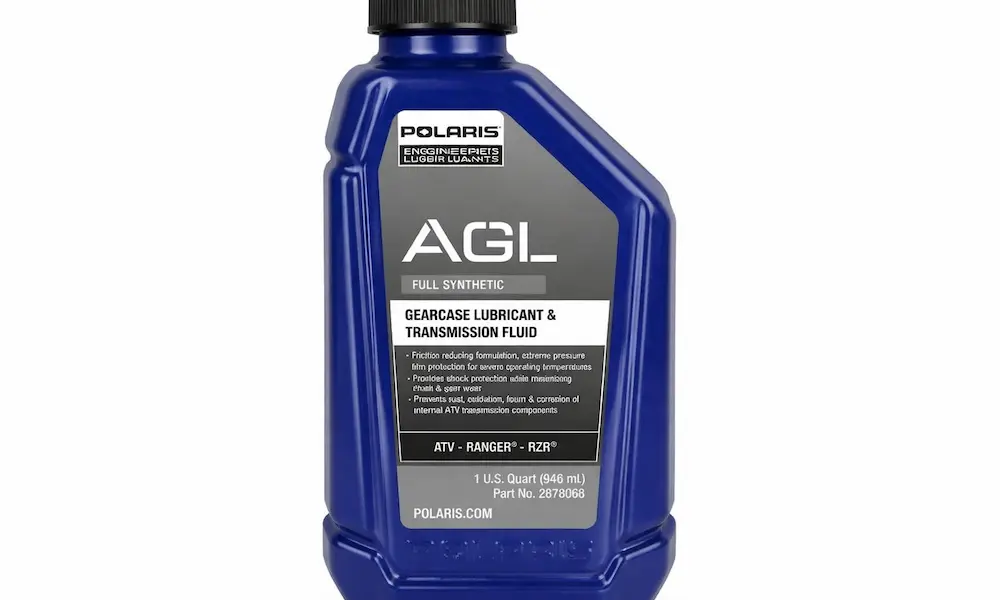
- AGL (All Gear Lubricant) → Main transmission and rear differential
- Angle Drive Fluid → Older models with angle drive rear gearcases
Angle Drive Fluid is significantly thicker and formulated for different gear geometries. AGL uses a different friction modifier profile suited for transmission chains. None of these are interchangeable with front drive fluid — and none of them belong in your front gearcase.
How to Change Your Front Gearcase Fluid
The gearcase capacity is small — less than 10 ounces depending on your model. That small volume degrades faster than a large automotive differential, so clean fluid matters more here than most people realize.
Step-by-step process:
- Park on a completely level surface, transmission in Park, parking brake on
- Clean around both the fill plug (upper) and drain plug (lower) — dirt in the gearcase is a fast track to bearing failure
- Remove the fill plug first — if it strips and you’ve already drained the fluid, you’re stuck
- Position a drain pan, then remove the lower drain plug with an 8mm Allen socket
- Inspect the O-rings on both plugs — replace them if they’re flattened or cracked
- Reinstall the drain plug and torque it to spec
- Fill through the upper port until fluid just weeps from the bottom of the fill threads — that’s your full mark
- Reinstall the fill plug, torque to spec, wipe clean, check for leaks
| Plug | Torque Spec | Tool |
|---|---|---|
| Fill Plug | 8–19 ft-lbs (11–26 Nm) | 8mm Allen Socket |
| Drain Plug | 11–19 ft-lbs (15–26 Nm) | 8mm Allen Socket |
(Torque varies by model year — confirm in your owner’s manual)
Gearcase Capacities by Model
| Platform | Common Models | Approximate Capacity |
|---|---|---|
| Recreational ATV | Sportsman 400, 500, 570, 800 | 200–265 mL (6.75–9.0 oz) |
| High-Performance ATV | Sportsman 850, XP 1000, Scrambler | 250–275 mL (8.5–9.3 oz) |
| Sport Side-by-Side | RZR 800, 900, XP 1000, Turbo, Pro XP | 200–250 mL (6.75–8.5 oz) |
| Utility Side-by-Side | Ranger 570, 1000, General | 200–250 mL (6.75–8.5 oz) |
How Often Should You Change It?
Polaris sets two separate maintenance schedules based on how hard you ride.
Standard use (moderate trails, light hauling, normal conditions):
Change every 100 hours, 12 months, or 1,000 miles — whichever comes first.
Extreme use — and this covers more situations than you’d think:
- Prolonged Active Descent Control operation
- Repeated steep mountain descents
- Deep mud, water crossings, or heavy snow plowing
- Using ADC as your default driving mode
Under extreme use, that interval drops to just 25 hours. The small fluid volume can’t absorb and dissipate heat the way a large automotive differential can. Once friction modifiers burn out, clutch chatter and accelerated wear follow fast.
If your front end starts chattering during Active Descent Control, change the fluid immediately — don’t wait for a scheduled interval.
Watch the Drained Fluid
What comes out tells you a lot:
- Milky or cloudy → Water intrusion through seals or the breather tube. Flush and refill immediately. Water emulsifies with oil and destroys film strength.
- Metallic sheen or visible shavings → Active gear or bearing wear is happening. A fluid change alone won’t fix this — the gearcase needs inspection.
- Dark but clean → Normal degradation. Regular change and you’re good.
The One-Fluid Solution Worth Considering
If you’re tired of tracking multiple fluid types for your Polaris, the AMSOIL Synthetic ATV/UTV Powertrain Fluid is worth a hard look. It’s the only product on the market that legitimately replaces both Demand Drive Fluid and AGL in one formulation — cutting your maintenance inventory in half without compromising protection.
For riders doing heavy ADC work in mountainous terrain, Lucas Command Drive’s friction tuning for clutch chatter makes it a smart call. For vehicles stored seasonally, Maxima’s ester chemistry gives you peace of mind that your gearcase has a protective layer waiting when you fire it up again.
What you don’t want is ATF from the auto parts store, anything with a GL-5 rating, or tractor hydraulic fluid. Those substitutions look harmless until they’re not — and by the time the symptoms show up, the damage is already done.