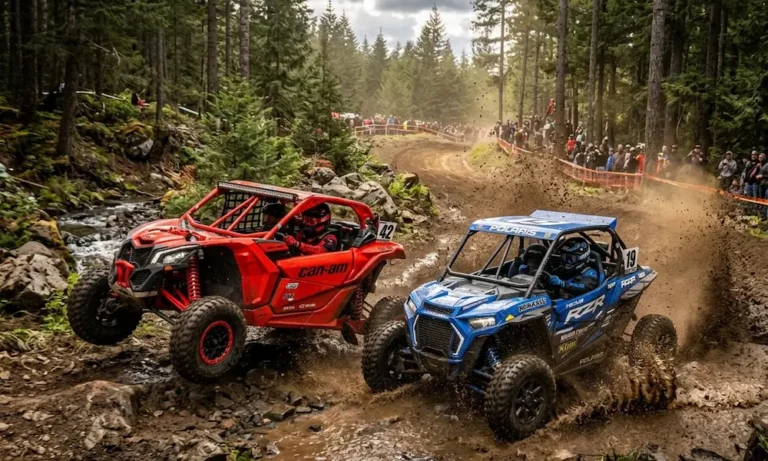
Picking between Can-Am and Polaris feels a lot like choosing between a sports car and a pickup truck. Both are excellent. Both have serious fans. But they’re built for different people. This breakdown cuts through the noise so you can figure out which brand actually fits your riding style, budget, and maintenance tolerance.
Two Very Different Philosophies
Can-Am vs Polaris isn’t really a fair fight because they’re not trying to win the same race.
Polaris, founded in Minnesota back in 1954, is built around American utility. Think farms, ranches, and construction sites. The machines are approachable, the parts are cheap, and your neighbor with a socket set can fix most things in his driveway.
Can-Am, owned by Bombardier Recreational Products out of Canada, plays a completely different game. Their engineering is aggressive, performance-first, and powered by Rotax engines that punch well above their displacement. They want to win at the track, the dunes, and the desert.
Both brands dominate the U.S. powersports market, but they get there by very different roads.
Engines and Power Delivery
Polaris ProStar: Smooth and Predictable
Polaris uses its ProStar engine lineup — liquid-cooled, dual-overhead-cam twins and triples. The power delivery is linear and smooth. There are no sudden surges. That makes Polaris machines easier to manage in tight, technical spots like rocky trails, dense woods, or backing a trailer through a narrow gate.
Can-Am Rotax: Muscular and Immediate
Can-Am goes with Rotax V-twins and turbocharged triples. The throttle response is sharp and deliberate. When you need to haul a heavy load up a loose gravel slope, the Rotax just pulls. It doesn’t hunt for power. It simply delivers it.
For sport riding, that same aggression translates to faster acceleration and class-leading top speeds.
Transmissions: The Biggest Gap Between Brands
This is where the can am vs polaris debate gets genuinely interesting.
Polaris Steeldrive: Solving the Belt Problem
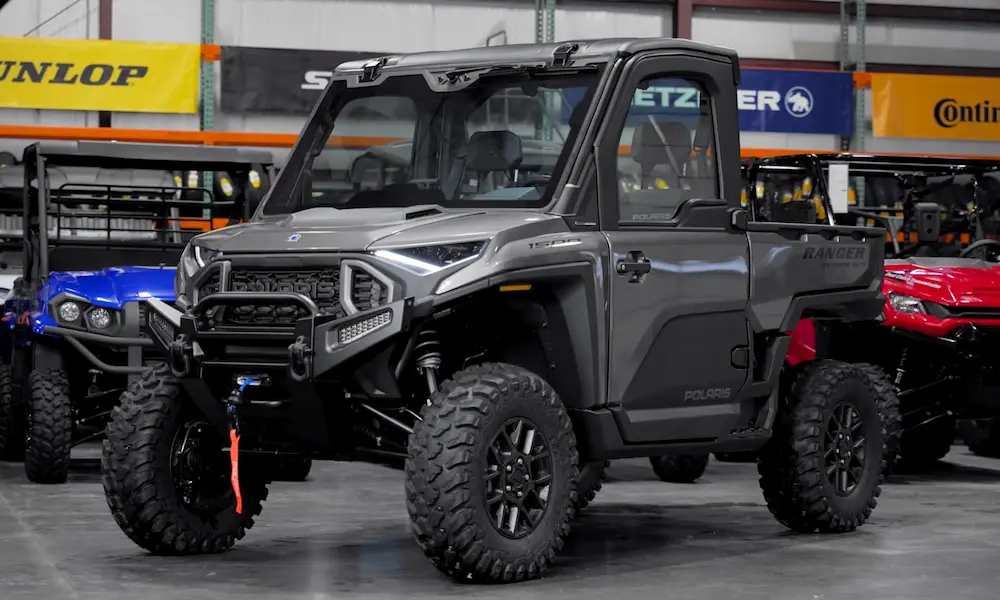
Traditional CVT rubber belts fail under heat. Polaris tackled this head-on with the Steeldrive transmission in the Ranger XD 1500. It’s a fully sealed, liquid-cooled CVT with a 100% steel belt. It also features a Torque Boost function that temporarily spikes engine RPMs to force the machine out of high-resistance situations without destroying the drivetrain.
That’s a genuinely big deal for anyone who uses their UTV for heavy work.
Can-Am DCT: No Belt at All
Can-Am took an even bolder step with the Maverick R. They ditched the belt entirely and fitted a 7-speed dual-clutch transmission. Shifts happen in milliseconds. There’s zero torque interruption. Power goes straight from the engine to the wheels with no parasitic belt loss.
For sport and racing applications, that’s a massive advantage.
Traction and Differential Systems
Polaris On-Demand AWD
Polaris uses a reactive system. When the rear wheels slip, the front axle engages automatically and backs off once traction returns. It’s seamless, requires zero driver input, and works exceptionally well. Many Polaris utility vehicles also include Turf Mode, which unlocks the rear differential so you’re not tearing up grass or scuffing pavement during tight turns.
Can-Am Smart-Lok
Can-Am’s Smart-Lok differential is electronically controlled and fully lockable on the fly. It monitors multiple vehicle sensors and adjusts locking force based on terrain — rocks, mud, trails. It gives experienced riders real, granular control over grip dynamics.
The traditional Visco-Lok system on lower Can-Am trims is slightly slower to engage than Polaris’s system, but Smart-Lok closes that gap on premium models.
Suspension: Comfort vs. Performance
Polaris Rides Like a Couch
Polaris tunes its suspension for plush isolation. The Ranger series in particular gets consistent praise for absorbing trail chatter and large impacts equally well. After a full day of work, your back will thank you.
The Polaris Dynamix active suspension system reads driver inputs — steering angle, speed, braking — and adjusts shock damping proactively. It stiffens before a corner, not after. That’s a meaningful difference.
Can-Am Handles Like a Race Truck
Can-Am’s suspension is built for speed and stability. The Torsional Trailing Arm Independent Rear Suspension on the Outlander and Commander keeps the tire contact patch flat through the entire suspension stroke, which matters a lot at high speeds.
The Maverick R’s tall knuckle suspension with 25 inches of travel is the current benchmark for desert racing geometry. The Can-Am Smart-Shox system reacts rapidly to abrupt terrain changes. It’s incredibly plush on rough ground, though Polaris Dynamix edges ahead in proactive chassis management.
Utility Side-by-Sides: Ranger vs. Defender
This is the heart of the can am vs polaris rivalry for most buyers.
Polaris Ranger XD 1500: The Heavy Hauler
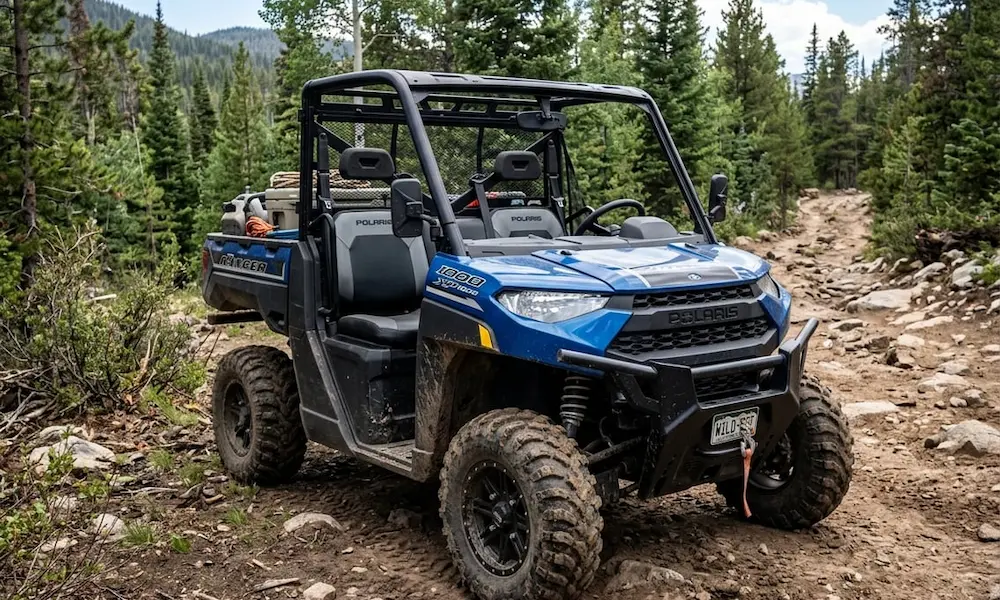
The Ranger XD 1500 is in a class by itself for raw work capacity. A 1,498cc triple pushing 110 horsepower and 105 lb-ft of torque. Tows 3,500 lbs. Carries 1,500 lbs in the cargo box.
The NorthStar Edition adds factory HVAC, power windows, and sound deadening that genuinely rivals automotive cabin quality. The Texas Edition pushes 32-inch tires, upgraded ground clearance, and a JBL Trail Pro audio system. The Mountaineer Edition drops the gearing for high-altitude climbing.
The catch? The top trims cost over $50,000.
Can-Am Defender: Built Like a Tank
The Defender HD10 and HD11 feel exceptionally rigid under load. The chassis barely squats when fully loaded. Steering geometry stays composed. When you’re dragging heavy implements or navigating deep mud, the Rotax V-twin pulls with confidence.
The Defender MAX Limited’s enclosed cab is often called the most refined factory cab at its price point. The Versa-Pro flip-up seats create serious interior storage. Panel fitment is tight and dust intrusion is minimal.
| Model | Engine | Horsepower | Towing | Cargo | Base MSRP |
|---|---|---|---|---|---|
| Ranger XD 1500 Texas Edition | 1.5L Triple | 110 hp | 3,500 lbs | 1,500 lbs | ~$51,999 |
| Ranger XD 1500 NorthStar | 1.5L Triple | 110 hp | 3,500 lbs | 1,500 lbs | ~$40,999 |
| Ranger XP 1000 | 999cc Twin | 82 hp | 2,500 lbs | 1,000 lbs | ~$21,499 |
| Defender MAX Limited HD11 | 976cc V-Twin | 95 hp | 2,500 lbs | 1,000 lbs | ~$31,999 |
| Defender HD10 | 976cc V-Twin | 82 hp | 2,500 lbs | 1,000 lbs | ~$19,599 |
| Defender HD7 | 650cc Single | 52 hp | 1,500 lbs | 1,000 lbs | ~$13,399 |
Sport Side-by-Sides: RZR Pro R vs. Maverick R
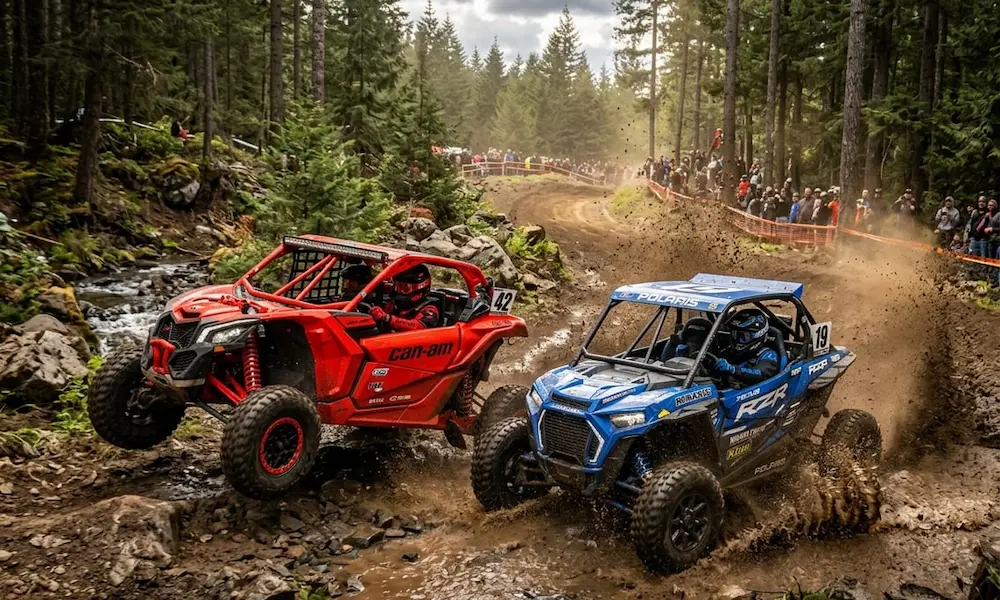
Both machines cost over $40,000. Both are genuinely ridiculous in the best possible way.
Polaris RZR Pro R
The RZR Pro R runs a 2.0L naturally aspirated four-cylinder making 225 horsepower. No turbo means no heat soak and instant throttle response. The heavy steel chassis has earned its reputation through Baja 1000 victories. Dynamix active suspension delivers 22 inches of travel.
The tradeoff is weight. The Pro R is big and thirsty.
Can-Am Maverick R
The Maverick R counters with a 999cc turbocharged triple at 240 horsepower. It features a motorsport-derived anti-lag system that keeps turbo pressure alive during off-throttle moments. Combined with the 7-speed DCT and 25 inches of tall knuckle suspension travel, it’s the fastest thing available from the factory.
Some racers do question whether a small-displacement turbocharged engine holds up as long as the Polaris’s larger, lower-stressed naturally aspirated unit. Fair concern.
| Model | Displacement | Aspiration | Horsepower | Transmission | Suspension Travel |
|---|---|---|---|---|---|
| Can-Am Maverick R | 999cc Triple | Turbocharged | 240 hp | 7-Speed DCT | 25.0 inches |
| Polaris RZR Pro R | 1,997cc Inline-4 | Naturally Aspirated | 225 hp | CVT | 22.0 inches |
Crossover Segment: General vs. Commander
Need a dump bed but still want sport suspension? This is your segment.
The Polaris General XP 1000 produces 100 horsepower with 14 inches of suspension travel front and rear. It handles heavy cargo and rough terrain without complaint. It’s the go-to for hunters and trail workers who split their time between hauling gear and recreational riding.
The Can-Am Commander 1000R also produces 100 horsepower but leans sport. The TTI rear suspension keeps the chassis planted at speed. The cockpit is tight and sporty, though that means less elbow room than the General. If trail speed is your priority and hauling is secondary, the Commander wins.
ATVs: Sportsman vs. Outlander
Polaris Sportsman: Comfort First
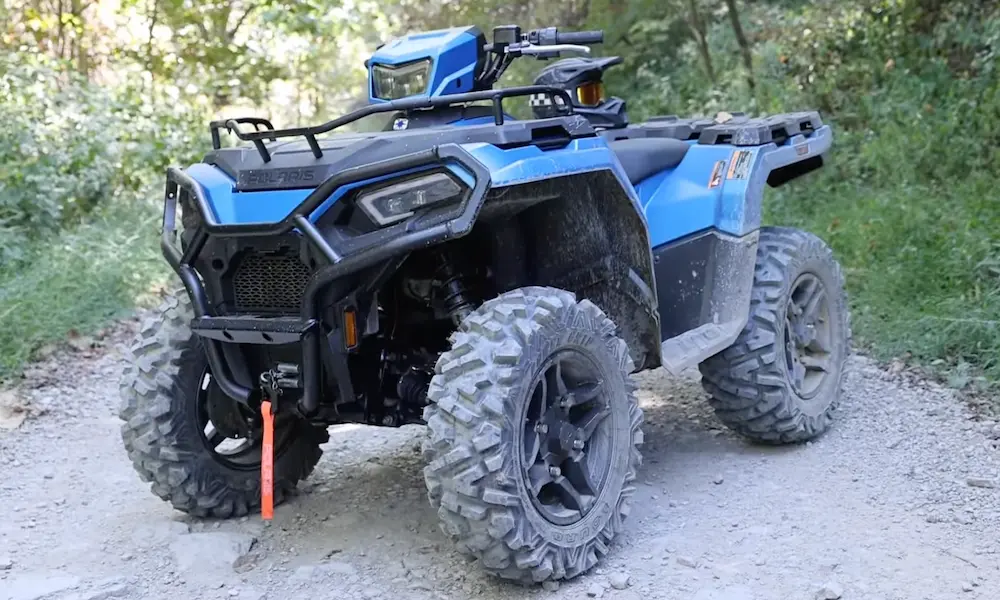
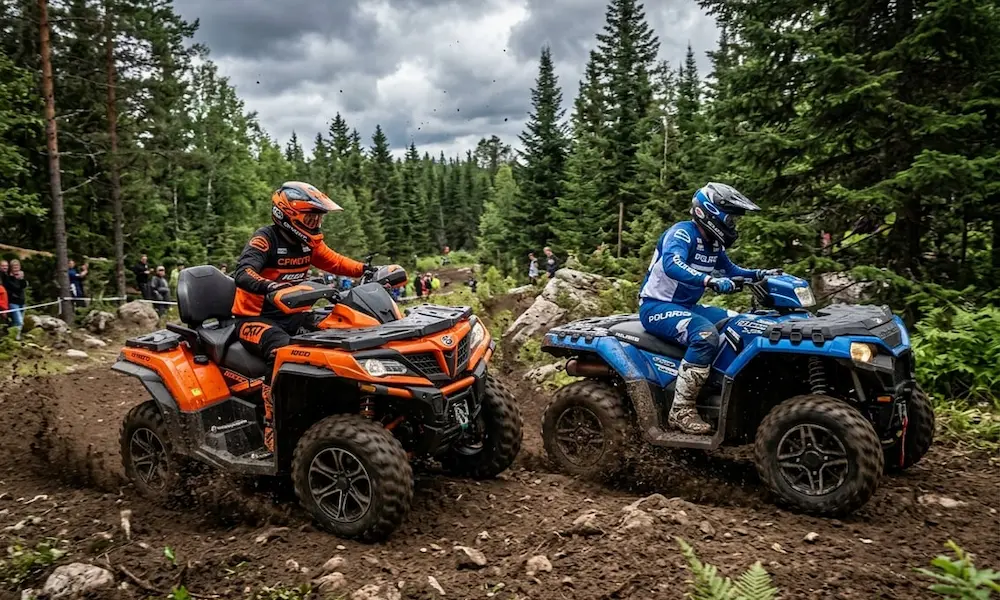
The Sportsman XP 1000 S expanded its track width to 55 inches, which kills the top-heavy feeling common in large ATVs. Riders consistently report less fatigue on full-day rides. Speed-sensitive electronic power steering provides heavy assistance at low speeds and firms up at high speeds for terrain feedback.
Can-Am Outlander: Power and Pull
The 2025/2026 Outlander 1000R produces 101 horsepower — the most ever from a factory production ATV. It tows 1,830 lbs, significantly more than the Sportsman’s 1,750 lbs. The Visco-4Lok front differential locks completely for deep mud and vertical rock crawling.
The stiffer suspension transfers more trail vibration than the Sportsman. On genuinely rough terrain, you’ll feel it.
| ATV Model | Engine | Horsepower | Towing | Front Suspension | Width |
|---|---|---|---|---|---|
| Polaris Sportsman XP 1000 S | 952cc Twin | 89 hp | 1,750 lbs | Dual A-Arm | 55.0 in |
| Can-Am Outlander 1000R | 999cc V-Twin | 101 hp | 1,830 lbs | Double A-Arm | 48.5 in |
| Polaris Sportsman 570 | 567cc Single | 44 hp | 1,350 lbs | MacPherson Strut | 48.0 in |
| Can-Am Outlander 500 | 650cc Single | 40 hp | 1,830 lbs | Double A-Arm | 47.6 in |
Digital Tech: Ride Command vs. BRP GO!
Polaris Ride Command runs on a ruggedized 7-inch display with topographic mapping, waypoint plotting, and vehicle telemetry. The star feature is Group Ride tracking via Vehicle-to-Vehicle radio antennas. You can track every rider in your group on the map without any cell service. That’s genuinely valuable in remote backcountry.
Can-Am’s premium models feature a 10.25-inch touchscreen with camera integration, suspension diagnostics, and the BRP GO! app. The display is impressive. But some Group Ride features have historically relied on cellular data tethering. In areas with no signal, that’s a problem. Can-Am is actively improving offline mapping, but Ride Command currently wins for off-grid reliability.
Reliability and Maintenance Reality
Here’s the honest version of this conversation.
Can-Am is engineered tight. When you maintain it correctly, it lasts. Rotax engines handle extreme thermal stress exceptionally well. The downside is complexity. When something electrical fails, you almost always need dealer-grade diagnostic software. That means more downtime and higher service bills.
Polaris is built for simplicity. Parts are cheap, widely available, and easy to install in your garage with basic tools. Wear items like bearings, bushings, and rubber belts need replacing more frequently. But they’re affordable fixes. The machines are forgiving workhorses that keep running even when they’re not perfectly maintained.
Warranty Coverage: What You Actually Get
| Coverage | Polaris | Can-Am |
|---|---|---|
| Standard ATV / Sport Warranty | 6 Months, Unlimited Miles | 6 Months, Unlimited Miles |
| Standard Utility Warranty | 1 Year, Unlimited Miles | 1 Year, Unlimited Miles |
| Extended Program | Polaris Protection Plan | B.E.S.T. Program |
| Max Extended Coverage | Up to 48 Months | Up to 60 Months |
Can-Am’s B.E.S.T. extended service contract transfers to new owners at no cost, which meaningfully boosts resale value. Polaris’s Protection Plan maxes out at 48 months versus Can-Am’s 60. On a $40,000+ machine, that extra coverage matters.
So Which One Should You Actually Buy?
Choose Polaris if you:
- Work your machine hard daily on a farm or ranch
- Want to handle maintenance yourself
- Prioritize ride comfort over outright speed
- Need reliable off-grid navigation with Group Ride
Choose Can-Am if you:
- Want maximum horsepower and performance
- Ride aggressively and push the machine to its limits
- Don’t mind dealer maintenance for complex repairs
- Value premium cabin refinement and structural rigidity
The can am vs polaris decision isn’t about which brand is better. It’s about which machine matches how you actually ride, where you ride, and how much wrenching you’re willing to do. Both brands build genuinely excellent machines. Pick the one that fits your life.