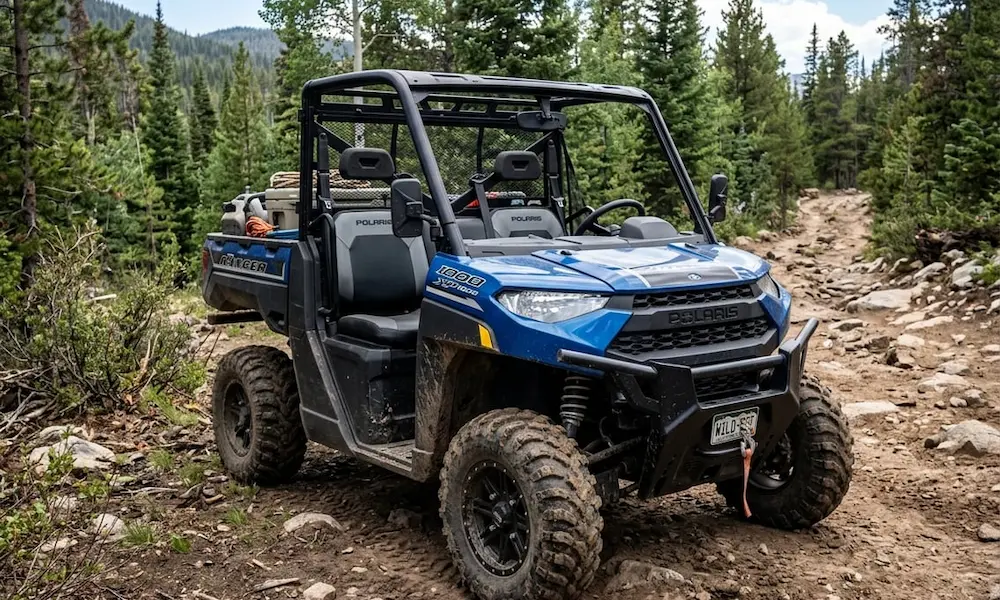
Your Polaris Ranger cranks but won’t start — and it’s driving you crazy. The good news? A cranking engine already rules out half the problem. The bad news? What’s left still covers a lot of ground. This guide walks you through every real cause, from dead battery voltage to vapor lock, so you can stop guessing and start fixing.
What “Cranks But Won’t Start” Actually Tells You
Here’s the thing — a cranking engine is actually useful information.
If your starter spins the engine over, you’ve already confirmed that your battery has enough juice to run the starter, your starter solenoid works, and your safety interlock circuits are satisfied.
So the problem lives somewhere in three areas: fuel, spark, or compression. Let’s dig in.
Check the Safety Interlocks First
Before you pull anything apart, rule out the simple stuff.
Brake Pressure Switch
Your Polaris Ranger won’t start unless you press the brake pedal hard enough to close the hydraulic brake pressure switch. The original switch (part number 4014262) is known to fail internally, meaning you have to stomp the pedal with serious force to trigger it. If yours is worn out, replace it with the updated part number 4014225.
Gear Position Sensor
If your shifter shows Neutral but the dashboard shows a dash instead of “N” or “P,” your gear position sensor isn’t reading correctly. This happens when the shift linkage cable stretches out of adjustment. The ECU reads the wrong gear and kills the start sequence. Adjust the linkage, add dielectric grease to the sensor contacts, and recheck.
Seatbelt Interlock
On Rangers made after 2015, an unbuckled seatbelt triggers a speed limiter — and on some models, it kills the engine entirely past five miles per hour. If you’ve swapped to aftermarket racing harnesses, the factory buckle receiver sits open, and the ECU sees an incomplete circuit.
Fix it with a DragonFire Racing harness override clip, which plugs directly into the factory wiring and closes the loop permanently.
The Battery Voltage Problem Nobody Talks About
Here’s a tricky one. Your battery reads 12.5 volts sitting still. Looks fine, right? It might not be.
When the starter motor engages, it pulls hundreds of amps in an instant. If your battery has internal sulfation or age damage, its internal resistance spikes under that load. The system voltage crashes.
The Polaris Ranger ECU needs a minimum of 7 volts to stay on during cranking. Drop below that threshold, and the ECU shuts itself off to protect its circuits. The starter keeps spinning — but there’s no fuel signal and no spark because the ECU went dark.
This is one of the most frequently misdiagnosed crank-no-start conditions. Mechanics replace fuel pumps and sensors when the actual problem is a weak battery that looks healthy at rest.
Test it properly: Load-test the battery, not just voltage-test it. You need a load tester that simulates the amperage draw of the starter.
Starter Motor Failure Sounds — Know the Difference
| Sound | What It Means |
|---|---|
| Single sharp click | Solenoid works, starter motor has a dead spot or corroded connection |
| Rapid clicking | Battery lacks amperage to hold the magnetic field |
| High-pitched whirring | Starter spins but doesn’t engage the flywheel — bendix gear or sprag clutch failure |
| Nothing | No power reaching the solenoid — check fuses and relay |
On 2016 and newer Rangers, cold-weather relay failures are common below 35°F. The EFI relays physically freeze and won’t switch. The factory fix is installing updated cold-weather rated relays.
Read Your Diagnostic Codes Before Touching Anything
Don’t skip this step. Your Ranger stores fault codes that point directly at the problem.
On modern digital displays: Turn the key to ON (don’t crank). Press the Mode or Toggle button until you see “DIAGCODE” or “Engine Error Codes” on the screen.
On older models (pre-digital dash): Cycle the ignition key from OFF to ON three times rapidly, leaving it ON on the third cycle. Count the Check Engine light blinks.
Blink Codes for Older Polaris Ranger Models
| Blink Code | System | What It Means |
|---|---|---|
| 21 | Crankshaft Position Sensor | ECU lost timing sync — engine cranks, no start |
| 22 | Throttle Position Sensor | Open or short circuit — won’t idle or rev |
| 23 | RAM Error | ECU is defective and needs replacement |
| 25 | Transmission Input | Invalid gear detected — start is blocked |
| 41 | Intake Air Temp (T-MAP) | Sensor harness error — floods engine |
| 45/46 | Manifold Absolute Pressure | Broken wire at connector — poor running |
| 51/52 | Fuel Injector Circuit | Harness failure — misfires or no start |
Modern SPN Fault Codes (Digital Display Models)
| SPN Code | System | What It Means |
|---|---|---|
| 168 | Battery Voltage | Voltage too low during crank — ECU shuts down |
| 102 | Manifold Absolute Pressure | T-MAP signal erratic — intake leak or broken harness |
| 105 | Intake Air Temperature | Out-of-range signal — defaults to extremely rich fueling |
| 520344 | Fuel Trim / O2 Sensor | Extreme lean or rich condition — clogged filter or bad pump |
| 520280/520281 | Throttle Body | Electronic throttle failure — forces limp mode |
Fuel System Failures That Kill Your Start
Listen for the Fuel Pump Prime
Turn the key to ON without cranking. You should hear a high-pitched hum for about 2–3 seconds. That’s the fuel pump priming the rail. No hum means no fuel pressure — check the fuel pump fuse, relay, and wiring to the tank before anything else.
Required Fuel Pressure by Engine Size
| Engine Size | Required Fuel Pressure |
|---|---|
| 400cc / 500cc / 700cc | 39 PSI ± 3 PSI |
| 800cc (Pre-2013) | 39–40 PSI |
| 800cc (2013+) | 45–50 PSI |
| 570cc / 900cc / 1000cc | 45–58 PSI |
If pressure drops below 30 PSI, the injectors drip liquid fuel instead of spraying a fine mist. Liquid fuel doesn’t ignite reliably in a combustion chamber — the engine cranks endlessly and never fires.
Fuel Pressure Regulator O-Ring Failure
Inside the fuel pump assembly, rubber O-rings seal the pressure regulator. Ethanol-blended gas degrades these O-rings fast. When they crack, high-pressure fuel bleeds straight back into the tank before reaching the engine. The pump runs fine, but the fuel rail starves. This is a primary cause of hard starting and total no-start conditions.
Replacing the pump assembly with an upgraded unit from Quantum Fuel Systems uses corrosion-resistant polymers that handle modern fuel blends far better than OEM rubber.
Vapor Lock on 2011–2012 Ranger 800 Models
These specific models used a lower-spec 40 PSI regulator. In extreme heat, the fuel inside the lines boils into vapor. The pump can’t push vapor through. The engine runs fine cold, but after a hot shutdown, it won’t restart until everything cools down.
The fix is upgrading to the 58 PSI regulator adopted by the factory in 2013, then reflashing the ECU for a longer hot-start injector pulse.
Check Your Tank Vent
A blocked fuel tank vent creates vacuum inside the tank as fuel drains out. Eventually the vacuum overpowers the pump. The engine stalls, and the Polaris Ranger cranks but won’t start afterward.
Quick test: unscrew the gas cap. If you hear a loud rush of air, the vent is blocked. Replace or clear the vent hose.
Wiring Harness Failures: The Hidden Killer
The Polaris Ranger vibrates constantly during off-road use. That vibration work-hardens copper wire strands inside the harness until they break — but the outer plastic insulation stays perfectly intact. You can’t see the break.
T-MAP Sensor Wiring
The Temperature and Manifold Absolute Pressure sensor sits on the intake manifold. When its internal wires break from vibration, the ECU defaults to assuming intake air is at -40°F. It dumps a massive amount of fuel into the engine, flooding it completely. The Polaris Ranger cranks but won’t start because the cylinders are soaked in raw fuel.
Stretch test: Pull gently on each wire at the connector. If a wire stretches like a rubber band instead of staying firm, the copper inside is broken.
Repair it with OTB Powersports wiring repair pigtails — the standard industry fix for this recurring vibration failure.
Crankshaft Position Sensor
Without a good signal from the crankshaft position sensor, the ECU is completely blind to engine timing. It won’t trigger spark or inject fuel. The engine cranks forever and never fires.
Test it with a multimeter across the signal wires. A healthy sensor reads around 560 ohms. An open circuit or infinite resistance means the sensor is dead.
Fuel Injector Wiring
The same vibration that breaks T-MAP wiring also breaks fuel injector harnesses. Listen to the injector body with a long screwdriver handle pressed to your ear while cranking. A healthy injector clicks rhythmically. Silence means a dead electrical coil or a clogged nozzle. Ohm-test the injector pins — an open circuit means replacement time.
The ECU Problem That Fools Everyone
If you replace a damaged ECU with a brand-new OEM unit and the Polaris Ranger still cranks but won’t start, here’s why: new ECUs ship from the factory blank. They contain no fuel maps, ignition timing, or logic. They need to be flashed at an authorized dealer with software matched to your exact VIN. A blank ECU installed as plug-and-play will crank the engine all day and never start it.
Mechanical Issues That Stop Combustion Cold
Valve Lash Clearance
On high-mileage Rangers — especially the 500cc single-cylinder models — valve seats wear deeper over time. Eventually the valve no longer closes fully during the compression stroke. Air-fuel mixture escapes, compression drops, and the spark fires into an empty chamber.
The telltale sign: the engine starts only when it’s warm, because thermal expansion temporarily restores clearance. Check valve lash with feeler gauges against factory spec.
Compression Test Results
| Engine Platform | Healthy Compression Range |
|---|---|
| Ranger 600cc–800cc | 150–185 PSI |
| Ranger 900cc/1000cc | 160–195 PSI |
| Ranger 570cc | 140–160 PSI |
| Ranger 400cc/500cc (with decompressor) | 50–90 PSI |
The 400cc/500cc low reading is normal — these engines use an automatic compression release mechanism on the camshaft that intentionally bleeds pressure at low RPM. That same reading on a 900cc twin means catastrophic internal damage.
Throttle Body Carbon Buildup
Off-road dust combines with crankcase vapor to form sticky carbon sludge on the back of the throttle plate. It blocks the idle bypass ports completely. The engine cranks, fuel injects, but there’s no air to support combustion.
The giveaway: the engine starts only if you slightly press the accelerator while cranking. That forces the throttle plate open manually. Clean the throttle body bore chemically to restore normal bypass airflow.
Ethanol and Storage: A Slow Disaster
Ethanol in modern gas absorbs moisture from the air. Leave your Ranger sitting for a season, and the fuel separates — water and ethanol sink to the bottom of the tank, right where the fuel pump pickup sits.
When you try to start it, the pump sends water-ethanol mix into the injectors. Water doesn’t burn. The engine cranks hard and won’t fire. Worse, that mix rusts the injector internals and degrades the pump assembly. Even after adding fresh fuel, the system may stay compromised.
Always use a quality fuel stabilizer before storage. It’s the only real prevention.
Spark Delivery Failures
Even with perfect fuel pressure and compression, you need a spark to light the fire.
Worn spark plugs develop wider electrode gaps over time. Carbon buildup creates a shortcut path for voltage to bleed into the cylinder head instead of jumping the gap. After a water crossing, moisture inside the plug boot does the same thing — the high voltage shorts to the engine block and never reaches the electrode.
The engine cranks fine, fuel goes in, but nothing ignites. Inspect and replace spark plugs as part of your regular maintenance schedule, and always dry out the plug boots thoroughly after water crossings.
One More Sneaky Issue: The “Ghost Misfire”
Your Ranger throws a misfire code, but the spark plugs and injectors check out perfectly. Here’s what’s actually happening.
The ECU measures misfires by watching crankshaft rotation speed. When a cylinder fires, the crank accelerates slightly. Between firings, it slows down. If your CVT drive belt is glazed, worn, or water-logged, it slips violently against the clutch sheaves. That mechanical shock travels backward through the drivetrain into the crankshaft.
The ECU mistakes belt slip for engine misfires. As a protective measure, it shuts off the fuel injectors. The engine stalls and won’t restart. Chasing injectors and spark plugs wastes your time — inspect the CVT belt first.
A Systematic Approach Saves Time and Money
When your Polaris Ranger cranks but won’t start, work through the systems in this order:
- Safety interlocks — brake switch, gear sensor, seatbelt circuit
- Battery load test — not just a voltage check
- Diagnostic codes — blink codes or digital SPN codes
- Fuel pressure — mechanical gauge on the rail
- Wiring harness — stretch test on T-MAP and injector connectors
- Spark — plug condition, wire continuity, coil output
- Compression — physical test with a gauge
- Throttle body and air — carbon buildup, tank vent blockage
Every step eliminates a category. By the time you reach step four or five, you’ve almost always found the problem — without buying parts you don’t need.