Got a check engine light and a scan tool showing Toyota P0016? This post breaks down exactly what’s happening inside your engine, why it matters, and what you need to do about it. Stick around — the fix isn’t always obvious, and getting it wrong can cost you an engine.
What Is the Toyota P0016 Code?
Toyota P0016 means your engine control module (ECM) spotted a timing mismatch between the crankshaft and the intake camshaft on Bank 1. The official name is “Crankshaft Position – Camshaft Position Correlation (Bank 1 Sensor A).”
Here’s the simple version: your crankshaft and camshaft need to spin in perfect sync. When the ECM detects they’re out of sync by more than 5–10 degrees, it stores P0016 and lights up the check engine lamp.
Toyota uses 2-trip detection logic, meaning the ECM needs to see the fault across two separate drive cycles before the warning light comes on. That’s a built-in safeguard against false alarms from cold starts or brief oil pressure dips.
How Toyota’s VVT-i System Works (And Why It Fails)
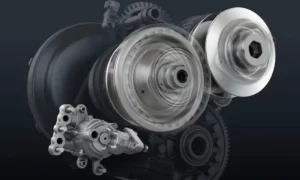
Toyota’s Variable Valve Timing-intelligent (VVT-i) system isn’t just a static chain connecting the crankshaft to the camshaft. It’s a dynamic, hydraulically-driven system the ECM actively controls to optimize performance at every RPM.
Three layers work together:
- Electronic layer — The ECM sends a pulse-width modulated (PWM) signal to the Oil Control Valve (OCV)
- Hydraulic layer — The OCV meters oil pressure into the camshaft phaser
- Mechanical layer — The phaser physically shifts the camshaft’s position relative to the crankshaft
When any one of these layers breaks down, P0016 follows.
VVT-i Detection Thresholds by Engine Family
Toyota calibrates a “VVT learning value” at idle — the baseline angle when the camshaft sits in its fully retarded position. If that angle drifts outside spec, the fault sets.
| Engine | Common Applications | Retarded Angle Lower Limit | Retarded Angle Upper Limit |
|---|---|---|---|
| 2AZ-FE | RAV4, Camry (2004–2008) | 25.0°CA | 51.0°CA |
| 1GR-FE | Tacoma, 4Runner, FJ Cruiser | 22.5°CA | 45.2°CA |
| 1NZ-FXE | Prius (Hybrid) | 30.0°CA | 46.0°CA |
| 2AR-FE | Camry, RAV4 (2010+) | ~25.0°CA | ~50.0°CA |
The 7 Most Common Causes of Toyota P0016
1. Worn Timing Chain (“Stretch”)
This is the most common culprit on high-mileage Toyotas. The chain doesn’t literally stretch — it wears at each pin and bushing junction. Hundreds of those joints add up. Even 1% chain elongation pushes the camshaft’s position beyond the ECM’s allowable window.
Signs it’s the chain:
- Rattling from the front of the engine on startup
- P0016 combined with P0300-series misfire codes
- High mileage (typically 100,000+ miles with inconsistent oil changes)
2. Failed Timing Chain Tensioner
Toyota’s hydraulic tensioners depend on oil pressure to keep the chain taut. If the tensioner’s internal ratchet wears out or oil pressure drops, the chain goes slack. Slack chain = timing fluctuations = P0016.
On 1GR-FE V6 engines (Tacoma, 4Runner), you can remove a small access cover on the timing cover to inspect the tensioner plunger. If it extends more than 10mm, the chain needs replacing.
3. VVT-i Phaser Locking Pin Failure
The camshaft phaser has a spring-loaded pin that locks it in the fully retarded position when you shut the engine off. Why? Because there’s no oil pressure at shutdown to hold it steady.
When that pin wears or fails to engage, the phaser rattles during the first two seconds of a cold start. Over time, this damages the internal vanes and seals, leading to hydraulic control failure and a P0016 code.
That brief diesel-like rattle at startup? That’s often the locking pin failing to do its job.
4. Stuck or Dirty Oil Control Valve (OCV)
The OCV directs oil pressure into either the advance or retard side of the phaser. Sludge, varnish, or metal debris can cause the valve’s spool to stick — holding the phaser in the wrong position even when the ECM commands a correction.
A stuck OCV at idle means the camshaft can’t reach the “home” retarded position. The ECM compares the actual camshaft angle to its learned baseline, finds it off, and stores P0016.
5. Clogged VVT Oil Filter (Strainer)
Behind a threaded plug in the cylinder head, there’s a tiny mesh screen protecting the OCV from debris. It’s easy to overlook and almost never gets replaced during routine maintenance.
A partially blocked strainer slows the hydraulic response of the phaser. The ECM commands a timing change, the phaser can’t move fast enough, and the fault triggers. Cleaning or replacing this screen is one of the cheapest fixes — and one of the most overlooked.
6. Faulty CMP or CKP Sensor
The Camshaft Position (CMP) and Crankshaft Position (CKP) sensors feed the ECM the real-time data it compares. If either sensor drifts, a chipped reluctor tooth distorts the signal, or corroded wiring introduces resistance — the ECM can see a “correlation error” even when the mechanical timing is perfectly fine.
Watch for:
- P0016 that only appears after long highway drives (heat soak)
- Intermittent codes that clear and return
- Codes present with no obvious mechanical noise
7. Shifted Reluctor Wheel
On some Toyota V6 and V8 engines, the crankshaft reluctor wheel is pressed onto the shaft. Under extreme heat or vibration, it can rotate slightly, creating a permanent offset in the CKP signal. The timing chain and phaser can be perfect, but the ECM still reads a correlation error because the physical reference point moved.
What Toyota P0016 Feels Like to Drive
An engine running with P0016 isn’t breathing properly. The valves open and close at the wrong points in the piston stroke, and you’ll notice it.
Common symptoms:
- Rough idle or unstable RPM at stop lights
- Sluggish acceleration, especially under load
- Poor fuel economy
- Occasional misfires
- Engine stall in severe cases
- Cold-start rattle from the front of the engine
If the camshaft is stuck advanced, the intake valves open while exhaust valves are still closing. Exhaust gases get pulled back into the intake manifold, diluting the fuel charge and causing misfires. If it’s retarded too far, the engine runs lean and stumbles at idle.
The ECM will also pull ignition timing back as a safety measure to prevent knock — which makes the sluggishness even worse.
Don’t ignore this code. Toyota engines with interference designs can suffer bent valves or worse if timing jumps a tooth while the chain is already stretched.
Model-Specific Issues You Should Know
2AR-FE / 1AR-FE (Camry, RAV4 2010+): Cold-Start Rattle
The 2.5L 2AR-FE is notorious for a brief cold-start rattle that sounds like a diesel knock. Toyota issued Technical Service Bulletin T-SB-0041-13, which superseded T-SB-0146-10, addressing exactly this issue.
The root cause is a worn locking pin hole in the intake camshaft timing gear assembly. The pin can’t lock the phaser at shutdown, it rattles on startup, and internal damage eventually triggers P0016 or P0012. The updated gear assembly (P/N 13050-0V040) is the fix.
1GR-FE V6 (Tacoma, 4Runner, FJ Cruiser): Chain Stretch
The 4.0L 1GR-FE uses a dual-bank VVT-i system. P0016 is Bank 1; P0018 is Bank 2. High-mileage examples often develop timing chain stretch, especially when oil changes were stretched past 5,000-mile intervals. Check the tensioner plunger depth through the access cover — over 10mm means it’s time for a chain kit.
2ZR-FE / 1NZ-FXE (Corolla, Prius): OCV and Phaser Issues
The 1.8L 2ZR-FE Corolla and 1.5L 1NZ-FXE Prius are sensitive to contaminated oil. In the Prius, the engine frequently starts and stops — if the oil is dirty, the phaser can’t lock reliably on each startup. Toyota’s T-SB-0087-09 covers VVT gear replacement for the 2ZR-FE Corolla and Matrix.
How to Diagnose Toyota P0016 Step by Step
Step 1: Read the Freeze Frame Data
Pull the code with a scan tool — Toyota Techstream gives you the best data. Check the freeze frame:
- RPM and engine load when the fault set — Idle faults point to OCV or phaser pin issues. Load faults suggest chain stretch or low oil pressure.
- Coolant temperature — Hot-only codes suggest heat soak or thinning oil
- VVT learning value — If it’s near the upper limit (like 51°CA on a 2AZ-FE), the timing is mechanically off by a significant margin
Step 2: Run the Active Test
Using Techstream, command the OCV to 100% duty cycle at idle while watching live data.
- Engine stumbles or stalls → OCV works, phaser is moving. Look at the chain and sensors.
- RPM doesn’t change at all → Seized OCV, blocked oil passage, or mechanically stuck phaser.
Step 3: Check Oil Condition First
Before replacing anything, check your oil. Dirty, thick, or low oil causes most P0016 faults on Toyotas. If the oil looks dark brown or black, do a full oil service with the correct viscosity (0W-20 for most modern Toyotas) before continuing diagnosis.
Step 4: Oscilloscope Signal Check
| Signal Pattern | What You See on the Scope | Likely Cause |
|---|---|---|
| Normal | CMP pulse aligns cleanly with a specific CKP tooth | Timing correct — check ECM or wiring |
| Shifted | CMP pulse is consistently offset by several CKP teeth | Chain stretch or jumped tooth |
| Erratic | CMP pulse jitters or cuts out intermittently | Failing sensor or loose reluctor wheel |
| Distorted | Square wave edges are rounded with noise | Wiring interference or poor ground |
How to Fix Toyota P0016
Clean or Replace the VVT Oil Filter Strainer
Start here. It’s cheap, takes 20 minutes, and fixes a surprising number of P0016 cases. The strainer is behind a plug in the cylinder head near the OCV. Remove it, clean the mesh screen, reinstall.
Replace the Oil Control Valve
If the active test shows no response, replace the OCV. It’s typically a $40–$80 part and bolts directly into the cylinder head. Always clean the surrounding area before installation — debris in the oil passage causes the new valve to fail quickly.
Replace the Timing Chain Kit — Completely
If the chain is the problem, don’t cut corners. Replace the chain, all plastic guides, the tensioner, and the phaser if it shows wear or rattle damage. Replacing just the chain and leaving worn guides is a short-term fix that’ll come back to haunt you within 10,000 miles.
One critical detail: Toyota timing covers use Form-In-Place Gasket (FIPG) sealant. Don’t over-apply it. Excess sealant squeezes inside the engine, breaks off, and clogs the OCV strainer — triggering another P0016 weeks after the repair.
Reset the ECM and Relearn
After any repair, clear the codes and reset the VVT learned value. Drive through a full range of RPMs for at least 15 minutes. This lets the ECM recalibrate its idle baseline with the new parts and complete the VVT monitor. If no codes return, you’re done.
The Real Cause of Most Toyota P0016 Codes: Oil Maintenance
Here’s the honest truth — P0016 is largely an oil quality code. The VVT-i system depends entirely on clean, correctly-viscosity oil flowing freely through tiny passages.
Toyota specifies 0W-20 or 0W-16 in modern engines for a reason. These low-viscosity oils flow instantly at startup, pressurizing the phaser and tensioner within milliseconds. Running thicker oil in a cold climate can cause lazy VVT response and intermittent P0016 codes.
When oil sits too long, its detergent additives break down. Sludge forms in the low-flow areas of the VVT system — the OCV passages, the phaser chambers, and the strainer screen. Change your oil every 5,000 miles with a full synthetic that meets Toyota’s specifications. That single habit prevents the majority of P0016 faults before they start.
Most Toyota P0016 repairs range from $50 for a strainer cleaning to $1,500+ for a full timing chain job. The difference between those two outcomes usually comes down to one thing — how consistently the oil was changed.