That little check engine light just ruined your morning. You scanned it, and now you’re staring at “Toyota P0770 — Shift Solenoid E Malfunction.” Here’s the thing: this code can mean a cheap fix or a serious transmission problem. Knowing the difference saves you thousands. Read this before you spend a single dollar.
What Is the Toyota P0770 Code?
The Toyota P0770 code is an OBD-II diagnostic trouble code labeled “Shift Solenoid E Malfunction.” In most Toyota and Lexus vehicles, it specifically points to the Torque Converter Clutch (TCC) lock-up solenoid system.
The TCC lock-up solenoid does one critical job. At highway speeds, it creates a direct mechanical connection between your engine and transmission input shaft. This eliminates fluid “slip,” improves fuel economy, and reduces transmission heat. When Shift Solenoid E fails, that connection is compromised — and your transmission starts working overtime.
The Powertrain Control Module (PCM) or Transmission Control Module (TCM) monitors this solenoid constantly. The moment it detects an electrical or hydraulic discrepancy, it flags P0770 and lights up your dash.
How the Torque Converter Lock-Up System Actually Works
Your automatic transmission uses a torque converter to transfer engine power to the wheels using hydraulic fluid. It’s smooth and forgiving, but it wastes energy through “slip” — the turbine always spins slightly slower than the engine.
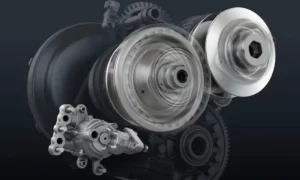
Shift Solenoid E fixes this problem. When your speed, throttle position, and engine temperature hit the right thresholds, the PCM energizes the solenoid. That sends pressurized transmission fluid through the input shaft, which clamps a friction disc against the pressure plate inside the converter. You get a direct 1:1 mechanical drive — no slipping, no wasted energy.
Modern Toyota Flex Lock-Up Strategy
Newer Toyota six-speed and eight-speed transmissions like the U660E and U760E use something called Flex Lock-Up. Instead of a simple on/off solenoid command, the TCM uses Pulse Width Modulation (PWM) — rapidly cycling the solenoid at around 300Hz. This controls a precise, adjustable amount of slip for smoother transitions, better engine braking, and wider lock-up range across multiple gears.
| System Component | Function | What Fails |
|---|---|---|
| Shift Solenoid E | Controls hydraulic flow to TCC | Loss of lock-up or circuit fault |
| TCC Friction Plate | Creates mechanical coupling | Overheating, RPM slip |
| Input Shaft Passage | Routes fluid to converter | Blockage or hydraulic delay |
| PCM/TCM Firmware | Commands and monitors solenoid | Wrong PWM signal, false codes |
What Causes the Toyota P0770 Code?
This code rarely has one single cause. Three distinct failure paths can trigger it, and misidentifying which one leads to wasted money.
Electrical Circuit Failures
The PCM monitors Shift Solenoid E’s circuit resistance continuously. If it reads out-of-spec resistance or loses continuity entirely, P0770 triggers.
- The solenoid coil contains fine copper wire that degrades from constant heat cycling
- An internal short or open circuit kills the solenoid’s ability to respond
- Corroded connectors at the transmission case are a sneaky culprit — road salt and moisture increase circuit resistance, making the PCM think the solenoid is dead even when it’s fine
Hydraulic Degradation
Old transmission fluid is a silent killer of shift solenoids.
- Aged ATF loses its anti-foaming and anti-oxidation additives, forming varnish inside the solenoid plunger and valve body
- Metallic particles from clutch and gear wear can physically block the solenoid’s tiny fluid orifices
- This is especially common in transmissions that haven’t had a fluid change every 60,000 miles
Internal Mechanical Failure
If the electrical system and fluid check out, the problem may be deeper.
- Worn TCC friction material can’t hold under load — even with full hydraulic pressure applied
- A worn pressure regulator valve in the valve body reduces line pressure, so the lock-up piston never fully compresses
- The PCM detects the RPM difference and logs P0770
| Probable Cause | Specific Mechanism | What to Look For |
|---|---|---|
| Solenoid Coil Failure | Thermal degradation of windings | Out-of-spec resistance reading |
| Harness Corrosion | Oxidized terminal pins | Intermittent signal, high voltage drop |
| Fluid Varnish | Plunger stiction in valve bore | Delayed lock-up engagement |
| TCC Clutch Wear | Friction material depletion | RPM slip at 100% duty cycle command |
Toyota P0770 Symptoms You’ll Actually Notice
The way this code shows up in your driving depends on how the solenoid failed. There are two main scenarios.
Solenoid Stuck OFF — No Lock-Up
This is the most common scenario. The TCC never engages.
- Higher RPMs at highway speed — your engine works harder than it should
- Worse fuel economy — often 2 to 3 MPG lower than normal
- Burning ATF smell — the torque converter churns fluid and generates serious heat
- Long-term: this heat destroys internal seals and clutch packs
Solenoid Stuck ON — Converter Won’t Unlock
This one’s nastier to drive with.
- Engine shudders or stalls when slowing to a stop — it acts like a manual car with no clutch
- Harsh, jerky downshifts at lower speeds
- In severe cases, the vehicle becomes nearly undrivable in stop-and-go traffic
Limp Mode
Many Toyota models built after 2010 activate a limp-home strategy when P0770 triggers. The PCM locks the transmission into 3rd or 4th gear and disables overdrive. It protects the transmission but limits your speed significantly.
How to Diagnose Toyota P0770 the Right Way
A code scan is just the starting point. Proper diagnosis requires live data analysis and circuit testing.
Step 1 — Check TCC Slip Speed in Live Data
The TCC Slip Speed PID is your best diagnostic window. It shows the difference between engine RPM and transmission input shaft RPM.
- Warm the vehicle to full operating temperature
- Drive on a flat road above 45 MPH
- Monitor “Lockup Solenoid Duty Cycle” on your scan tool
- When the PCM commands 100% duty cycle, slip speed should drop to near zero
- If slip speed stays above 200 RPM at 100% duty cycle, the mechanical or hydraulic system is failing — not just the wiring
Step 2 — Resistance Test the Solenoid Circuit
Resistance testing from the PCM connector rules out wiring harness issues before you drop the transmission pan. Here are Toyota’s specs:
| Transmission Family | Solenoid Identifier | Resistance at 68°F |
|---|---|---|
| A-Series (A340E, A750E) | SR / S1 / S2 | 11–15 Ω |
| U-Series (U140, U241, U250) | SR / S4 / DSL | 11–15 Ω (SR/S4) |
| U-Series (U151, U250) | DSL (TCC) | 11–13 Ω |
| PWM Solenoids (SL1, SL2, SLT) | SL-Series | 5.0–5.6 Ω |
If resistance is in spec at the solenoid but out of spec at the PCM connector, the harness is your problem — not the solenoid.
Step 3 — Bench Test the Solenoid
Remove the solenoid and apply 12V DC directly to its terminals. You should hear a clean, sharp mechanical click. A muffled click or no sound at all means the internal valve is sticking or the coil is weak.
Sensor Failures That Fake a P0770
Three upstream sensors can cause a false Toyota P0770. Don’t replace solenoids before checking these.
- Engine Coolant Temperature (ECT) Sensor — The PCM disables lock-up when the engine is too cold or too hot. A bad ECT sensor lying about temperature means the PCM never commands lock-up, eventually logging P0770
- Mass Air Flow (MAF) Sensor — In Flex Lock-Up systems, engine load data determines slip amount. A dirty MAF creates bad load data and causes TCC shudder — commonly misdiagnosed as a solenoid issue
- Brake Switch — The TCC disengages the moment you touch the brakes. An intermittently stuck-ON brake switch prevents the solenoid from ever energizing during highway driving
Model-Specific P0770 Issues Toyota Owners Should Know
2003 Corolla and Matrix
These cars threw P0770 specifically during highway driving, with perfect city performance. TSB T-EG020-02 addressed this with a solenoid replacement and TCM software update. The U341E transmission used in this model year was highly sensitive to minor hydraulic delays in lock-up duty cycle logic.
2012–2018 Camry
P0770 in these vehicles often arrives with company — codes P0750 through P0760 show up too. The six-speed transmission uses a unified solenoid pack rather than individual replaceable units. TSB-0078-21 confirms that metallic sludge from worn clutch packs clogs the solenoid pack. Replacing just the solenoids is a temporary fix. If the friction surfaces are disintegrating, you need a full overhaul.
1996–2002 4Runner
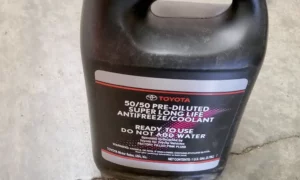
The 3rd Gen 4Runner community knows this code well. The internal radiator cooler can fail and mix engine coolant with ATF — creating what owners call a “pink milkshake”. This contaminant immediately destroys Shift Solenoid E and wipes out the TCC friction material. If your 4Runner has P0770 and pink ATF, both the transmission and radiator need replacement.
2024 Tacoma
The new Tacoma’s eight-speed transmission is a different animal. Per current Toyota factory directives, field repair of individual solenoids or the torque converter isn’t recommended for this generation. The tolerances are too tight. Toyota replaces the entire transmission and converter as a single assembly.
What Does Toyota P0770 Repair Actually Cost?
Your repair bill depends entirely on where the fault lives.
| Service Level | Parts Cost | Labor Hours | Total Estimate |
|---|---|---|---|
| Diagnostic Data Logging | $0 | 1–1.5 hrs | $100–$180 |
| Fluid Flush & Filter Change | $60–$120 | 1.5–2 hrs | $200–$400 |
| Single Solenoid E Replacement | $30–$150 | 2–4 hrs | $300–$700 |
| Solenoid Pack Replacement | $300–$700 | 3–5 hrs | $600–$1,300 |
| Torque Converter Replacement | $250–$600 | 6–10 hrs | $1,200–$2,000 |
| Full Transmission Overhaul | $1,800–$3,500 | 12–18 hrs | $3,500–$6,000 |
OEM vs. Aftermarket Solenoids — Does It Matter?
Yes, it really does. OEM solenoids match the exact resistance and hydraulic flow specs the PCM expects. Cheap aftermarket kits — sometimes as low as $89 for a full set — often have slight coil resistance variations. In PWM-controlled transmissions, that tiny difference causes shift hunting and can bring P0770 right back. Spend the extra money on OEM parts for this repair.
The Right Order to Fix Toyota P0770
Don’t skip steps. This sequence saves time and money.
- Inspect the ATF first — Dark fluid or a burnt smell means solenoid-first repairs will fail again. Prepare for deeper work
- Test circuit resistance from the PCM connector — Confirm it’s not a wiring harness issue before dropping the pan
- Analyze TCC slip speed in live data — This confirms whether the failure is electrical or mechanical
- Check for TSBs on your specific model — Toyota has published Technical Service Bulletins with specific repair sequences for known P0770 issues
- Use OEM parts — If a solenoid replacement is confirmed, don’t cut corners on the part itself
Ignoring a Toyota P0770 code is expensive. The longer the torque converter runs unlocked, the more heat builds up, and that heat destroys everything downstream. Catch it early, diagnose it properly, and you’re looking at a manageable repair. Wait too long, and a $150 solenoid turns into a $5,000 overhaul.