If you own a 2005–2011 Toyota Tacoma Pre-Runner or 4×4, there’s a safety recall you can’t afford to ignore. A broken leaf spring sounds like a minor inconvenience — until it punctures your fuel tank and starts a fire. This post breaks down exactly what happened, who’s affected, and what you need to do right now.
What Is the Toyota Tacoma Leaf Spring Recall?
In 2014, Toyota issued a voluntary safety recall — designated by NHTSA as Campaign 14V-604 — covering approximately 711,000 Tacomas in the United States and around 790,000 worldwide.
The recall targets 2005–2011 model year Tacoma Pre-Runner and 4×4 trucks. The defect involves rear leaf springs that fracture due to a combination of metal fatigue and corrosion. Once a spring breaks, the loose fragment can migrate and punch a hole through the fuel tank. Fuel leak plus ignition source equals fire.
That’s not a hypothetical scenario. That’s the reason NHTSA got involved.
| Vehicle Model | Model Years | Production Window |
|---|---|---|
| Tacoma Pre-Runner | 2005–2011 | Sept 2004 – Oct 2010 |
| Tacoma 4×4 | 2005–2011 | Sept 2004 – Oct 2010 |
| Total U.S. Vehicles Affected | ~711,000 | — |
Why Do the Leaf Springs Break in the First Place?
The rear suspension on these Tacomas uses a semi-elliptical leaf spring setup — basically a stack of curved steel bars that absorb road impacts and support the truck’s weight.
Here’s where it goes wrong:
Corrosion starts the chain reaction. In states that use road salt during winter, that protective coating on the steel wears off fast. Once bare metal meets moisture and oxygen, rust forms. Rust creates tiny pits on the steel surface.
Those pits become cracks. Engineers call these stress risers — points where physical force concentrates instead of spreading evenly. Every bump, every payload, every mile adds stress to these weak spots.
The crack spreads until the spring snaps. At that point, the fracture can cause the broken segment to migrate out of position, especially under road vibrations and normal driving maneuvers.
You might hear a loud clunk or bang from the rear of your truck when this happens. That sound matters — don’t ignore it.
Why Only Pre-Runner and 4×4 Models?
This is a fair question. The answer comes down to geometry.
Pre-Runner and 4×4 models use an over-slung leaf spring design, where the springs sit above the rear axle — putting them dangerously close to the fuel tank. Standard two-wheel-drive Tacomas use an under-slung design, with springs positioned below the axle. In that configuration, a broken spring can’t physically reach the fuel tank, so the fire risk disappears.
That spatial difference is why the recall is so specific.
Three-Leaf vs. Four-Leaf: Does It Matter for the Recall?
Some Tacomas left the factory with three-leaf spring packs. Others had four-leaf assemblies — either from the factory or installed later through a technical service bulletin (TSB T-SB-0359-10) that addressed rear sagging under load.
Both configurations were affected by the recall. Toyota created separate remedy kits for each setup to make sure the replacement springs matched the correct load-bearing rating.
| Spring Configuration | Common Application | Primary Failure Mode | Risk Level |
|---|---|---|---|
| Three-leaf pack | Standard Pre-Runner/4×4 | Stress-corrosion fracture | Critical |
| Four-leaf pack | Heavy-duty or TSB-equipped | Stress-corrosion fracture | Critical |
If your truck already had a four-leaf upgrade, it still needed the recall repair. The TSB modification didn’t eliminate the fracture risk.
What the Recall Repair Actually Involves
This isn’t a quick visual inspection and a handshake. The remedy for recall 14V-604 is a full rear leaf spring replacement — and Toyota required certified technicians (Master or Master Diagnostic level) to perform it.
Here’s what that repair process looks like step by step:
- Structural inspection — Technicians check the existing springs for fractures and look for damage to the fuel tank, brake lines, shock absorbers, and ABS wire harnesses.
- Axle support and hardware removal — The rear axle gets supported with screw jacks. Technicians remove the U-bolts, parking brake cable brackets, and lower shock bolts.
- Shackle and bushing service — Old rubber bushing flanges get cut off with an air hammer. New bushings are pressed in using Toyota’s specialized service tools.
- New springs installed — Fresh leaf spring kits go in with all-new hardware. Guide pins align carefully with the rear axle.
- Alignment and calibration — The suspension gets jounced multiple times to settle the components. Then a full four-wheel alignment brings the truck back to factory specs.
Toyota distributed the spring kits from a dedicated facility in Texas. Because of the size and weight of these parts, shipping took five to seven business days — so dealers often arranged loaner vehicles for owners during the wait.
The Phased Rollout: Why It Took So Long
Toyota didn’t flip a switch and fix 711,000 trucks overnight. The recall remedy launched in phases starting in early 2016, more than a year after the initial defect report in late 2014.
The rollout prioritized Cold Climate States first — places like Massachusetts, Maine, New Hampshire, Rhode Island, and Vermont, where road salt creates the highest corrosion risk. Later phases expanded to Mid-Atlantic and Midwest states, then eventually to Southern and Western regions.
This approach made logistical sense. High-risk trucks got fixed first. Dealers in each region could manage parts inventory without being overwhelmed.
How the Leaf Spring Recall Connected to Frame Corrosion Campaigns
Here’s something many Tacoma owners don’t realize: the leaf spring recall intersected with a completely separate service campaign for frame corrosion.
Many 2005–2011 Tacomas qualified for frame inspections — and in bad cases, full frame replacements — under Limited Service Campaign K0D and Customer Support Program ZKA. These campaigns targeted trucks with severe rust perforation in the main chassis.
When a frame replacement happened, the new frame kit included updated leaf springs. So if your Tacoma got a replacement frame, Toyota marked the leaf spring recall (E02) as “Completed” in its records. No redundant repair needed.
The important takeaway: if you’re unsure whether your specific truck received the leaf spring fix — even if you had frame work done — check your VIN against Toyota’s recall database.
Other Tacoma Recalls You Should Know About
The leaf spring issue isn’t the only rear-end problem that’s hit the Tacoma platform.
2022–2023 Tacoma: Rear Axle Recall (NHTSA 24V-152)
In early 2024, Toyota recalled approximately 381,000 model year 2022 and 2023 Tacomas for a separate issue. Welding debris left during manufacturing could loosen retaining nuts on the rear axle assembly. If those nuts fall off, part of the axle shaft can separate from the housing — causing immediate loss of stability and reduced braking performance.
Watch for these warning signs:
- Vibrations from the rear of the truck
- Unusual grinding or clunking noises
- Differential gear oil leaking near the rear axle
2024–2025 Tacoma: Rear Brake Hose Damage
Certain four-wheel-drive 2024 and 2025 Tacomas with 16-inch brakes and 17-inch wheels face a brake hose recall. During off-road driving, mud and debris can build up inside the rear wheels and wear through the brake hoses. That leads to hydraulic fluid loss and longer stopping distances. Toyota’s fix involves replacing the hoses with an improved design and updated routing.
How to Check If Your Tacoma Has an Open Recall
Every Toyota recall check starts with your 17-character VIN. Here’s where to find it:
| VIN Location | Where to Look |
|---|---|
| Dashboard (exterior view) | Lower-left corner, visible through the windshield |
| Driver’s door jamb | Certification label on the door frame |
| Engine bay | Stamped on the engine block |
| Documents | Registration card, insurance card, or owner’s manual |
Once you have your VIN, plug it into either of these official resources:
- Toyota’s recall lookup tool at Toyota.com/recall
- NHTSA’s recall database at nhtsa.gov/recalls
Both tools show open, unrepaired recalls tied to your specific vehicle. They won’t show recalls that are already completed or service campaigns that aren’t safety-related — so always check both if you want the full picture.
For direct help, contact Toyota’s Brand Engagement Center:
- Phone: 1-800-331-4331
- Hours: Monday–Friday, 8:00 AM–8:00 PM ET | Saturday, 9:00 AM–7:00 PM ET
- Mail: Toyota Motor Sales, U.S.A., Inc., P.O. Box 259001, Plano, TX 75025-9001
How to Keep Your Tacoma’s Rear Suspension Healthy
Recall repairs fix the defect Toyota created. Maintenance prevents new problems from forming. If you’re in a rust-prone state, these habits make a real difference:
- Apply undercoating. Oil-based or wax-based rustproofing products create a barrier against road salt. They’re especially useful if your truck lives in the Northeast or Midwest during winter.
- Rinse your undercarriage regularly. A simple hose-down after driving on salted roads slows surface rust significantly.
- Check U-bolt torque. Loose U-bolts are a leading cause of centering bolt failure and leaf movement. After installing new springs or running heavy loads, have them re-torqued.
- Respect your payload rating. Consistently overloading your bed accelerates the fatigue cycle in the leaf steel. If you haul heavy gear regularly, consider a heavier-duty spring configuration rated for that use.
What the 2024 Tacoma Changes Mean Going Forward
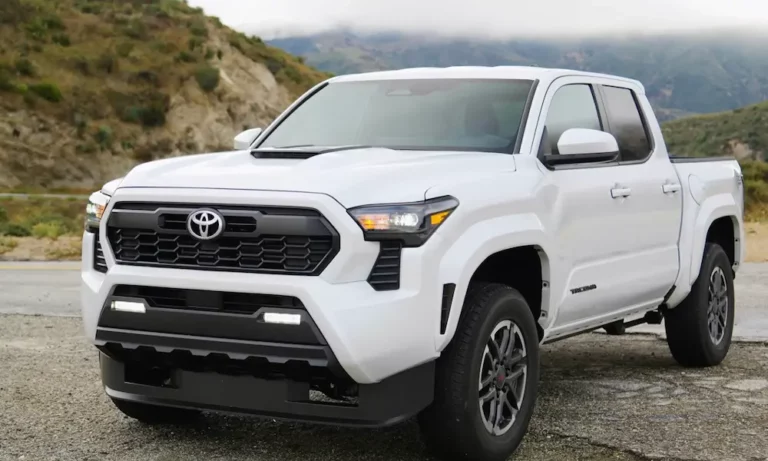
Toyota made a significant engineering shift with the 2024 Tacoma. Several trim levels — including TRD Off-Road, TRD Sport, and Limited — now use a multi-link rear suspension with coil springs, similar to what you’d find on the Tundra or a modern SUV.
Coil springs don’t carry the dual burden of weight-bearing and axle location. That separation of duties means better ride comfort and improved off-road articulation. It also removes the fuel tank proximity risk that made the original recall so serious.
That said, Toyota still offers leaf springs on work-oriented trims like the SR and TRD PreRunner. Leaf springs remain highly durable for trucks doing genuine payload work — they’re just no longer the default for every buyer.
If you own a second-gen Tacoma with the leaf spring recall still open, don’t wait on this. Check your VIN, call Toyota, and get it fixed. A broken leaf spring isn’t just a suspension problem. It’s a fire waiting to happen.