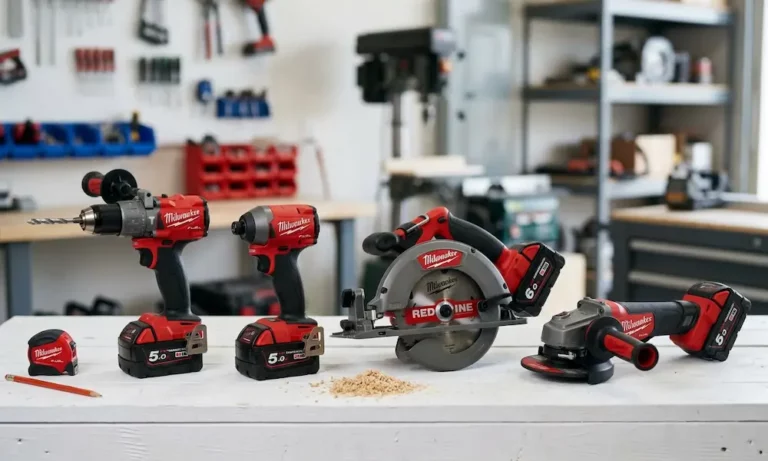
Wondering where are Milwaukee tools made? The answer isn’t a single factory or even a single country. It’s a global network built around one clear goal: give trade professionals the best tools possible. Read to the end — you’ll know exactly what’s made where, and why it actually matters for the tools on your belt.
Milwaukee Tool: A Quick Origin Story
Milwaukee Tool started in 1924 in Milwaukee, Wisconsin. A.H. Petersen founded it with a simple idea — build tools that work hard. Fast-forward to 2005, and Techtronic Industries (TTI) bought the brand for $626.6 million. That deal changed everything.
TTI shifted Milwaukee’s entire focus toward trade professionals — electricians, plumbers, mechanics. No more trying to be everything to everyone. That sharp focus turned a good brand into a $9.9 billion powerhouse by 2024.
Here’s the key thing to understand: Milwaukee doesn’t make all its tools in one place. The brand splits production based on what each region does best. That’s a smart strategy, not a shortcut.
Where Are Milwaukee Tools Made in the USA?
The short answer — more than you might think, and growing fast.
Wisconsin: The Brain and Backbone
Wisconsin is Milwaukee’s global headquarters and R&D core. Brookfield, WI houses the main campus where engineers design the M18 and M12 platforms, brushless motors, and the ONE-KEY digital tool management system. In 2022, Milwaukee dropped $206 million to expand these R&D facilities.
That’s not all for Wisconsin. Here’s the full picture:
| Wisconsin Site | What Happens There | Investment/Scale |
|---|---|---|
| Brookfield | Global HQ & R&D | $206M expansion (2022) |
| West Bend | Hand tool manufacturing | $55M; 95,000 sq. ft. |
| Menomonee Falls | Multipurpose tech campus | $42M; 22 acres; 300 jobs |
| Mukwonago | Hand tools & tool storage | Specialized manufacturing |
| Sun Prairie | Empire Level & Imperial Blades | $7.5M blade expansion |
The West Bend plant deserves a callout. It opened in August 2022 and it makes high-end hand tools — pliers, screwdrivers — right in Wisconsin. These tools feature laser-hardened edges and laser-etched tips. That precision work stays close to the engineering team in Brookfield for good reason.
The Menomonee Falls campus, announced in September 2025, adds 300 high-skill engineering jobs. Milwaukee’s Wisconsin workforce has grown from 900 people in 2016 to over 4,000 today. The state backed that growth with $70.5 million in performance-based tax credits tied to investment and job creation milestones.
Mississippi: The Manufacturing Muscle
Mississippi has been part of Milwaukee’s production story since 1973. Today, it’s the home of Milwaukee’s largest U.S. facility.
The Grenada plant opened in late 2022. It’s 500,000 square feet along Interstate 55 and cost $60 million to build. This is where Sawzall reciprocating saw blades get made — the iconic ones that tradespeople trust on brutal job sites. The plant is expected to employ 800+ people and includes a wellness center and fitness gym built right into the climate-controlled facility.
Here’s the full Mississippi footprint:
| Mississippi Site | Role | Key Products |
|---|---|---|
| Grenada | Largest U.S. plant | Sawzall blades & accessories |
| Jackson | Power tool manufacturing | Heavy-duty professional tools |
| Clinton | Expansion hub | Growing cordless tool lines |
| Greenwood | Accessory manufacturing | Bi-metal & carbide hole saws |
| Kosciusko | Manufacturing (est. 1995) | Power tools & accessories |
| Olive Branch | Distribution center | North American shipping |
| Byhalia | Logistics/warehousing | Inbound receiving & inventory |
The Clinton expansion added 357,000 square feet in 2021. The Olive Branch distribution hub, running since 1979, manages truckload, LTL, and parcel shipments across North America. It’s the logistical gateway that keeps everything moving fast.
Mississippi’s Advantage Mississippi Initiative and GAP Program made expansion in Greenwood and Grenada possible. These programs target economically challenged areas — a win for communities and for Milwaukee’s growth plan.
What’s the “Made in USA” Label Actually Mean?
You’ll see “Made in USA with Global Materials” on many Milwaukee products. This isn’t a loophole — it follows FTC guidelines and reflects real domestic manufacturing where raw materials or some components come from global suppliers.
Products that typically carry this domestic label include:
- Sawzall blades — Made in Mississippi using advanced heat treatment
- Hole Dozer hole saws — Bi-metal and carbide saws from U.S. facilities
- Step drill bits — Engineered and manufactured domestically
- Hand tools (West Bend) — Pliers and screwdrivers made by American workers for trade professionals
These are the categories where U.S. metallurgy expertise gives Milwaukee a genuine edge. Laser-hardened cutting edges and precision mechanical assemblies benefit from being close to the engineering teams who design them.
Where Are Milwaukee’s Cordless Tools Made?
Here’s the honest answer — most M18 and M12 cordless tools come from Asia or Mexico. That’s not a red flag. Here’s why it makes sense.
China: The Cordless Hub
The Dongguan region in China handles the bulk of Milwaukee’s cordless tool production. Modern cordless tools aren’t simple — they involve brushless motor controllers, printed circuit boards, and high-density battery packs. China’s electronics supply chain ecosystem supports rapid iteration at massive scale.
Milwaukee’s Chinese operations follow ISO-certified quality standards with the same testing protocols used domestically. The design and engineering? That stays in Brookfield, Wisconsin. China handles the assembly.
Vietnam: Expansion and Diversification
Vietnam is Milwaukee’s secondary Asian hub, focused on cordless drills and various accessories. This expansion does two things — it meets rising Southeast Asian demand and reduces reliance on a single manufacturing region. Smart supply chain thinking.
Mexico: Fast Shipping to North America
Milwaukee operates in Matamoros, Juarez, and Torreon. The Mexico plants focus on impact drivers and cordless outdoor equipment. Being close to the U.S. border means shorter shipping times and lower logistics costs compared to trans-Pacific routes. When demand spikes for a specific tool, Mexico’s proximity matters.
Here’s the international breakdown in one table:
| Global Manufacturing Hub | Main Role | Key Products |
|---|---|---|
| China (Dongguan) | High-volume cordless production | M18/M12 power tools, electronics |
| Vietnam | Expansion & diversification | Cordless drills, accessories |
| Mexico (Matamoros, Juarez, Torreon) | North American market efficiency | Impact drivers, outdoor power tools |
| Germany | Precision engineering | Advanced AC tools, multi-tools |
| Israel | R&D & battery technology | Smart tools, next-gen battery packs |
Germany and Israel: The Less Obvious Ones
Germany handles advanced corded power tools and high-end multi-tools. German engineering standards reinforce Milwaukee’s premium industrial identity in the European market.
Israel might surprise you. It’s not a high-volume assembly site — it’s an innovation center. Milwaukee’s Israeli team focuses on next-generation battery technology and smart tool development. High-output battery packs and IoT-integrated tools get designed and tested there before moving to global factories for production. Israel’s strength in power electronics and software makes it a perfect fit.
Who Actually Owns Milwaukee Tool?
TTI — Techtronic Industries — owns Milwaukee Tool 100%. TTI is a Hong Kong-based multinational, founded in 1985, and trades on the Hong Kong Stock Exchange. Major institutional investors include BlackRock and Vanguard, but the Pudwill family holds roughly 25% of shares.
In May 2024, Steven Richman — who ran Milwaukee Tool for 17 years — became TTI’s CEO. That’s significant. The person who built Milwaukee into a $9.9 billion brand now runs the parent company. The culture and strategy stay consistent.
That ownership stability funds the big moves — $285 million in committed capital investment across Wisconsin alone, with performance milestones tied to every dollar of state tax credits received.
What’s Coming Next From Milwaukee’s Factories
Milwaukee’s Pipeline 2025 announcements point to where the manufacturing focus is shifting:
- MX FUEL heavy equipment — Larger cordless units like 7200W power supplies and SDS Max rotary hammers require advanced battery assembly capabilities
- Expanded “Made in USA” hand tools — Wire strippers and pliers wrenches indicate more volume coming through West Bend
- Safety-integrated tools — ONE-KEY tracking and advanced braking systems in saws and grinders require tighter coordination between Wisconsin’s software engineers and China’s electronics assembly teams
Milwaukee’s goal is a resilient, diversified global network — not dependence on any single region. Wisconsin and Mississippi anchor the brand’s American identity and handle precision-critical products. Asia and Mexico handle the scale and speed the global market demands. Germany and Israel keep the innovation edge sharp.
So next time you pick up a Milwaukee tool, the label tells you something real. “Made in USA with Global Materials” on your Sawzall blade means Wisconsin and Mississippi workers made that. “Made in China” on your M18 drill means Dongguan’s electronics ecosystem built it to Milwaukee’s Brookfield-designed specs. Either way, the engineering behind it starts in Wisconsin.