
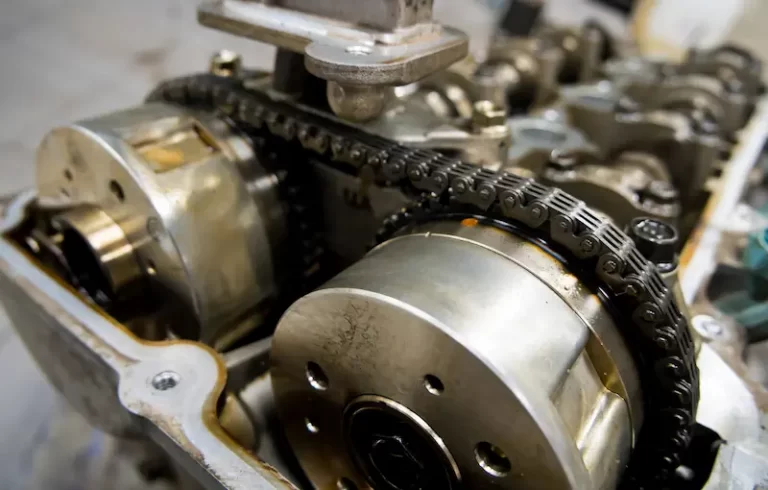
Hearing a rattle from your engine on cold starts? Your 2.4 Ecotec might be telling you something important. A worn timing chain on these engines isn’t just annoying — it can destroy your engine completely. This guide walks you through everything: symptoms, parts, tools, and the full replacement procedure. Stick around, because the details here can save your engine.
Why the 2.4 Ecotec Timing Chain Fails
The 2.4 Ecotec isn’t a bad engine. It powered millions of GM vehicles across nearly two decades. But its timing system has a well-documented weakness that you need to understand before you start wrenching.
The root cause is almost always low oil level combined with worn hydraulic tensioners. These engines are known to consume oil quietly. Many owners don’t notice until it’s too late. When oil drops, the tensioner loses pressure. The chain goes slack. Then it starts whipping against the plastic guides.
Those guides are made from glass-filled nylon. They get brittle after years of heat cycles. One hard slap from a slack chain, and they shatter. Once a guide breaks, the chain can jump a tooth on the crankshaft or camshaft sprockets. On an interference engine like this one, that means pistons meet open valves — and your engine is done.
Here’s the other piece of this puzzle. GM identified a specific problem with the 2010 and 2011 models. The chrome plating on the balance shaft chain pins was too thin, causing rapid wear. GM extended the warranty on those components to 10 years or 120,000 miles through a Special Coverage Adjustment.
Which GM Vehicles Use the 2.4 Ecotec?
Before you buy parts or tools, confirm your engine variant. The 2.4 Ecotec came in several versions — the LE5, LE9 flex-fuel, LAF, and LEA direct-injection variants. Each appeared in different vehicles across GM’s lineup.
| Vehicle | Years | Engine Code |
|---|---|---|
| Chevrolet Equinox | 2010–2017 | LAF, LEA |
| Chevrolet Malibu | 2008–2014 | LE5, LE9, LAF |
| GMC Terrain | 2010–2017 | LAF, LEA |
| Buick Regal | 2011–2017 | LAF, LEA |
| Buick Verano | 2012–2017 | LEA |
| Saturn Vue | 2007–2010 | LE5, LE9 |
| Pontiac G6 | 2006–2009 | LE5 |
| Saturn Aura | 2007–2009 | LE5 |
| Chevrolet HHR | 2006–2011 | LE5, LE9 |
Your mounting configuration matters too. The Equinox and Malibu use a transverse mount, putting the timing cover inches from the inner fender. You’ll need to lower or raise the engine during the repair. The Pontiac Solstice and Saturn Sky use a longitudinal mount, which gives you easier front-of-engine access.
Warning Signs: What a Failing Timing Chain Sounds and Looks Like
Don’t wait for a catastrophic failure. The 2.4 Ecotec gives you clear warnings.
The Sounds
The first sign is a metallic rattle on cold starts. Oil drains out of the hydraulic tensioner overnight. Until pressure rebuilds, the worn chain flaps against the guides. As things get worse, you’ll hear a constant buzzing or whirring sound that increases with engine speed.
In advanced cases, a broken guide falls into the oil pan. The rotating crankshaft strikes it, creating a loud intermittent knock. Many people mistake this for a bad rod bearing and start planning a full engine rebuild.
The Codes
Your engine control module watches the crankshaft and camshaft position sensors constantly. When a stretched chain causes the camshafts to lag behind, the computer stores codes. These are the ones to watch for:
| Code | Meaning | What It Tells You |
|---|---|---|
| P0016 | Crank-Intake Cam Correlation | Mechanical timing mismatch |
| P0017 | Crank-Exhaust Cam Correlation | Mechanical timing mismatch |
| P0011 | Intake Cam Over-Advanced | Cam not in commanded position |
| P0014 | Exhaust Cam Over-Advanced | Cam not in commanded position |
P0016 and P0017 almost always mean a mechanical problem — a stretched chain or a jumped sprocket. A GM technical service bulletin from NHTSA confirms this pattern across multiple model years.
Parts You’ll Need for a Complete 2.4 Ecotec Timing Chain Replacement
Replace everything while you’re in there. Reusing old guides or tensioners is how you end up doing this job twice. Industry best practice is a full system replacement in one shot.
Here’s your complete parts list:
- Primary timing chain (148 links)
- Primary hydraulic tensioner (third-generation design preferred)
- Intake and exhaust camshaft phasers
- Primary chain guides — upper, left, and tensioner-side
- Balance shaft drive chain (134 links)
- Balance shaft tensioner and three guides
- Dual-row crankshaft sprocket
- New water pump with integrated drive gear
- Front crankshaft seal and timing cover RTV silicone
- Valve cover gasket and spark plug tube seals
- New harmonic balancer bolt — this is a one-time-use fastener; don’t reuse the old one
Many shops and DIYers use ZZPerformance’s upgraded complete timing chain kit or similar comprehensive kits that include upgraded components.
Specialty Tools You Can’t Skip
This job requires more than a standard socket set. You’ll need these specific tools to do it right:
- EN-48953 Camshaft Phaser Locking Tool — bolts to the cylinder head and locks the phasers while you torque the phaser bolts
- EN-48749 Timing Chain Retainer Tool — holds the chain against the guides if the head needs removal
- GM-43653 Flywheel Holding Tool — locks the engine while you torque the harmonic balancer bolt (over 200 ft-lbs)
- Torque Angle Gauge — required for torque-to-yield fasteners throughout the assembly
The Full Replacement Procedure
Step 1: Prepare the Engine Bay
Disconnect the negative battery cable first. Remove the decorative engine cover, air intake ducting, ignition coils, and spark plugs. Pulling the spark plugs lets you rotate the engine by hand without compression resistance — you’ll need that later for timing verification.
Remove the serpentine belt by rotating the tensioner with a 3/8-inch drive ratchet. On transverse-mounted applications like the Chevrolet Equinox, support the engine with a bridge across the strut towers or a floor jack under the oil pan. Then remove the passenger-side engine mount and bracket.
Step 2: Pull the Valve Cover and Timing Cover
Remove the valve cover. Check the camshaft journals for oil sludge — that’s a sign the VVT system has been starved of oil. Remove the 10 mounting bolts and keep them organized.
Use the flywheel holding tool to lock the crankshaft. Remove the harmonic balancer bolt with a breaker bar and 24mm socket. Pull the balancer off. The timing cover uses RTV silicone instead of a gasket, so you’ll need to break the bond carefully without gouging the aluminum. Organize the cover bolts by length — they vary.
Step 3: Set Initial Timing Alignment
Before removing anything from the timing system, rotate the crankshaft until the timing mark on the crankshaft sprocket sits at the 6 o’clock position. This puts cylinder one at Top Dead Center on its exhaust stroke. The intake phaser mark should be near 2 o’clock and the exhaust phaser near 10 o’clock.
Step 4: Remove the Old Components
Remove the primary timing chain tensioner using a 32mm socket. With the tensioner out, the chain goes slack. Pull the upper, left, and right guides, then lift the primary chain off the phasers and crankshaft sprocket.
Next, remove the balance shaft tensioner and its three guides. Lift the balance shaft chain off the inner row of the crankshaft sprocket, the two balance shaft sprockets, and the water pump gear. Remove the dual-row crankshaft sprocket and inspect the crankshaft keyway for wear.
Step 5: Install the Balance Shaft System
The balance shaft chain has three uniquely colored or marked links. These must align precisely with the sprocket marks. Get this wrong and you’ll have severe engine vibration.
- Place the first marked link at the 6 o’clock timing mark on the inner crankshaft sprocket row
- Moving clockwise, align the next marked link with the intake balance shaft sprocket mark
- Loop the chain over the water pump gear — alignment here isn’t critical
- Align the final marked link with the exhaust balance shaft sprocket mark
Install the balance shaft guides and torque the shoulder bolts to 11 ft-lbs. Install the balance shaft tensioner and torque to 89 in-lbs. Remove the shipping clip — the tensioner should extend immediately and take up chain slack. If it doesn’t, the tensioner is defective.
Step 6: Install the Primary Timing Chain
Install the new intake and exhaust camshaft phasers using the EN-48953 locking tool to hold the camshafts steady. Finger-tighten the phaser bolts only — final torque comes later. The phaser marked “INT” goes on the intake (rear) camshaft. The one marked “EXT” goes on the exhaust (front) camshaft. They’re not interchangeable.
The primary chain has three colored links for alignment:
- Align the first colored link with the mark on the outer row of the crankshaft sprocket
- Match the next colored link to the diamond-shaped mark on the intake phaser
- Align the final colored link with the triangle mark on the exhaust phaser
Install the left-hand fixed guide, the tensioner guide, and the upper guide. Torque all guide bolts to 89 in-lbs. Thread the primary tensioner in by hand, then torque to 55 ft-lbs.
Step 7: Activate the Tensioners — Don’t Skip This
This step causes more comeback failures than any other. A deactivated tensioner provides zero pressure. If you button everything up without activating it, the chain will jump teeth the moment the starter fires.
Use a long screwdriver to press down sharply on the timing chain between the phasers. This forces the tensioner plunger inward and releases the internal locking mechanism. You’ll hear a distinct click. The chain should go tight immediately. No click and no tension means the tensioner needs to come out and be reset.
Step 8: Verify the Timing
Rotate the crankshaft by hand for two full revolutions (720 degrees) clockwise. This confirms the tensioners have taken up all slack, checks for valve-to-piston interference, and verifies the timing marks return to their correct positions. Check the physical marks on the sprockets against the block and head reference points — don’t chase the colored links, they won’t realign for many rotations.
Torque Specs for the 2.4 Ecotec Timing Chain Replacement
| Fastener | Torque | Angle |
|---|---|---|
| Camshaft Phaser Bolts | 48 ft-lbs | +90° |
| Harmonic Balancer Bolt (Final) | 59 ft-lbs | +125–200° |
| Primary Timing Tensioner | 55 ft-lbs | — |
| Timing Cover Bolts | 18 ft-lbs | — |
| Valve Cover Bolts | 71 in-lbs | — |
| Timing Chain Guide Bolts | 89 in-lbs | — |
| Balance Shaft Guide Bolts | 106 in-lbs | — |
| Engine Mount Bracket Bolts | 74 ft-lbs | — |
| Water Pump Bolts | 18 ft-lbs | — |
The harmonic balancer bolt gets a specific multi-stage process: torque to 111 ft-lbs, loosen one full turn, re-torque to 59 ft-lbs, then add 125–200 degrees depending on your bolt design. Use a new bolt every time — no exceptions.
Sealing the Timing Cover
Clean both the cover and engine block surfaces with a plastic scraper and brake cleaner. They must be completely dry. Apply a 3mm bead of RTV silicone around the perimeter of the cover, running inside the bolt holes. Install the cover and tighten bolts to 18 ft-lbs in a spiral pattern from center outward.
Install the valve cover with a new gasket and spark plug tube seals. Tighten valve cover bolts to 71 in-lbs in a criss-cross pattern.
First Start and Break-In
Before the first start, pull the fuel pump fuse and crank the engine for 10 seconds. This builds oil pressure in the new tensioners before combustion loads hit the chain. Reinstall the fuse and start the engine.
Let it reach full operating temperature. Watch the coolant temp — your new water pump should be circulating immediately. Once cool, inspect the timing cover and valve cover for leaks.
Keeping Your 2.4 Ecotec Timing Chain Healthy Long-Term
The best timing chain replacement is the one you never need to do again. Here’s how to protect your investment:
- Check oil at every fill-up. These engines consume oil silently. A low oil level is the number one trigger for tensioner failure — don’t let it happen.
- Change oil every 5,000 miles with full synthetic, even if the Oil Life Monitor says you have more miles left. Carbon and sludge clog the VVT solenoids and starve the tensioners.
- Inspect the PCV system. A clogged PCV orifice in the intake manifold builds internal pressure, accelerates oil consumption, and stresses the crankshaft seals. Clean it while you have the intake off.
The 2.4 Ecotec timing chain replacement is a serious job — but it’s absolutely manageable with the right parts, the right tools, and attention to the details that actually matter. Follow the torque specs, activate your tensioners, and keep that oil full. Your engine will thank you with years of reliable service.














