Got a 2012 Honda Civic and need to know exactly what oil goes in it? You’re in the right place. The wrong oil type or a bad fill level can quietly wreck your engine. This guide covers the 2012 Honda Civic oil type and capacity for every trim and engine — plus the steps to do it right.
What Oil Type Does a 2012 Honda Civic Take?
Every 2012 Honda Civic — regardless of trim — takes 0W-20 full synthetic motor oil. That covers the standard 1.8L, the Si’s 2.4L, and the Hybrid’s 1.5L engine.
Honda picked 0W-20 for a reason. It’s a low-viscosity oil that flows fast during cold starts, reaching overhead cam components quickly before heat builds up. It also cuts internal friction, which helps fuel economy.
The oil must meet API service standards. Look for the API donut on the bottle — if it says 0W-20 and carries the API certification, you’re good.
Can you use conventional oil? Temporarily, yes. But shorten your change interval to every 3,000–5,000 miles. Conventional oil breaks down faster under heat, and these engines don’t forgive sludge buildup.
2012 Honda Civic Oil Capacity by Engine
Oil capacity depends on which engine you have and whether you’re replacing the filter. You should always swap the filter at every oil change — old filter media traps contaminants that contaminate fresh oil.
Here’s the full breakdown from Honda’s official specs and technical data:
| Engine | Trims | With Filter | Without Filter |
|---|---|---|---|
| 1.8L Inline-4 (R18Z1) | DX, LX, EX, EX-L, HF, Natural Gas | 3.9 qts (3.7L) | 3.7 qts (3.5L) |
| 2.4L Inline-4 (K24Z7) | Si Sedan & Coupe | 4.4 qts (4.2L) | 4.2 qts (4.0L) |
| 1.5L Hybrid (LEA-MF6) | Hybrid Sedan | 3.3–3.7 qts (3.1–3.5L) | 3.1–3.3 qts (2.9–3.1L) |
The 1.8L Engine (Most Common)
This is the engine in the majority of 2012 Civics. The R18Z1 block is an aluminum SOHC unit found in DX, LX, EX, EX-L, HF, and Natural Gas trims. Fill it with 3.9 quarts when replacing the filter. That’s your standard number.
The 2.4L Si Engine
The Si uses the K24Z7 — a DOHC engine with plateau-honed cylinder sleeves and ion-plated piston rings designed to reduce friction. It needs slightly more oil: 4.4 quarts with a filter change. Don’t shortchange it — this engine spins harder and needs full lubrication coverage.
The 1.5L Hybrid Engine
The Hybrid’s capacity shows a range — 3.3 to 3.7 quarts — because aftermarket filter sizes vary. Different filters hold different amounts of residual oil. Always start with the lower amount, run the engine briefly, let it sit for three minutes, then check the dipstick. Top off from there.
How to Check the Oil Level Correctly
The dipstick is your final authority — not the spec sheet. Even if you pour in the exact spec amount, always verify with the dipstick.
Here’s how to do it properly, per Honda’s official owner documentation:
- Park on a level surface
- Let the engine cool for at least three minutes after running
- Pull the dipstick, wipe it clean, reinsert fully
- Pull it again and read the level
- Oil should sit between the MIN and MAX marks
If you’re consistently low, that’s worth investigating. The 2012 Civic’s ninth-generation run had some documented oil consumption concerns on the 1.8L engine. Checking every 1,000 miles is smart practice.
How to Change the Oil on a 2012 Honda Civic
This is a straightforward job. You need a 17mm socket, a drain pan, a new crush washer, and your oil filter.
Drain Plug Torque Specs
Don’t skip the torque specs. Over-tightening strips the aluminum oil pan. Under-tightening causes leaks.
| Engine | Drain Plug Size | Torque | Crush Washer |
|---|---|---|---|
| 1.8L (R18Z1) | 17mm | 29 ft-lbs | Required — new each time |
| 2.4L (K24Z7) | 17mm | 30 ft-lbs | Required — new each time |
Always install a new crush washer on the drain plug every time. Reusing the old one risks a slow leak that you won’t notice until there’s oil on your driveway.
Oil Filter Installation
Apply a thin film of clean oil to the rubber gasket before threading the filter on. Hand-tighten until the gasket contacts the block, then add three-quarters to one full additional turn. That’s it. No wrench needed for install — just for removal.
After the Fill
Pour in your oil, start the engine, and let it idle for 30 seconds. Shut it off. Wait three minutes. Then check the dipstick. This sequence lets the oil pump prime the system and settle back into the pan before you take a reading.
What Happens If You Overfill or Underfill
Both directions cause real damage. Here’s why each matters:
Too little oil:
- Bearings and camshaft lobes don’t get enough lubrication
- Heat builds up faster with less fluid to absorb it
- At severe starvation, engine seizure is the outcome
Too much oil:
- The crankshaft lobes whip through excess oil in the pan
- That churning aerates the oil — creates foam
- Foamy oil can’t hold pressure — the pump pushes air instead of lubricant
- You get blown seals, spark plug fouling, and potential catalytic converter damage
Stay between the MIN and MAX marks. Half a quart either way isn’t going to hurt you, but a full quart over the max is a real problem.
Oil Change Intervals for the 2012 Civic
The 2012 Civic uses Honda’s Maintenance Minder system. It tracks engine revs, temperatures, and drive cycles to calculate when your oil actually needs changing — not just when a calendar says so.
When the system shows “A” or “B” on your dashboard, it’s time for service.
If you’re not using the Maintenance Minder or you drive under severe conditions (lots of short trips, dusty environments, towing), use these intervals instead:
- Full synthetic 0W-20: Every 7,500–10,000 miles
- Conventional oil (temporary use): Every 3,000–5,000 miles
Severe driving conditions shorten oil life faster than the algorithm expects. If you’re doing lots of city stop-and-go, lean toward the shorter end of the synthetic interval.
Transmission and Other Fluids to Know
While you’re under the hood, these specs are worth keeping on hand. Secondary fluids get neglected, and they matter.
| Component | Fluid Type | Service Fill |
|---|---|---|
| 5-Speed Automatic (BRZA) | Genuine Honda ATF DW-1 | 2.5 qts |
| 5-Speed / 6-Speed Manual | Genuine Honda MTF | ~1.5 qts |
| CVT (Hybrid) | Honda CVT Fluid P/N 08200-9006 | 2.5 qts |
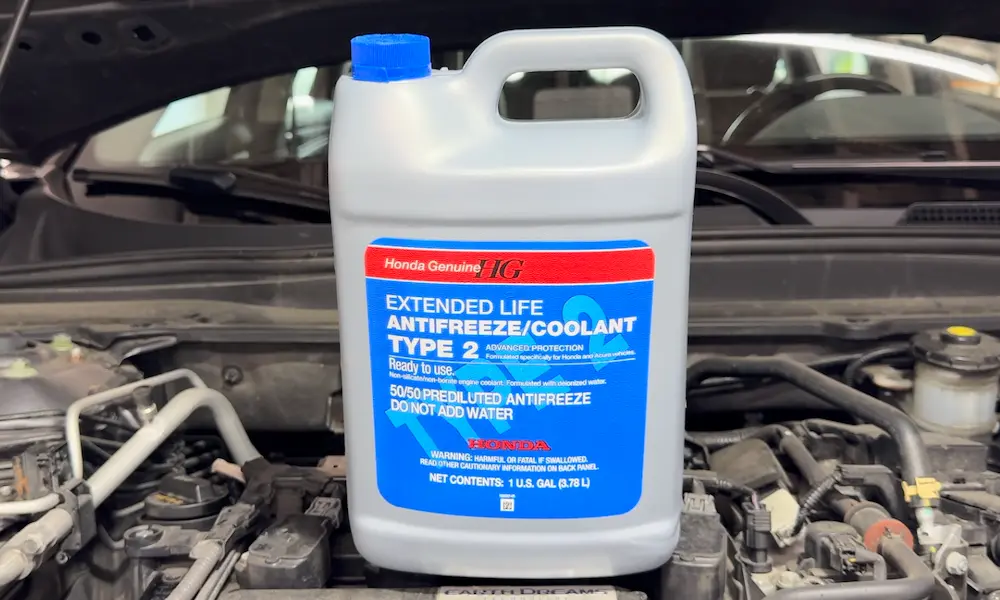
| Cooling System (1.8L) | Honda Type 2 Premixed Coolant | 5.9 qts total |
One important note on the CVT: the Hybrid’s transmission requires genuine Honda CVT fluid. Per NHTSA technical documentation, using aftermarket fluids in Honda CVTs can cause clutch slippage and shift quality issues. Don’t cut corners here.
For the automatic transmission, a standard drain-and-refill only exchanges about 2.5 quarts — less than half the total system volume. The rest stays trapped in the torque converter. That’s normal. A full flush takes multiple drain cycles.
Special Considerations for Si and Hybrid Owners
Si Owners
The K24Z7 is a performance engine. It uses advanced piston coatings and specialized cylinder honing that work best with quality synthetic 0W-20. Don’t run conventional oil in this engine long-term. The tighter tolerances won’t thank you for it.
Hybrid Owners
The 1.5L Hybrid has a dual sequential ignition system — two spark plugs per cylinder, eight plugs total. That affects your maintenance costs, but it also means the engine burns cleaner and runs quieter. When it’s time for plugs, budget accordingly.
Also, check the dipstick more carefully on hybrid fills. The capacity range (3.3–3.7 qts) is real, not a typo. Filter size drives that difference. Always fill to the lower spec first, then adjust.
Quick-Reference Summary
Here’s everything in one place:
- Oil type: 0W-20 full synthetic, API certified
- 1.8L capacity: 3.9 qts with filter / 3.7 qts without
- 2.4L Si capacity: 4.4 qts with filter / 4.2 qts without
- 1.5L Hybrid capacity: 3.3–3.7 qts with filter (check dipstick)
- Drain plug torque: 29–30 ft-lbs with a new crush washer
- Filter install: Hand-tight plus ¾ turn after gasket contact
- Change interval: Follow Maintenance Minder, or 7,500–10,000 miles with full synthetic
The dipstick confirms everything. Use it every time, and your 2012 Civic engine will stay healthy for a long time.