Ever wondered what makes Ford’s heavy-duty trucks so powerful? It’s not magic – it’s the 6.7 PowerStroke diesel engine. Whether you’re looking to buy a Super Duty or just fascinated by what’s under the hood, understanding this powerhouse can help you make sense of why these trucks command such respect.
Let’s dig into what makes the 6.7 PowerStroke tick, from its impressive torque ratings to its innovative design features.
The Birth of the 6.7 PowerStroke Engine
The 6.7 PowerStroke marked a turning point for Ford. Introduced in 2011, this was Ford’s first in-house designed and built diesel engine for their Super Duty lineup. Before this, Ford had partnered with Navistar International for their diesel engines.
Nicknamed “Scorpion” during development, this engine featured a unique layout with the exhaust manifold and turbocharger positioned in the engine’s valley – a design that improved thermal efficiency and reduced noise. This wasn’t just another engine; it was Ford’s statement that they were serious about controlling their diesel destiny.
Ford collaborated with AVL of Austria during the development process, creating an engine that would set new standards for power, efficiency, and durability in the heavy-duty segment.
Core Engine Specifications
Let’s break down the core specs of the 6.7 PowerStroke:
| Specification | Details |
|---|---|
| Engine Type | V8 Turbocharged Diesel |
| Displacement | 6.7 liters (406 cubic inches) |
| Block Material | Compacted Graphite Iron (CGI) |
| Cylinder Head Material | Aluminum |
| Bore | 99.06 mm |
| Stroke | 107.95 mm |
| Compression Ratio | 16.2:1 (2011-2019), 15.8:1 (2020+) |
| Valve Configuration | 32 valves, pushrod OHV |
| Weight | Approximately 981 pounds (445 kg) |
The engine features a deep-skirt block design made from compacted graphite iron – a material that’s stronger and lighter than traditional cast iron. This construction helps handle the immense pressures inside the engine while keeping weight manageable.
Each cylinder uses six head bolts to ensure proper sealing under the high compression pressures typical of diesel engines. The slightly undersquare design (bore smaller than stroke) favors torque production – exactly what you want in a heavy-duty truck engine.
Turbocharger System
The 6.7 PowerStroke’s breathing system is centered around its turbocharger design:
Early models (2011-2014) used a Garrett GT32 DualBoost variable geometry single sequential turbocharger with a wastegate. This complex name describes a single turbo designed to provide the advantages of a twin-turbo setup.
The turbocharger location is particularly innovative. Unlike traditional designs where turbos mount to the side of the engine, the 6.7 PowerStroke positions its turbo in the valley between the cylinder banks. This creates shorter exhaust paths, improving throttle response and reducing heat transfer to surrounding components.
Later generations saw refinements to the turbo system, contributing to the engine’s increased power ratings over time.
Fuel System Technology
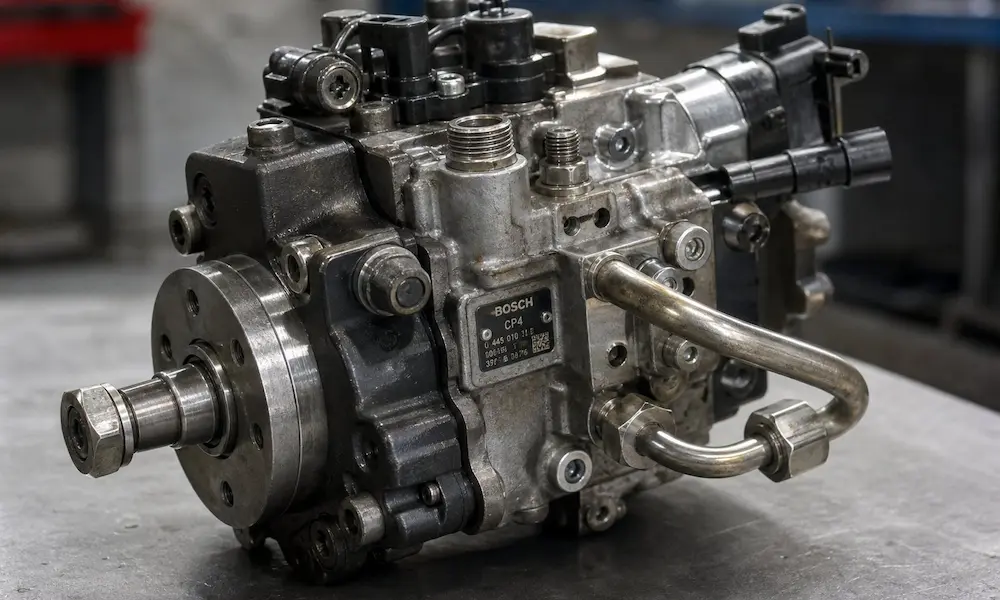
The 6.7 PowerStroke uses a sophisticated high-pressure common rail fuel system:
- Initial versions (2011-2019): Capable of 30,000 PSI fuel pressure
- Later models (2020+): Upgraded to 36,000 PSI
This high-pressure system allows for extremely precise fuel delivery and multiple injection events per combustion cycle. Early engines could perform up to five separate injections per cycle, while third-generation engines can execute up to eight.
This precision helps maximize power while minimizing emissions and the characteristic diesel “knock.” It’s part of what makes modern diesel engines so much more refined than their predecessors.
The system is also designed to operate on diesel blends containing up to 20% biodiesel (B20), giving owners some flexibility in fuel choices.
Power and Performance Evolution
Perhaps the most impressive aspect of the 6.7 PowerStroke is how its performance has evolved over time:
| Model Year | Horsepower | Torque |
|---|---|---|
| 2011 Initial | 390 hp | 735 lb-ft |
| 2011 Revised | 400 hp | 800 lb-ft |
| 2015-2016 | 440 hp | 860 lb-ft |
| 2017-2019 | 450 hp | 935 lb-ft |
| 2020-2022 | 475 hp | 1,050 lb-ft |
| 2023+ Standard | 475 hp | 1,050 lb-ft |
| 2023+ High Output | 500 hp | 1,200 lb-ft |
This continuous improvement demonstrates Ford’s commitment to keeping the PowerStroke competitive. The current high-output version delivers an astonishing 1,200 lb-ft of torque – numbers that would have seemed impossible for a production pickup truck engine just a decade ago.
These power figures translate directly to capability. Properly equipped Super Duty trucks with the 6.7 PowerStroke can tow up to 35,000 pounds and handle payloads up to 7,640 pounds, making them some of the most capable production trucks ever built.
Cooling and Lubrication Systems
Keeping a high-output diesel engine running properly requires sophisticated cooling and lubrication:
The 6.7 PowerStroke uses a dual-circuit cooling system with separate high-temperature and low-temperature loops. The high-temp circuit cools the engine block and heads, while the low-temp circuit handles transmission cooling and charge air cooling.
For lubrication, the engine requires 15 quarts of oil with the filter. Ford specifies SAE 10W-30 Super Duty Diesel Oil for proper protection. This substantial oil capacity helps with cooling and ensures adequate lubrication even under heavy loads.
The aluminum cylinder heads feature dual water jackets for enhanced cooling, critical for maintaining proper operating temperatures under load.
Emission Control Systems
As a modern diesel engine, the 6.7 PowerStroke incorporates several emission control technologies:
- Diesel Particulate Filter (DPF): Captures soot particles from the exhaust
- Selective Catalytic Reduction (SCR): Uses diesel exhaust fluid (DEF) to reduce nitrogen oxide emissions
- Exhaust Gas Recirculation (EGR): Recirculates a portion of exhaust gas to lower combustion temperatures and reduce NOx formation
These systems work together to ensure the engine meets stringent emissions regulations. The precise fuel injection system also plays a key role in minimizing emissions at the source through optimized combustion.
Generational Changes and Improvements
Over its production run, the 6.7 PowerStroke has seen several major revisions:
First Generation (2011-2014)
- Initial design with the “Scorpion” layout
- Early reliability issues addressed through running changes
- Started at 390 hp/735 lb-ft, later revised to 400 hp/800 lb-ft
Second Generation (2015-2019)
- Structural enhancements to the block, heads, and internal components
- Improved turbocharger and fuel delivery systems
- Power increased to 440 hp/860 lb-ft (2015-2016), then 450 hp/935 lb-ft (2017-2019)
Third Generation (2020+)
- New injectors with improved combustion efficiency
- Capability for up to eight injection events per combustion cycle
- Steel pistons for better durability under higher pressures
- Power increased to 475 hp/1,050 lb-ft (standard) and 500 hp/1,200 lb-ft (high output)
These generational improvements focused on increasing power while enhancing reliability and emissions compliance.
Applications and Vehicle Integration
The 6.7 PowerStroke diesel serves as the premium engine option in Ford’s Super Duty truck lineup:
- F-250 Super Duty
- F-350 Super Duty
- F-450 Super Duty
- F-550 Super Duty
Typically paired with Ford’s TorqShift heavy-duty automatic transmission, this powertrain forms the backbone of Ford’s heavy-duty truck capability. The transmission has also evolved alongside the engine, moving from a 6-speed to a 10-speed in recent models.
The engine competes directly with other heavy-duty diesel offerings like the Cummins 6.7L in Ram trucks and the Duramax diesel in GM vehicles.
Reliability Considerations
Like any complex engine, the 6.7 PowerStroke has had its share of issues:
Early models (2011-2014) experienced problems with:
- Turbocharger failures
- EGR system issues
- Fuel system contamination concerns
Ford addressed many of these issues in subsequent generations, with the latest versions showing significantly improved reliability. The move to steel pistons, strengthened internal components, and refined fuel and emissions systems has contributed to better long-term durability.
Regular maintenance remains critical for these engines, particularly:
- Timely oil changes with proper diesel-specific oil
- Fuel filter replacements
- Attention to the cooling system
- Proper warmup and cooldown procedures when towing heavy loads
Design Innovations and Engineering Philosophy
Several innovative design elements set the 6.7 PowerStroke apart:
The “reverse-flow” heads direct air from the intake manifold on the outside of the heads toward the turbocharger in the valley. This creates a more efficient airflow pattern and contributes to better thermal management.
The use of compacted graphite iron for the block strikes a balance between weight and strength. This material is about 75% stronger than conventional cast iron but lighter, helping to manage the engine’s overall weight.
Ford’s engineering philosophy with this engine focused on balancing brute strength with technological sophistication. The pushrod valve design provides simplicity and reliability, while the high-pressure common rail injection system delivers cutting-edge precision.
The Future of the 6.7 PowerStroke
Looking ahead, the 6.7 PowerStroke continues to evolve:
For 2025 models, Ford is maintaining both standard and high-output versions of the engine, with the high-output version continuing to deliver its class-leading 1,200 lb-ft of torque.
While electrification is transforming many vehicle segments, heavy-duty trucks still benefit tremendously from diesel power, particularly for long-distance towing. The 6.7 PowerStroke will likely continue as a mainstay in Ford’s lineup, possibly with hybrid assistance in future iterations.
Ongoing development will likely focus on further emissions improvements, efficiency gains, and durability enhancements while maintaining or increasing the impressive power output.
Maintenance Requirements and Longevity
To keep a 6.7 PowerStroke running properly:
- Oil changes: Every 10,000 miles under normal conditions, more frequently when towing
- Fuel filters: Primary and secondary filters should be replaced at recommended intervals
- Air filters: Inspect regularly, especially in dusty conditions
- Cooling system: Maintain proper coolant levels and condition
With proper maintenance, these engines can deliver impressive longevity. Many have surpassed 300,000 miles with good care, though components like turbochargers and injectors may require attention at higher mileages.
The substantial oil capacity (15 quarts) and robust cooling system contribute to the engine’s potential for long service life, even under demanding conditions.
How the 6.7 PowerStroke Compares to Competitors
In the competitive heavy-duty diesel market:
The 6.7 PowerStroke currently leads the torque race with its 1,200 lb-ft high-output version, compared to the Cummins 6.7L (1,075 lb-ft) and Duramax 6.6L (975 lb-ft).
Each engine has its strengths. The Cummins has a reputation for simplicity and torque, the Duramax for refinement, and the PowerStroke for technology and power density.
The 6.7 PowerStroke’s in-house design gives Ford complete control over how the engine integrates with their trucks, potentially offering advantages in overall vehicle optimization.
Let the truck wars continue – the real winners are customers who benefit from this fierce competition driving continuous improvement.