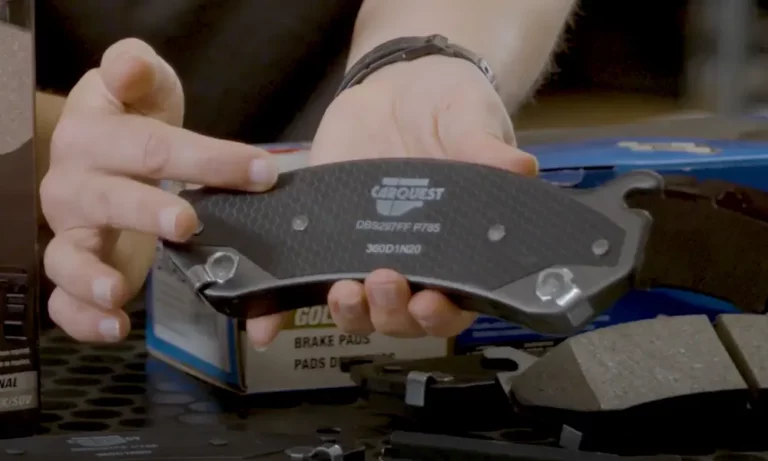
Ever wondered if those Carquest brake pads are worth your money? You’re not about to drop cash on parts that’ll leave you disappointed – or worse, unsafe. I’ve done the research on these popular Advance Auto Parts brake pads to help you make an informed decision about whether they deserve a spot on your vehicle.
In this comprehensive review, I’ll break down everything from performance and durability to pricing and real user experiences. By the end, you’ll know exactly where Carquest brake pads shine and where they fall short.
What Are Carquest Brake Pads?
Carquest brake pads are aftermarket replacement parts sold primarily through Advance Auto Parts stores. They come in three distinct product lines designed to meet different driving needs and budgets:
- Professional Platinum series – Their premium offering featuring ceramic formulations with 4-layer HEX shim technology, PTFE-coated hardware, and burnishing compounds for faster break-in.
- Premium Gold line – The mid-tier option designed to meet OE specifications with multi-layer shims for quieter operation.
- Standard series – The most economical choice with basic single-layer shim design and dependable stopping power at entry-level pricing.
What many drivers don’t realize is that Carquest brake pads are manufactured by multiple suppliers. Evidence suggests Roulunds produces some lines, while others come from WVR (Wearever). This multi-supplier approach might explain some of the inconsistencies in quality that users report.
Performance Testing: How Do They Stack Up?
Independent testing reveals significant performance variations across Carquest’s product lines. Let’s look at what testing shows about these brake pads:
Stopping Power and Fade Resistance
The Professional Platinum line claims impressive performance numbers in manufacturer-sponsored tests. According to Carquest’s own testing, their Platinum pads outperform original equipment in:
- Cold stopping distance
- Recovery stopping distance
- Fade resistance
However, independent testing tells a more nuanced story. Mid-tier pads comparable to Carquest’s Premium Gold showed concerning variance in initial brake behavior during fade testing. While performance stabilized in secondary testing, the inconsistent pedal feel compared to premium options raises questions.
Corrosion Resistance
This is where things get concerning. Independent testing showed that parts store pads similar to Carquest developed visible rust within just 24 hours of accelerated corrosion testing (equivalent to about two months of winter driving). Premium competitors showed no visible corrosion under identical conditions.
Real-World Durability: How Long Do They Last?
User reports reveal troubling patterns of inconsistent performance and sometimes premature failure. Here’s what actual drivers are experiencing:
Lifespan Issues
Multiple documented cases reveal significant durability concerns:
- Some users report complete pad wear within 22,000-25,000 miles under normal driving conditions
- One Nissan Frontier owner described their Carquest Platinum pads as “toast” after just 23,000 miles
- For comparison, their original equipment pads had lasted 80,000 miles under similar driving conditions
This dramatic difference in longevity suggests that while the initial price might seem attractive, the cost-per-mile could actually be higher with Carquest pads for many applications.
The Dust Problem
If you hate dirty wheels, pay attention to this point. Excessive brake dust production emerges as a persistent complaint across multiple Carquest product lines. Users consistently report:
- Heavy black brake dust accumulation
- Some owners mention needing weekly wheel washing due to dust buildup
- This issue affects both the Gold and Platinum series, contradicting marketing claims about “low dust” performance
Noise Concerns
User experiences with noise vary significantly:
- Some report satisfactory quiet operation
- Others experience persistent squealing
- One Toyota Venza owner specifically noted that despite advertising claims about noise reduction technology, their Carquest Platinum pads “squeal a lot”
Price vs. Value: Are They Worth It?
Carquest brake pads typically retail between $25-60 for a complete axle set:
- Standard pads start around $25
- Premium Gold fall in the $35-45 range
- Professional Platinum reach $55-65 depending on application
This pricing is competitive within the aftermarket segment, but the value equation changes when considering durability concerns. Let’s break down the real cost:
| Product | Initial Cost | Typical Lifespan | Cost Per Year |
|---|---|---|---|
| OE Pads | $225 | 80,000+ miles (5+ years) | $45 or less |
| Carquest Platinum | $150 | 22,000-25,000 miles (1.5-2 years) | $75-100 |
As this comparison shows, the seemingly lower upfront cost might not translate to actual savings over time.
Installation and Fitment Issues
Professional mechanics and DIY enthusiasts both report occasional challenges with Carquest pads:
- Multiple users mention fitment issues requiring significant modification
- One mechanic noted that Carquest Gold pads required extensive Dremel work to fit properly
- Some users report that the included hardware doesn’t always match what’s needed
These issues can turn what should be a straightforward brake job into a more time-consuming and frustrating project.
How They Compare to Competitors
When placed alongside competitors, Carquest pads often come up short in direct comparisons:
Superior Alternatives
Professional mechanics consistently recommend these alternatives:
- Akebono ProACT pads receive particularly strong endorsements for superior stopping power, reduced dust, and consistent performance
- Wagner ThermoQuiet ceramic pads get positive mentions for better durability
- Raybestos Element3 and Centric Premium receive more favorable user feedback even in similar price ranges
The performance gap becomes especially evident when talking with professionals. Even commercial customers who use Carquest brakes often do so based on pricing considerations rather than performance preferences.
Technical Features: What Makes Them Different?
The Professional Platinum line does incorporate some legitimate engineering approaches:
- Patented 4-layer HEX shim technology with aramid fibers for noise reduction
- PTFE hardware coating to prevent corrosion
- Powder-coated backing plates for extended life
- Burnishing compound technology intended to accelerate break-in periods
However, the gap between these technical specifications and real-world performance suggests implementation challenges or quality control issues across manufacturing batches.
Environmental and Safety Considerations
Carquest brake pads claim to use copper-free friction materials for environmental compliance, aligning with regulations in many states. However, the excessive dust production reported by users raises questions about overall environmental impact.
More concerning are the safety implications of premature wear. Several users reported sudden transition from apparently adequate braking to metal-on-metal contact without adequate warning, suggesting potential wear indicator issues or rapid deterioration.
Are Carquest Brake Pads Right for You?
Based on all the evidence, here’s my assessment of which drivers might consider Carquest pads:
Consider Carquest If:
- You’re on an extremely tight budget and need a temporary solution
- You drive very limited miles annually (under 5,000)
- You’re willing to replace pads more frequently
- You find them on deep discount
Look Elsewhere If:
- You value long-term value over initial savings
- You hate excessive brake dust
- You drive moderate to high mileage annually
- You want predictable, consistent performance
- Your vehicle is used for towing or performance driving
Making the Right Choice for Your Vehicle
If you’re still considering Carquest brake pads, here are some practical tips:
- Research your specific application – Some vehicle models seem to have better experiences than others
- Stick to the Professional Platinum line if possible – It consistently outperforms the lower tiers
- Check return policies – Advance Auto Parts offers a “Limited Lifetime Warranty” but it specifically excludes normal wear and tear
- Compare total cost of ownership – Factor in the likelihood of more frequent replacement
For most drivers, investing in proven alternatives like Akebono ProACT or Wagner ThermoQuiet will likely provide better performance, less dust, and longer life – making them a better value despite the higher initial cost.
The Bottom Line on Carquest Brake Pads
Carquest brake pads represent a mixed bag with significant variations in performance and durability. While their Professional Platinum series shows promise in controlled testing, real-world experiences reveal concerning patterns of inconsistent quality, premature wear, and excessive brake dust.
The modest price savings often prove illusory when considering shortened service life and potential safety implications. For most drivers, the answer to “are Carquest brake pads good?” is a qualified “not really” – especially when superior alternatives exist at similar or slightly higher price points.
Remember: brake pads are critical safety components where reliability should take precedence over minor cost savings. Your stopping power is too important to compromise.