Wondering if Craftsman tool boxes are actually worth your money? The answer isn’t a simple yes or no — it depends on which series you pick. Choose wrong, and you’ll end up with a wobbly drawer that frustrates you every time you reach for a wrench. Choose right, and you’ll have a box that outlasts your truck. Read on and you’ll know exactly which one fits your shop.
A Quick Word on Craftsman’s History
Craftsman started in 1927. Sears registered the brand for just $500 — barely $9,000 in today’s money. That’s a bargain for a name that would become synonymous with American garage culture for the next 70 years.
For decades, a company called Waterloo Industries made the actual metal storage units. Those boxes were tanks. The “706” model prefix still gets collectors excited. Then the 1990s hit, globalization kicked in, and production quietly moved overseas. Quality slipped. Regular customers noticed.
The real turning point came in 2017. Stanley Black & Decker bought Craftsman from Sears for roughly $900 million. Their CEO, James Loree, admitted publicly that the brand had been allowed to “de-volve” — his word. He wanted to fix it.
That fix included building a new factory in Fort Worth, Texas. Spoiler: it didn’t go smoothly. The highly automated equipment failed to meet production specs, and the plant closed before hitting full capacity. Today, most metal storage units roll out of a facility in Sedalia, Missouri — assembled in the USA, with some components sourced globally.
That matters because U.S. assembly means tighter quality control and faster response to design issues. It’s not perfect, but it’s a real improvement over the outsourced era.
The 4 Craftsman Series Explained
This is where the real answer to “are Craftsman tool boxes good” lives. The brand runs four distinct tiers. Each one targets a different type of user.
1000 Series: The Light-Duty Starter Box
The 1000 Series is built for homeowners who need organization, not heavy-duty storage. The steel runs 20 to 24 gauge — thin enough that overloading it with power tools will cause the slides to flex and wiggle.
| Feature | 1000 Series |
|---|---|
| Steel Gauge | 20–24 Gauge |
| Drawer Capacity | 30–50 lbs per drawer |
| Total Capacity | 300–600 lbs |
| Casters | 3-inch x 1-inch |
| Warranty | 3-Year Limited |
It’s not a bad box. It’s just a light-duty box. If you’ve got a handful of screwdrivers, a socket set, and some measuring tape, this does the job without breaking the bank. Don’t pile air tools in here and expect it to hold up.
S2000 Series: The Sweet Spot for Serious Hobbyists
This is where Craftsman earns its reputation back. The S2000 is widely cited as the brand’s best value proposition for the serious hobbyist — and for good reason.
The big upgrade here is I-Frame construction. That means the steel has structural folds built in, which resist “racking” — the twisting that happens when you roll a loaded cabinet across an uneven floor. It’s a real-world engineering detail that cheaper boxes skip entirely.
| Feature | S2000 Series |
|---|---|
| Steel Gauge | 18–20 Gauge |
| Drawer Capacity | 100 lbs per drawer |
| Total Capacity | 1,500 lbs |
| Casters | 5-inch x 2-inch toe-locking |
| Extras | Soft-close slides, drawer liners included |
| Warranty | 10-Year Limited |
The soft-close slides deserve a special mention. They use fluid dampers to slow each drawer before it closes. That stops tools from shifting around inside and protects the slide mechanism over thousands of open-and-close cycles. It sounds like a luxury feature. Over time, it’s a durability feature.
One note: the soft-close only works correctly if the cabinet sits on a level floor. A significant slope and those drawers may not catch the damper properly.
3000 Series: Deep Storage for the High-Volume User
If you work on your own vehicles multiple times a week, the 3000 Series is where you want to be. The defining feature is depth — 22 inches versus the standard 16–18 inches on consumer boxes. That extra space makes a genuine difference when you’re storing impact guns, breaker bars, and jumbo socket sets.
| Feature | 3000 Series |
|---|---|
| Steel Gauge | 18 Gauge |
| Drawer Capacity | 120–200 lbs per drawer |
| Total Capacity | 3,000 lbs |
| Depth | 22 inches |
| Power | Built-in 6-outlet strip with USB ports |
| Warranty | 10-Year Limited |
The built-in power strip is a smart practical touch. Charging cordless tool batteries on top of the chest instead of hunting for an outlet keeps your workspace cleaner. The 6-inch casters — four swiveling, two locking — handle the weight without drama.
V-Series: Pro-Grade Build for Commercial Shops
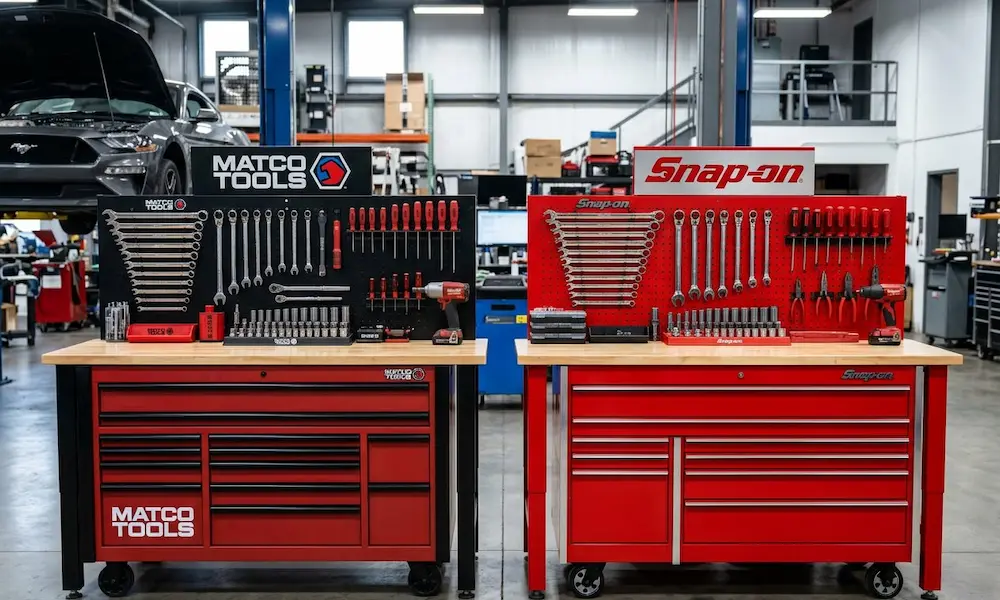
The V-Series is Craftsman’s answer to the “tool truck” brands — the Snap-on and Mac Tools wagons that show up at dealerships. It’s assembled in the USA and built with 16–18 gauge steel, the thickest in the lineup.
| Feature | V-Series |
|---|---|
| Steel Gauge | 16–18 Gauge |
| Drawer Capacity | 150–200 lbs per drawer |
| Total Capacity | 3,000 lbs |
| Casters | Spring-loaded heavy-duty |
| Assembly | Made in USA |
| Warranty | 10-Year Limited |
The spring-loaded casters aren’t just a flex. They absorb shock when you roll the unit across shop floors with metal shavings, expansion joints, or debris. That protects the casters and the floor. In a commercial shop, that matters every single day.
How Does Craftsman Stack Up Against the Competition?
Craftsman vs. US General (Harbor Freight)
US General’s Series 3 gets praised for thick steel at a low price. But Craftsman pulls ahead on user experience. The S2000’s soft-close slides feel noticeably more refined than US General’s mechanical latching system. More importantly, Craftsman’s 10-year warranty blows past the standard 90-day coverage most US General products carry. That gap matters when something goes wrong two years in.
Craftsman vs. Husky (Home Depot)
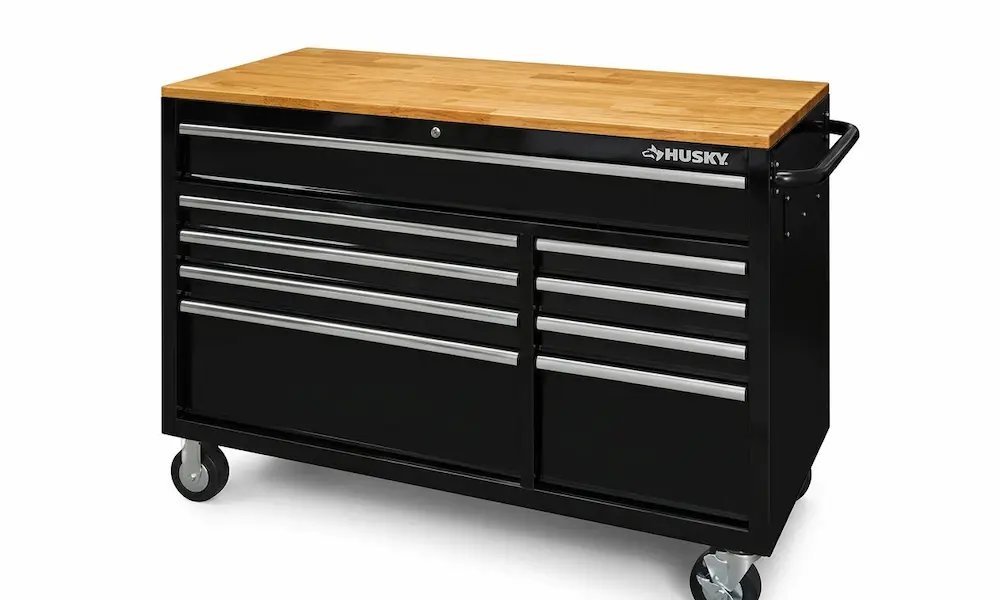
This one’s close. Both brands target the prosumer crowd, and both offer 18-gauge steel with integrated power strips at similar price points. The real difference comes down to drawer layout. Husky tends to run full-width, deep drawers — great for long pry bars and big socket sets. Craftsman uses tiered drawer sizes, which works better if you like to organize tools by category. Your workflow should drive that choice.
Craftsman vs. Milwaukee
Milwaukee’s steel storage integrates with its M18 battery platform and includes clever tool-specific organizers. That ecosystem lock-in is a real perk if you’re running Milwaukee power tools. But the V-Series often wins on raw material thickness in critical cabinet sections. If you want the sturdiest box and don’t need the battery integration, V-Series is the call.
What the Warranty Actually Covers
Here’s a common mistake: assuming everything Craftsman makes carries a lifetime warranty. It doesn’t.
- Hand tools (ratchets, wrenches): Full Lifetime Warranty. No receipt needed in most cases.
- Metal tool storage: Limited Warranty — 3 years for the 1000 Series, 10 years for the S2000, 3000, and V-Series. You need proof of purchase.
- What’s not covered: normal wear, accidental damage, or professional use on a box rated for residential use only.
Lowe’s has stated it will honor Craftsman lifetime warranties regardless of original purchase location — but real-world experiences at the service desk vary. Some customers get seamless exchanges. Others get the runaround. For tool boxes specifically, keep your receipt. Scan it and save it somewhere you won’t lose it.
If you hit a wall in-store, the Craftsman Customer Care Hotline at 888-331-4569 can help track down replacement parts or arrange a credit toward a newer model if yours has been discontinued.
Which Series Should You Actually Buy?
Here’s the straightforward breakdown:
- Home hobbyist who tinkers on weekends? Go with the S2000. You get I-Frame construction, soft-close drawers, and a 10-year warranty at a price that undercuts most professional boxes. It’s genuinely the best value in the lineup.
- Work on your own cars several times a week? The 3000 Series gives you the depth and the built-in power you’ll actually use. It’s a mobile workstation, not just a storage box.
- Running a commercial shop or doing this for a living? Don’t mess around with anything below the V-Series. The 16-gauge steel and spring-loaded casters are there for a reason — they’re built for daily professional punishment.
The finish on all three upper-tier series uses powder coating, not standard paint. Powder coat resists chips, scratches, and chemical spills far better than liquid paint — which matters in a garage where brake fluid and oil are part of the routine.
One more thing worth knowing: Craftsman uses polyurethane or heavy-duty rubber wheels on the S2000 and above. Cheap boxes use plastic wheels that flat-spot after sitting in one position for months. Craftsman’s wheels roll smoothly even after a long static period. That’s a small detail that you’ll appreciate the first time you need to rearrange your shop.
So — are Craftsman tool boxes good? Yes, once you get past the 1000 Series, they’re genuinely well-built, competitively priced, and backed by a warranty structure that most budget brands can’t touch. Match the series to your actual workload, keep your receipt, and you’ve made a solid call.