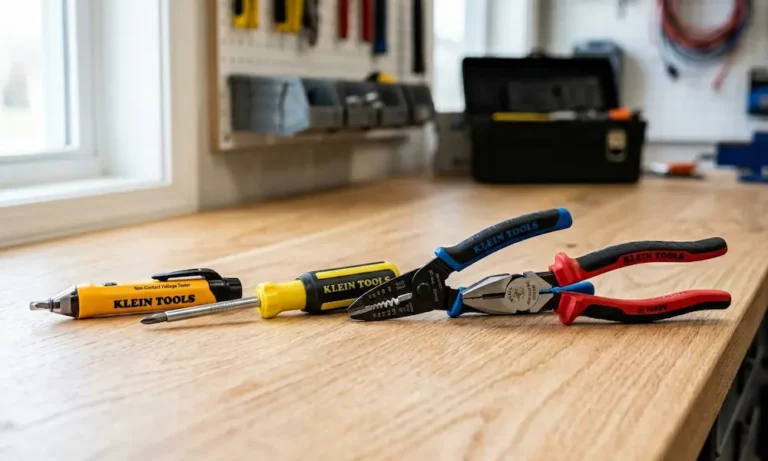
Thinking about stocking your tool bag with Klein gear but not sure if the hype is real? You’ve landed in the right place. This post cuts through the noise and gives you a straight answer — backed by real data, pro feedback, and a side-by-side look at the competition. Stick around to the end.
The Short Answer: Yes, Klein Tools Are Good
Klein Tools isn’t just good — for most professional electricians, it’s the default choice. The brand has been making trade-specific tools since Mathias Klein forged his first pair of side-cutting pliers in Chicago back in 1857. That’s not a marketing story. That’s a 160-year track record built one tool at a time.
Still, “good” means different things depending on what you’re buying. Let’s break it down.
Why Electricians Trust Klein Tools
Most electricians don’t pick Klein because of nostalgia. They pick it because the tools hold up on the job, shift after shift.
Here’s what separates Klein from the average hand tool brand:
Hot-riveted joints — Klein joins the two halves of their pliers while the rivet is still hot. When the metal cools, it shrinks into a tight, permanent fit. No wobble. No slop. This technique keeps the joint smooth for the life of the tool, which is something cold-pressed rivets simply can’t match.
Induction-hardened cutting edges — The cutting knives get targeted heat treatment so they stay sharp enough to slice through ACSR, nails, and hardened screws. The rest of the tool stays ductile so it doesn’t shatter on impact.
High-leverage pivot design — On many Klein pliers, the rivet sits closer to the cutting edge. This gives you about 46% more cutting and gripping power without asking more from your hand. That matters a lot on a ten-hour shift.
Cushion-Grip handles — A hard inner core anchors the shank. A soft outer layer gives you grip in oily or sweaty conditions. It’s not just comfort — it’s a real injury-prevention feature.
Where Klein Actually Makes Their Tools
One of the strongest arguments for Klein is their domestic manufacturing footprint. Klein produces 14 times more products in the USA than in any other country, and they run six specialized plants across the country.
| Facility | What They Make |
|---|---|
| Mansfield, TX (Plant 1) | Screwdrivers, nut drivers, fish tapes |
| Mansfield, TX (Plant 2) | Pliers, cable cutters, strippers |
| Elk Grove Village, IL | Heavy steel forging |
| Fort Smith, AR | Leather and canvas storage products |
| Bolivar, NY | Scissors and cutlery |
| Lincolnshire, IL | Global HQ — sales, marketing, customer service |
This level of domestic control means tight oversight from raw steel to finished handle. It’s why Klein holds more American-made electrical tools than any competitor.
One honest exception: electronic tools like multimeters and voltage testers. Klein has acknowledged that the specialized components for these items are sourced from Asia, where that manufacturing is concentrated. The products are still designed by Klein’s engineers in the US, but it’s worth knowing if country of origin matters to you.
How Klein Stacks Up Against the Competition
Are Klein tools good compared to Knipex or Milwaukee? That’s the real question most pros are asking. Here’s an honest breakdown:
| Brand | Real Strength | What Pros Say | Best For |
|---|---|---|---|
| Klein Tools | Tough, USA-built, electrician-specific features | The trusted default for core hand tools | Electricians, linemen, telecom workers |
| Knipex | Lighter, more precise, smoother out of the box | Top-tier German engineering | High-end pros, industrial techs |
| Milwaukee | Fast innovation, integrates with power tool systems | Clever features, sometimes gimmicky | General contractors, construction |
| Channellock | Solid value, legendary groove-joint design | Reliable but lacks electrical-specific extras | Plumbers, general trades |
| Southwire | Budget-friendly starter kits | Functional for light duty, below Klein quality | Apprentices, DIYers |
Knipex has earned serious respect among American electricians — especially for specialized plier work. Their tools are lighter and often smoother right out of the box. But many seasoned tradespeople still reach for Klein when they need something that can take a beating and function as a makeshift hammer in a pinch. Knipex pliers aren’t built for that.
Milwaukee competes on innovation and availability. Their multi-function designs are clever and well-priced, but for core electrical hand tools, most professionals still lean Klein.
Lineman’s Pliers Head-to-Head
If you want a direct comparison on one of the most important tools in any electrician’s bag, here’s how the top 9-inch lineman’s pliers stack up:
| Feature | Klein J2000-9NECRTP | Knipex 09 12 240 | Milwaukee 48-22-6100 |
|---|---|---|---|
| Weight | 18.3 oz | 15.8 oz | 10.5 oz |
| Joint Type | Hot-riveted | Precision machined bolt | High-leverage rivet |
| Cutting Hardness | Hardened for ACSR/Steel | 64 HRC (piano wire rated) | Iron carbide hardened |
| Added Features | Fish tape puller, crimper | Tape puller, crimper | Crimper, bolt shearing |
| Handle | Contoured Journeyman Grip | Multi-component comfort grip | Rubberized overmold |
| Made In | USA | Germany | USA |
Klein is the heaviest option here. Some pros love the extra mass when driving staples or persuading conduit. Others prefer Knipex’s surgical lightness. Your call.
The Quality Debate: Has Klein Slipped?
This is worth addressing directly because it’s all over the professional forums. There’s a real conversation happening — sometimes called “De-Klein” — about whether quality has dropped as Klein expanded into big-box retail.
Common complaints from electricians on Reddit and trade forums include:
- Stiffness out of the box — Some users report modern pliers need more break-in time than older versions
- Tip chipping on screwdrivers — A handful of pros have noted flathead tips twisting under high torque
- Inconsistent tolerances — Some pairs of the same model have tight, clean blades while others on the same shelf have slight misalignments
Is this the full story? Not quite. Any company producing millions of tools per year will have some variance. There’s also a “survivorship bias” at play — the only old Klein tools still floating around are the ones that never failed. That makes it an unfair comparison to today’s average output.
That said, Klein appears to be taking this seriously. The company has announced plans to invest over $100 million to expand USA-based production and bring previously outsourced manufacturing back in-house. That’s a significant move, and it suggests they’re listening.
Klein’s Wire Strippers and Testers: Worth Buying?
Beyond pliers, Klein’s wire strippers and diagnostic tools deserve a mention.
Wire strippers — The Klein-Kurve series uses accurately milled stripping holes to remove insulation cleanly without nicking the conductor. That’s critical for maintaining circuit integrity. The self-adjusting model (11061) handles solid, stranded, and NM cable in a single squeeze — a real time-saver during panel work.
Electronic testers — Klein’s multimeters and non-contact voltage testers are built for field use, not lab precision. They carry CAT III/CAT IV safety ratings, backlit displays, and audible alerts. For residential and commercial work, they’re more than capable. If you’re doing industrial-grade measurements, Fluke is still the benchmark — but for most electricians, Klein testers do the job reliably.
What’s the Warranty Actually Like?
Klein offers a lifetime warranty on hand tools, but the experience varies depending on where you bought them.
The old model was simple — walk into your electrical supply house, swap the broken tool, no questions asked. That “over-the-counter” exchange was the industry standard for decades.
Today it’s more complicated. Exchanges at Home Depot generally work. At Lowe’s, some users report being required to show original receipts and proof of purchase from an authorized distributor — which is a real step backward.
For specialty equipment like battery-powered hydraulic crimpers or test instruments, Klein has a formal Warranty Return Authorization process on their website. For calibration and repair on instruments, Trescal handles third-party servicing to bring tools back to like-new spec.
Bottom line: if you buy from a proper electrical distributor, warranty service tends to go smoothly. The big-box experience is hit or miss.
What Klein Has Coming in 2025 and 2026
Klein isn’t standing still. Their upcoming product roadmap leans hard into the “smart jobsite”:
- The KNECT System — Modular impact-rated sockets and drivers for faster size changes on the fly
- Impact-rated hand tools — Designed to handle the rotational stress of cordless impact drivers without cracking
- Advanced diagnostics — New borescopes (like the ET17) and sensitive circuit tracers for complex troubleshooting in commercial and industrial settings
These launches show up clearly in their 2026 product previews — and they suggest Klein is positioning itself as more than just a pliers company.
So, Are Klein Tools Good? Here’s the Bottom Line
Klein Tools earns its reputation. The core hand tools — pliers, screwdrivers, wire strippers — are genuinely built to last, especially the USA-made lines. For a journeyman building out a kit, Klein is still the safest investment for the tools you’ll use every single day.
The quality consistency questions are real, but they’re also being addressed through serious domestic reinvestment. The warranty experience needs work at big-box retailers, but buying from an electrical distributor keeps that process clean.
For most electricians, a smart tool bag in 2025 looks like this: Klein for your core hand tools, Knipex if you want precision-engineered pliers for specialized work, and Milwaukee where clever multi-functionality makes sense. That’s not a compromise — that’s how the best tradespeople actually build their kits.