Shopping for a used Kia Sportage? With 30+ years of model years to choose from, picking the right one feels like defusing a bomb. Some years are genuinely excellent. Others will drain your wallet faster than a cracked radiator. This guide cuts through the noise and tells you exactly which years to buy — and which to run from.
Why the Model Year Matters So Much With the Sportage
Not all Sportages are created equal. Kia has cycled through five generations, and within each one, certain years shine while others quietly self-destruct.
The difference between a 2012 and a 2015 Sportage isn’t just age. It’s engine reliability, safety ratings, and whether you’ll be calling a tow truck at 80,000 miles. Picking the right model year is honestly more important than trim level or color.
A Quick Look at the Five Generations
Before diving into specific years, here’s the big picture:
| Generation | Years | Key Change |
|---|---|---|
| First (NB) | 1993–2004 | Body-on-frame, Mazda-based |
| Second (JE/KM) | 2005–2010 | Switched to unibody crossover |
| Third (SL) | 2011–2016 | Sleek “Tiger Nose” design |
| Fourth (QL) | 2017–2022 | Premium interior, full ADAS rollout |
| Fifth (NQ5) | 2023–Present | Hybrid/PHEV, massive interior upgrade |
Each generation brought real improvements. But each one also had its share of rough patches — especially in the early years of a new design.
The Best Year for Kia Sportage: Our Top Picks
2021 Kia Sportage — The #1 Pick
If you want the most reliable used Kia Sportage, the 2021 model is it. Full stop.
Here’s why it tops the list:
- It’s the final year of the polished fourth generation
- Automatic emergency braking, lane-keep assist, and pedestrian detection are all standard
- J.D. Power awarded the 2018 Sportage for dependability — and the 2021 builds on that foundation
- Strong long-term reliability scores across the board
- Used prices currently range from $13,682 to $24,461 depending on trim and mileage
The 2021 hits the sweet spot between modern tech and a proven, refined powertrain. It’s had years of kinks worked out, and it’s hitting the used market right now as leases expire.
2019 Kia Sportage — Best Value Pick
The 2019 gives you almost everything the 2021 does, at a noticeably lower price. According to CarGurus’ Sportage buying guide, the 2019 offers solid reliability and modern safety features — making it one of the smartest buys in its class.
You still get:
- Blind-spot monitoring and rear cross-traffic alert
- An 8-inch touchscreen (on higher trims)
- Apple CarPlay and Android Auto
- A well-sorted 2.4L naturally aspirated engine
2018 Kia Sportage — Award-Winner
The 2018 model earned a J.D. Power dependability award in 2021 — that’s based on real three-year ownership data. It’s one of the most trouble-free years in the entire Sportage lineup. If you find a clean one with reasonable miles, it’s a strong buy.
2015–2016 Kia Sportage — Best Budget Option
Looking to spend around $10,000? The 2015 and 2016 models are your sweet spot. After the nightmare years of 2011–2013 (more on that below), Kia got its act together. By 2015, the third-generation engine issues were largely resolved.
The 2015 model has the fewest complaints of the entire third generation. You get the stylish “Tiger Nose” exterior at a fraction of new-car prices. Just don’t go backwards to a 2013 or earlier.
2007 Kia Sportage — Best Old-School Pick
Want something simple and cheap to maintain? The 2007 Sportage stands out as one of the most reliable years of the second generation. Fewer electronics mean fewer things to go wrong. It’s basic, rugged, and holds up well. Don’t expect heated seats or a touchscreen — do expect a vehicle that just keeps running.
Summary: Best vs. Worst at a Glance
| Reliability Rank | Model Year | Why |
|---|---|---|
| ⭐ Top Pick | 2021 | Peak QL generation, standardized safety tech |
| ✅ High Value | 2019 | Solid reliability, modern features at lower price |
| ✅ Award-Winner | 2018 | J.D. Power dependability award |
| 💰 Budget Choice | 2015–2016 | Post-engine crisis, modern styling |
| 🔧 Old Reliable | 2007 | Simple mechanics, high durability |
| ❌ Avoid | 2012 | Severe engine seizure risk |
| ⚠️ Caution | 2011, 2013 | Problematic Theta II engine |
| ⚠️ Caution | 2017 | High complaint volume, early HECU fire risk |
Kia Sportage Years to Avoid
2011, 2012, 2013 — Stay Away
These three years are the worst in Sportage history. The 2.4L and 2.0T engines in these models suffered from serious manufacturing defects tied to the Theta II engine family. Owners reported:
- Engines seizing or stopping while driving
- Excessive oil consumption
- Loud knocking sounds before failure
- Engine failures before 100,000 miles
The 2012 model is considered the absolute worst year to buy. Engine replacements are expensive. Power loss at highway speeds is dangerous. Skip these completely.
The 2011 also had reported braking issues and electrical short circuits on top of the engine problems.
2017 — Proceed Carefully
The 2017 was the first year of the fourth generation redesign — and it shows. First-year models almost always have bugs to work out, and the 2017 Sportage had a few big ones.
A significant recall was issued for 2017–2021 models due to a short-circuit risk in the Hydraulic Electronic Control Unit (HECU). Federal regulators warned owners to park affected vehicles outdoors and away from structures until repaired.
Some 2017 models also had intermittent oil consumption issues. If you’re set on a first-gen QL model, hold out for the 2018 instead.
2001 and 2008 — Minor Caution
These aren’t as bad as the Theta II era, but both years had elevated complaints around electrical accessories and minor powertrain issues. Not dealbreakers for the right price, but worth knowing before you buy.
Fourth Generation Deep Dive: 2017–2022
The QL generation is where the Sportage really grew up. Interior quality finally matched competitors. Road noise dropped significantly. The cabin felt genuinely premium for the first time.
Here’s how the fourth gen breaks down by year:
| Model Year | Reliability | Notes |
|---|---|---|
| 2017 | Caution | HECU fire recall, early-year bugs |
| 2018 | Excellent | J.D. Power award winner |
| 2019 | Excellent | Modern safety, solid powertrain |
| 2020 | Good | ADAS now standard on all trims |
| 2021 | Excellent | Top pick overall |
| 2022 | Very Good | Commands price premium of ~$2,000–$3,000 over 2021 |
The 2020 facelift was a big deal. Kia made automatic emergency braking, lane-keeping assist, and auto high beams standard on every trim — including the base LX. That’s a genuine safety leap.
The 2021 Nightfall Edition also added blackout trim and dark gray wheels if you want something a little sharper looking.
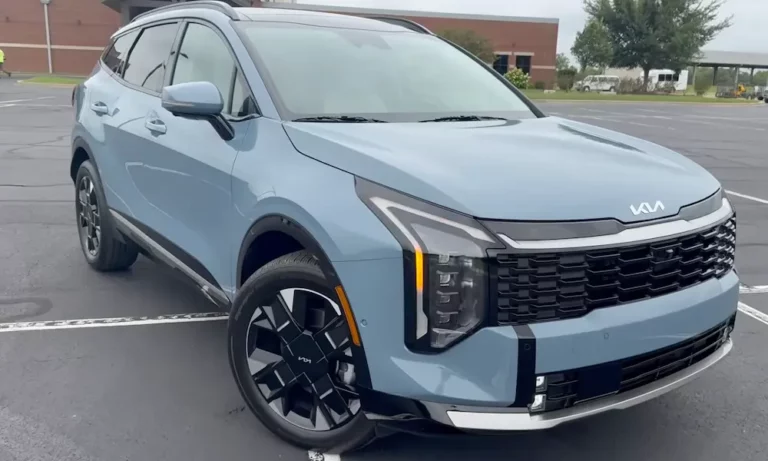
Fifth Generation: 2023 and Newer
The 2023 Sportage introduced the biggest redesign in the model’s history. It grew significantly — 3.4 inches more wheelbase and 7.1 inches longer overall. That means genuinely roomy rear seats and 39.6 cubic feet of cargo space.
The dual 12.3-inch curved display is impressive. Hybrid and plug-in hybrid (PHEV) models finally fixed the Sportage’s fuel economy problems:
| Powertrain | Horsepower | MPG (Combined) |
|---|---|---|
| 2.5L Gas (FWD) | 187 HP | 28 MPG |
| 2.5L Gas (AWD) | 187 HP | 25 MPG |
| 1.6L Hybrid (FWD) | 227 HP | 43 MPG |
| 1.6L Hybrid (AWD) | 227 HP | 38 MPG |
| 1.6L PHEV (AWD) | 261 HP | 84 MPGe |
That said, Edmunds describes the base 2.5L engine as “underpowered” and “very slow,” clocking 0–60 in 9.5 seconds. That’s not fast. The hybrid models solve this with noticeably better pull and smoother power delivery.
Known Issues With 2023–2025 Models
Early fifth-gen models have had some growing pains:
- Brake pedal stiffness and hydraulic brake failures reported
- Instrument cluster resets while driving (2025 models)
- Panoramic sunroof glass shattering without impact (2023–2025)
- Engine stalling at intersections on some 2024 models
Kia issued a recall for loose roof moldings that could detach while driving (SC292) and a software fix for instrument panel screens tied to a tow hitch harness (SC359).
These issues don’t make the fifth gen a bad choice — but they do mean waiting for the 2024 or 2025 may be smarter than grabbing a 2023.
The Theft Problem Nobody Talks About
Here’s something that catches a lot of buyers off guard. Many 2017–2021 Sportage models with key-start ignitions lacked an engine immobilizer — a basic anti-theft device that most other cars include as standard.
This led to a surge in vehicle thefts and legal action against Kia. If you’re buying a used Sportage from this era, confirm the vehicle received the manufacturer’s software update. If it hasn’t, a steering wheel lock is cheap insurance.
Ownership Costs: What to Expect
The annual maintenance cost for a Sportage sits around $462 — well below the segment average of $521. Over ten years, you’re looking at roughly $7,873 in total repair and maintenance costs.
Compare that to the competition:
| Feature | Kia Sportage | Toyota RAV4 |
|---|---|---|
| Reliability Rating | 4.6 / 5.0 | 4.5 / 5.0 |
| Avg. Annual Repair Cost | ~$450 | ~$480 |
| New Car Warranty | 5 yr / 100,000 km | 3 yr / 60,000 km |
| 5-Year Depreciation | ~47% | ~40% |
The Sportage depreciates faster than the RAV4, which actually works in your favor as a used buyer. You get more car for less money.
Know the Warranty Situation Before You Buy
Kia’s famous 10-year/100,000-mile powertrain warranty doesn’t fully transfer to private-party buyers. If you buy used from a private seller, you only get 5 years/60,000 miles from the original sale date.
Want the full 10-year coverage? Buy a Certified Pre-Owned (CPO) Sportage from an authorized Kia dealer. It’s often worth the slight price premium.
Common Technical Issues to Ask About Before Buying
A few recurring issues show up across multiple Sportage generations. Ask about these before signing anything:
Headlight condensation (2017–2022): A small amount is normal. Persistent water pooling means a failed seal and a pricey repair — you’ll need the front bumper cover removed to swap the assembly.
Master window switch failure (2017–2025): Intermittent or complete failure of the driver’s window panel is a known issue across the fourth and fifth generation. Early 2017 models also had a fragile window regulator gear covered by TSB SA418.
A/C performance (2017–2019): TSB CLI 046 addresses reduced or inoperative cooling in these years, usually traced to the compressor or evaporator temperature sensor.
These are fixable issues — but knowing about them gives you negotiating leverage and helps you avoid a surprise repair bill right after purchase.
So, What’s the Best Year for Kia Sportage?
Here’s the short answer:
Buy a 2021 if budget allows. It’s the most refined, most reliable, and best-equipped used Sportage on the market right now.
Go for a 2019 if you want to save money without sacrificing modern features or safety tech.
Consider a 2015–2016 for a tight budget — just verify the engine history and make sure you’re past the Theta II era problems.
Avoid 2011, 2012, and 2013 entirely. The engine failure risk in those years is too high to justify any price.
If you want the newest tech and the hybrid efficiency boost, the 2024 or 2025 Sportage Hybrid is genuinely excellent — just know you’re paying a premium and accepting that first-gen software bugs are still being ironed out. The 2026 refresh also fixes many complaints about the interior materials and infotainment speed, so that’s worth watching if you’re not in a hurry.
The Sportage has earned its spot as one of the best compact crossover values on the market. Pick the right year, and you’ll get a whole lot of vehicle for your money.