Pouring the wrong amount of oil into your 5.3 is a surprisingly easy mistake to make — especially since the correct amount changed significantly in 2014. This guide breaks down exactly how much oil your engine needs, what type to use, and why GM made the switch. Stick around to the end, because there’s a tricky 2014 capacity discrepancy that catches a lot of owners off guard.
Why the Chevy 5.3 Oil Capacity Isn’t Always the Same Number
Here’s the thing — the Chevy 5.3 V8 has been around since 1999, and it’s gone through three major generations. Each generation came with different technology, tighter tolerances, and updated lubrication needs.
The short version:
- Gen III (1999–2007): 6.0 quarts
- Gen IV (2007–2014): 6.0 quarts
- Gen V (2014–present): 8.0 quarts
That 2-quart jump between Gen IV and Gen V wasn’t random. GM needed more oil volume to support Direct Injection, Variable Valve Timing, and Dynamic Fuel Management — systems that use oil as a hydraulic fluid, not just a lubricant.
Gen III 5.3 Oil Capacity (1999–2007): The 6-Quart Vortec Era
The original 5.3L Vortec engines — the LM7, L59, LM4, and L33 — all ran on 6.0 quarts with a fresh filter. These engines were workhorses. Simple, reliable, and straightforward to maintain.
| Engine Code | Block | Oil Capacity (with filter) | Viscosity |
|---|---|---|---|
| LM7 | Iron | 6.0 quarts | 5W-30 |
| L59 | Iron | 6.0 quarts | 5W-30 |
| LM4 | Aluminum | 6.0 quarts | 5W-30 |
| L33 | Aluminum | 6.0 quarts | 5W-30 |
GM spec’d 5W-30 across the board for these engines. In extremely cold climates, 0W-30 was acceptable to improve cold-start flow. These engines had no cylinder deactivation, no fancy hydraulic solenoids — just oil doing its job. That simplicity is a big reason Gen III motors routinely hit 200,000–300,000 miles with basic maintenance.
The 6.0-quart capacity was actually generous compared to competitors at the time. Many rival V8s ran on 5 quarts. That extra quart gave the oil more room to cool down in the pan before recirculating — a small but meaningful advantage during hard work.
Gen IV 5.3 Oil Capacity (2007–2014): Same Quarts, New Complexity
Gen IV kept the 6.0-quart fill but introduced Active Fuel Management (AFM) and Variable Valve Timing (VVT). That changed everything about how the oil had to perform.
| Engine Code | Block | Features | Capacity (with filter) | Viscosity |
|---|---|---|---|---|
| LY5 | Iron | AFM | 6.0 quarts | 5W-30 |
| LMG | Iron | AFM, Flex Fuel | 6.0 quarts | 5W-30 |
| LC9 | Aluminum | AFM, VVT | 6.0 quarts | 5W-30 |
| LH6 | Aluminum | AFM | 6.0 quarts | 5W-30 |
| LH9 | Aluminum | VVT, Flex Fuel | 6.0 quarts | 5W-30 |
| LMF | Iron | VVT, No AFM | 6.0 quarts | 5W-30 |
AFM works by collapsing lifters on cylinders 1, 4, 6, and 7 using high-pressure oil routed through a Lifter Oil Manifold Assembly (LOMA). If the oil gets contaminated or runs low, those lifters can fail — sometimes catastrophically. This is the source of the well-known Gen IV lifter failure problem.
GM responded with several Technical Service Bulletins, including recommendations to install an AFM oil deflector in the pan and replace the left valve cover with a redesigned version that better controlled oil splash. These were band-aid fixes for a system that was pushing the limits of 6.0 quarts.
Gen IV also introduced the Dexos1 oil specification. Using a Dexos1-certified oil became mandatory for AFM-equipped engines under warranty. Conventional oils couldn’t prevent deposits from clogging the tiny passages in the AFM solenoids.
The Gen IV Oil Consumption Issue
Engines built before February 2011 had a well-documented oil consumption problem. According to GM’s own service guidelines, acceptable oil consumption is 1 quart per 2,000 miles. Some Gen IV owners were burning through oil significantly faster than that.
The culprit? Oil getting pulled through the PCV system or sprayed by an overactive AFM pressure relief valve in the pan. Once oil enters the combustion chamber, carbon builds up on the piston rings, and consumption accelerates.
If you’re buying a used Gen IV truck, it’s worth checking whether these TSB updates were completed before you commit.
Gen V 5.3 Oil Capacity (2014–Present): Why GM Jumped to 8 Quarts
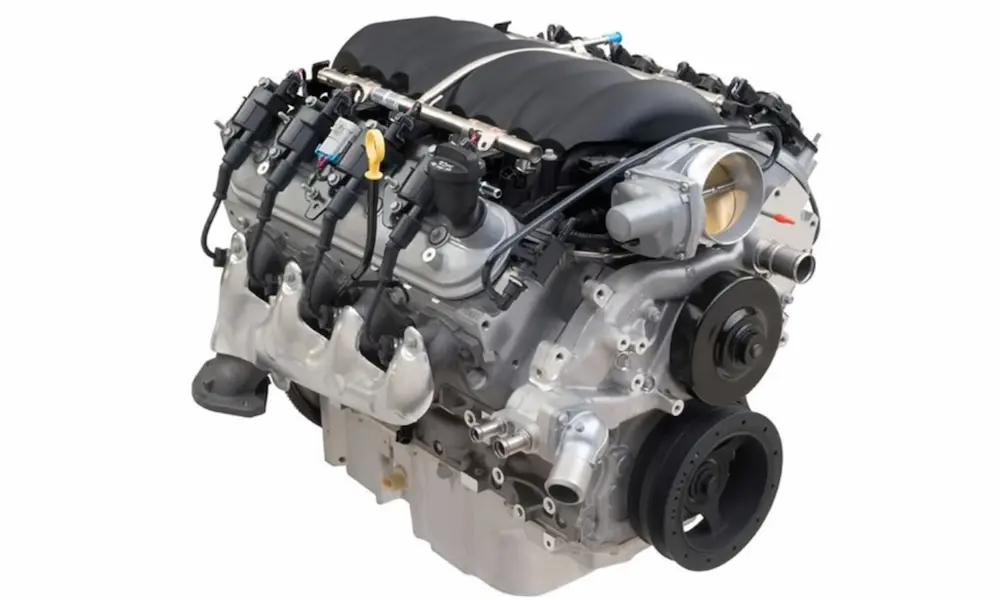
The EcoTec3 generation — L83, L82, and L84 — moved to an 8.0-quart capacity. That’s a 33% increase, and it wasn’t arbitrary.
| Engine Code | Architecture | Features | Capacity (with filter) | Viscosity |
|---|---|---|---|---|
| L83 | EcoTec3 | AFM, DI, VVT | 8.0 quarts | 0W-20 |
| L82 | EcoTec3 | AFM, DI, VVT | 8.0 quarts | 0W-20 |
| L84 | EcoTec3 | DFM, DI, VVT | 8.0 quarts | 0W-20 |
Two big reasons drove the capacity increase:
1. Direct Injection and fuel dilution. When fuel is injected straight into the combustion chamber at over 2,000 psi, small amounts can bypass the piston rings during cold starts and dilute the oil. More oil volume means those contaminants get diluted across a larger reservoir, protecting viscosity between changes.
2. Dynamic Fuel Management (DFM). The L84’s DFM system can run in 17 different cylinder firing patterns. Unlike Gen IV AFM (which only deactivated 4 cylinders), DFM works across all 8. That demands a massive, consistent supply of pressurized oil. At high RPM, a lot of oil is living up in the cylinder heads and galleries — the extra reservoir in the pan makes sure the pump never starves.
The 2014 Oil Capacity Confusion — 8.0 or 8.5 Quarts?
Here’s where things get messy. Some 2014 Silverado and Sierra owner’s manuals listed the capacity as 8.5 quarts. That was a publication error.
GM released PI bulletin PIP5231A clarifying that the correct fill for the 5.3L L83 is 8.0 quarts. Owners who filled to 8.5 noticed the dipstick showed an overfill. The bulletin also confirmed that the upper dimple on the dipstick is “Full” and the lower dimple is “Add.” If you have any documentation showing 8.5 quarts, consider it outdated.
Oil Viscosity: Why It Changed from 5W-30 to 0W-20
The shift to 0W-20 in 2014 wasn’t just about fuel economy, though that’s part of it. Lower viscosity oil reduces internal friction, particularly during warm-up, which can improve fuel efficiency by roughly 1–2%.
But there’s a mechanical reason too. Gen V engines have significantly tighter bearing clearances than Gen III or Gen IV engines. The 0W-20 flows into those tight spaces faster on a cold start, protecting the bearings in those critical first seconds. The VVT and DFM solenoids are also calibrated for the flow characteristics of 0W-20 — use thicker oil and you risk sluggish timing response and trouble codes.
Current Standard: Dexos1 Gen 3
The current spec for all modern 5.3L engines is Dexos1 Gen 3, introduced in 2022. It adds enhanced protection against Low-Speed Pre-Ignition (LSPI) — a combustion event that can damage pistons in high-compression, direct-injected engines. The Gen V 5.3 runs an 11.0:1 compression ratio, so this protection matters.
| Spec | Era | Key Goal |
|---|---|---|
| GM 6094M | Pre-2011 | Basic lubrication |
| Dexos1 Gen 1 | 2011–2014 | Sludge and aeration control |
| Dexos1 Gen 2 | 2015–2021 | LSPI protection |
| Dexos1 Gen 3 | 2022–present | High-temp stability, efficiency |
Oil Filter Specs for the Chevy 5.3
The filter you use matters as much as the oil. Here’s what changed across generations:
- Gen III: ACDelco PF44 or PF46
- Gen IV: ACDelco PF48 (higher bypass valve for AFM/VVT flow demands)
- Gen V: ACDelco PF63 or PF63E
The PF63 is a high-capacity filter designed for the 8.0-quart system and extended change intervals up to 10,000 miles. Aftermarket options like the WIX WL10255XP offer up to 99% filtering efficiency at 20 microns — worth considering if your truck has DFM.
Drain plug specs (all generations):
- Head size: 15mm
- Torque: 18 ft/lbs
- Replace the drain plug gasket every service to prevent slow leaks
Does 2WD vs. 4WD Change the Oil Capacity?
No. The 5.3L oil capacity is identical whether you’re driving a 2WD or 4WD Silverado, Sierra, Tahoe, or Suburban. The engine block and oil pan are the same across configurations. A 4WD truck has more total fluid when you add the front differential and transfer case, but the engine itself doesn’t change.
| Model | Drivetrain | 5.3L Oil Capacity |
|---|---|---|
| Silverado 1500 | 2WD | 8.0 quarts |
| Silverado 1500 | 4WD | 8.0 quarts |
| Tahoe / Suburban | 2WD | 8.0 quarts |
| Tahoe / Suburban | 4WD | 8.0 quarts |
Quick Reference: Chevy 5.3 Oil Capacity by Year
Not sure which generation your truck falls into? Here’s the fastest way to find your number:
- 1999–2013: 6.0 quarts, 5W-30 Dexos1
- 2014–present: 8.0 quarts, 0W-20 Dexos1 Gen 3 (not 8.5 — see the PIP5231A bulletin above)
If you’re running a 2025 Silverado with the L84, it’s still 8.0 quarts of 0W-20. That hasn’t changed since 2014.
Get the capacity right, use the correct Dexos spec, install the right filter, and torque that drain plug to 18 ft/lbs. That’s really all it takes to keep one of the most durable V8s ever built running strong for the long haul.