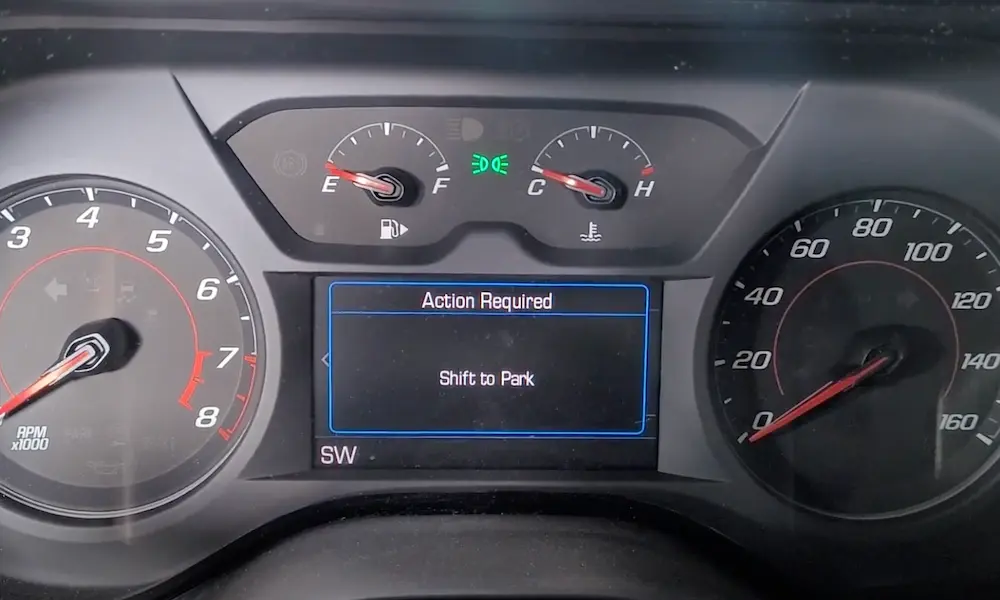
That “Reduced Engine Power” message just lit up your dash, and now your Chevy crawls like it’s scared of the highway. The P2138 code is behind it — and yes, it’s fixable. This guide walks you through exactly what’s happening, why it happens, and what you can do about it. Stick around to the end — the warranty section alone might save you hundreds.
What Is the Chevy P2138 Code?
The P2138 code stands for “Throttle/Pedal Position Sensor/Switch D/E Voltage Correlation.” In plain English? Your car’s computer is reading two signals from your accelerator pedal — and they don’t match.
Your Chevy uses a drive-by-wire system. There’s no physical cable connecting your foot to the engine. Instead, two sensors in the pedal assembly send signals to the Engine Control Module (ECM). The ECM compares both signals constantly. When they disagree by more than about 0.5 volts for 2 to 5 seconds, it triggers the P2138 code and kicks the engine into a safe, limited-power state.
Here’s how those sensors are designed to work:
| Sensor Circuit | Voltage Range | Signal Behavior |
|---|---|---|
| APP Sensor 1 (Circuit D) | 0.5V – 4.5V | Linear positive rise |
| APP Sensor 2 (Circuit E) | 0.25V – 2.25V | Half-rate positive rise |
| TP Sensor 1 (Throttle Body) | 0.5V – 4.5V | Feedback loop |
| TP Sensor 2 (Throttle Body) | 4.5V – 0.5V | Mirrored feedback |
The two APP sensors run at different voltage ranges on purpose. If they ever produce identical readings, the ECM knows something’s wrong. It’s a clever built-in safety check.
What You’ll Feel When P2138 Hits
The symptoms aren’t subtle. Your Chevy basically turns into a slow, grumpy version of itself.
- Reduced Engine Power warning lights up on the dash
- Top speed drops to around 40–50 mph
- Acceleration feels sluggish — merging into traffic gets dangerous
- Rough or high idle because the ECM can’t rely on the throttle plate position
- Engine stalls in severe cases during hard acceleration
- Erratic shifting because the transmission gets corrupted load data
This isn’t the car breaking down randomly. It’s the ECM deliberately limiting engine output to around 15–25% of normal torque. The system detected a problem it can’t verify, so it plays it safe. Smart, but incredibly annoying when you’re trying to get somewhere.
| Symptom | Severity | Root Cause |
|---|---|---|
| Reduced Engine Power message | Critical | ECM safety protocol |
| Acceleration lag | High | Pedal input map restricted |
| Speed cap (40–50 mph) | Moderate | Torque request limited |
| Stalling at idle | High | Air-fuel ratio instability |
| Erratic transmission shifts | Moderate | Load data corrupted |
Why Does P2138 Happen? The Real Causes
The code doesn’t always mean the pedal sensor failed. The actual cause is often somewhere in the wiring or connectors — and replacing parts blindly wastes money.
Worn Accelerator Pedal Sensors
Older GM vehicles (mostly pre-2015) used potentiometer-style sensors inside the pedal assembly. A tiny metal wiper slides along a carbon track, varying the voltage. Over time, the wiper grinds down the track and creates dead spots. You’ll see this as a sudden voltage dropout on one channel while the other reads normally.
Newer models use Hall-effect sensors, which don’t rely on physical contact. They’re more durable, but electrical signal drift can still push the output outside the ECM’s calibration window and trigger the code.
Corroded or Loose Wiring Connectors
This is where most techs waste money by skipping straight to parts. The APP sensors run on a 5-volt reference signal — so even a few extra ohms of resistance changes the voltage enough to cause a mismatch. Connector terminals oxidize over time through a process called terminal fretting. Tiny vibrations wear away the plating, bare metal meets oxygen, and you get an insulating layer of corrosion.
Here’s a common mistake: using standard dielectric grease on these connectors. Regular 12-volt dielectric grease introduces enough resistance on a 5-volt circuit to mimic a sensor failure. You need low-voltage lubricant designed for signal circuits.
Water Intrusion at the Kick Panel Connector
This one’s specific to Chevy trucks and SUVs, and it’s responsible for a huge number of P2138 codes in the field. GM’s own Technical Service Bulletin 07-06-04-019F addresses this directly.
The instrument panel-to-body harness connector (called X101 or C100 depending on the model) sits in the driver’s side kick panel area. Water leaks through the A-pillar seal, sunroof drain, or windshield cowl and pools behind the panel. That moisture bridges the 5-volt signal pins, skewing the voltage the ECM reads. Because the leak is intermittent, the P2138 code often appears only after rain or a car wash — and mysteriously disappears in a dry shop.
Which Chevy Models Get P2138 the Most?
The code clusters around specific platforms. Here’s what GM has officially acknowledged:
| Vehicle Years | Primary Models | Known Issue | TSB or Coverage |
|---|---|---|---|
| 2007–2014 | Silverado, Sierra, Tahoe | X101 connector water intrusion | TSB 07-06-04-019F |
| 2013–2015 | Malibu | ECM calibration sensitivity | Recall 15V164 |
| 2016–2018 | Malibu, LaCrosse, Regal | Internal pedal solder cracks | Special Coverage N182188250 |
| 2009–2011 | Impala, Lucerne | Broken solder in APP sensor | Special Coverage SB-10090054 |
| 2019–2025 | Silverado (new gen) | Integrated sensor failures | Special Coverage N212338400 |
If your Chevy is on this list, check whether you qualify for coverage before paying out of pocket.
How to Diagnose Chevy P2138 Step by Step
Don’t start by throwing parts at it. A methodical approach saves you time and money.
Step 1: Graph Live Sensor Data
You need a scan tool that shows live data — not just stored codes. Connect it, turn the ignition on (engine off), and watch APP Sensor 1 and APP Sensor 2 voltages while you slowly press the pedal from rest to the floor.
A healthy system shows two smooth, steady lines — no spikes, no dropouts. If one channel suddenly jumps to 5 volts or drops to zero while the other stays smooth, you’ve found your problem channel. If the dropout only appears when you wiggle the harness, the fault is in the wiring, not the sensor.
Step 2: Check the 5-Volt Reference and Ground
With a digital multimeter, probe the 5-volt reference wire at the sensor connector. It should read a steady 5.0 volts. A reading of 4.5 volts means something’s pulling the circuit down — either a shorted wire or a faulty ECM output. Then check the ground circuit. More than 0.2 ohms of resistance on the ground side will push your signal voltage above its actual value, causing a false correlation error. Corroded engine ground straps near the oil pan are a common culprit on GM trucks.
Step 3: Perform a Pin Drag Test
A circuit can show continuity on a multimeter but still fail at speed due to loose terminal tension. Insert a same-size male terminal into each female pin in the connector. You should feel resistance — a light drag — when you pull it back out. No drag means no spring tension in that terminal. It’ll work fine sitting still and drop out the moment vibration hits it. This is one of the most overlooked causes of intermittent P2138 codes.
How to Fix P2138
Once you’ve pinpointed the cause, the fix is usually straightforward.
Replace the Accelerator Pedal Assembly
If the sensors inside the pedal have failed — worn potentiometer tracks, cracked solder joints, or Hall-effect drift — replace the whole pedal assembly. The internal sensors aren’t serviceable individually. On the 2019–2025 Silverado, it’s two T30 Torx screws. After replacing it, disconnect the negative battery cable for a few minutes or run a throttle position relearn with your scan tool. Without that step, the ECM may still try to apply calibration data from the old sensor to the new unit.
Repair or Bypass the Wiring Harness
If the kick panel connector (X101/C100) is corroded or water-damaged, repair it properly. Some experienced technicians run a new six-conductor shielded cable directly from the pedal assembly to the ECM, bypassing the problem connector entirely.
One important note: don’t solder the connections. In a high-vibration environment, solder creates a rigid brittle point that cracks over time. GM’s own repair documentation recommends crimp connectors with integrated heat-shrink insulation for any P2138 harness repair.
Clean the Throttle Body
P2138 is an APP sensor code, but a sticky throttle plate can make things worse. Carbon deposits from the PCV system build up on the throttle plate and force the TAC motor to work harder. That extra electrical load can introduce noise into the reference circuit, pushing both sensor readings slightly off calibration. Clean the throttle body every 30,000 to 50,000 miles to keep the whole ETC system running cleanly.
What It Costs to Fix P2138
Here’s a realistic breakdown of what you’re looking at:
| Repair Type | Pro Cost | DIY Cost | Coverage Possible? |
|---|---|---|---|
| Accelerator pedal replacement | $350–$550 | $75–$150 | Yes — Special Coverage programs |
| Wiring harness repair | $250–$450 | $20–$50 | Case by case |
| ECM reprogramming | $150–$250 | N/A | Yes — recall/TSB |
| Throttle body replacement | $400–$700 | $150–$300 | Moderate |
| Diagnostic fee | $120–$180 | $0 | Usually included in repair |
Don’t underestimate the diagnostic step. A proper circuit test upfront might cost $150, but it stops you from replacing a $300 throttle body when the actual problem is a $5 corroded wire in the kick panel.
Check If GM Will Pay for It
GM has extended coverage on this failure far beyond the standard warranty on several models. The 2016–2018 Malibu, Buick LaCrosse, and Regal fall under Special Coverage N182188250, which offers a 10-year / 150,000-mile warranty on the APP sensor circuit. If you already paid for this repair out of pocket at an independent shop, GM may reimburse you — provided you have the receipt and the diagnostic code was P2138.
Before you spend anything, check your VIN at the GM owner center and cross-reference it with the TSBs in the table above. It takes five minutes and could save you several hundred dollars.