Your Chevy just threw a U0101 code and now it’s stuck in limp mode, barely crawling down the road. Before you panic and assume you need a new transmission, take a breath. This code is more often a wiring or power issue than a dead module — and you can fix it without throwing expensive parts at the problem. Read this to the end, because the fix might be simpler than you think.
What Is the Chevy U0101 Code?
The chevy U0101 code means “Lost Communication with Transmission Control Module (TCM)”. In plain terms, your engine’s brain (the ECM) stopped hearing from your transmission’s brain (the TCM). No signal means no coordination — and no coordination means your car goes into self-protection mode.
The TCM constantly sends data packets across the CAN bus every few milliseconds. When the ECM stops receiving those updates within a set timeout window, it logs U0101 and assumes the worst. That doesn’t mean the TCM is dead. It could just mean the communication line is broken somewhere between the two.
How the CAN Bus Works in Your Chevy
Your Chevy runs a High-Speed GMLAN network — think of it as the internet inside your truck or car. Every major module is connected through a twisted pair of wires called CAN-High and CAN-Low. They all talk constantly, sharing data about speed, torque, gear position, and braking.
Here’s who’s on that network and what they do:
| Module | Role | Protocol |
|---|---|---|
| ECM (Engine Control Module) | Controls combustion, throttle, timing | HS GMLAN / CAN Bus |
| TCM (Transmission Control Module) | Manages gear shifts, line pressure, solenoids | HS GMLAN / CAN Bus |
| BCM (Body Control Module) | Gateway for interior electronics | HS GMLAN / MS GMLAN |
| EBCM / ABS Module | Uses TCM speed data for braking/traction | HS GMLAN / CAN Bus |
| DLC (Data Link Connector) | Your scan tool’s entry point | J1962 Standard |
When the TCM goes quiet, the rest of the network notices — fast.
What You’ll Feel Behind the Wheel
The symptoms of a U0101 code hit hard and fast. Here’s what drivers typically report:
- Check Engine Light illuminates immediately
- Transmission stuck in one gear (usually 3rd or 5th depending on the model)
- Harsh, clunky shifting from Park into Drive or Reverse
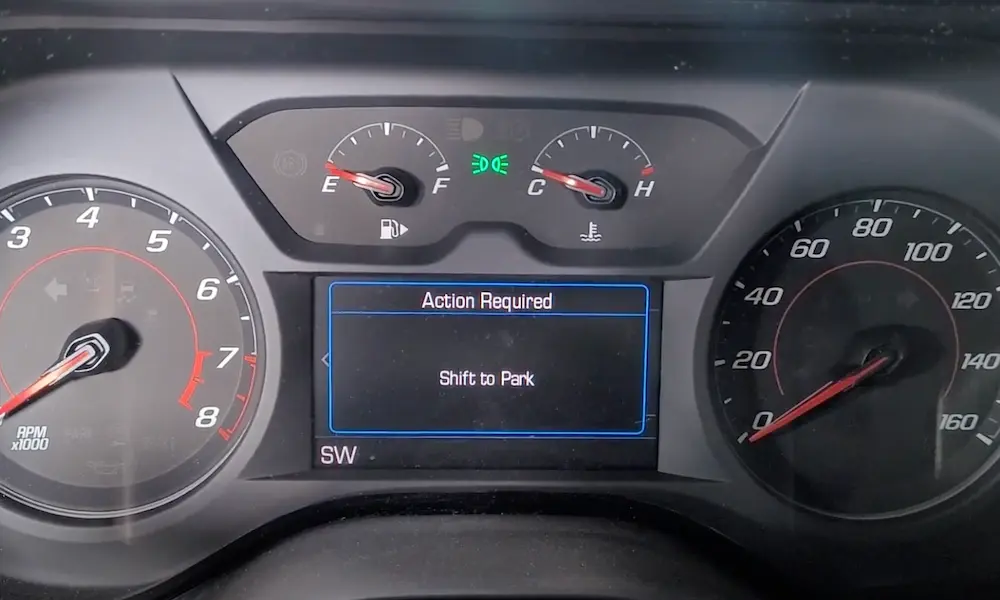
- Blank or dashed PRNDL display on the instrument cluster
- Service Traction Control and Service StabiliTrak warnings popping up
- Reduced Engine Power message limiting throttle response
- Stalling or rough idle when you try to shift
That cluster of traction and stability warnings shows up because those systems pull wheel speed data from the TCM. No TCM signal, no traction control — it’s all connected.
The transmission defaulting to maximum line pressure explains those brutal gear engagements. It’s a failsafe, not a mechanical failure. The system cranks up pressure to protect clutch packs from slipping — but it makes the ride feel like bumper cars.
The 4 Most Common Causes of Chevy U0101
Most U0101 faults aren’t the TCM’s fault. The problem usually lives in the wires, grounds, or power supply surrounding it. Here’s where to look:
1. Bad Battery or Unstable Voltage
A weak battery or a struggling alternator injects electrical noise into the CAN bus. That noise corrupts data packets, and the ECM interprets the silence as a missing TCM. A voltage drop of as little as 0.2V can knock a module off the network. Many “intermittent” U0101 codes disappear completely after a battery replacement.
2. Corroded or Loose Ground Points
Chevy trucks — especially Silverados — are notorious for ground point corrosion. Grounds like G106 and G107 are critical for TCM operation. Road salt, moisture, and time cause resistance to build up at these grounding points. High resistance means the TCM can’t maintain its CAN bus transceiver, and communication drops out.
3. Wiring Harness Rub-Through
This is a big one for 2014-2018 Silverados. The transmission harness can rub against sharp edges on the engine block or transmission case, wearing through the insulation over time. Once the CAN-High or CAN-Low wire shorts to ground or to each other, communication fails. GM’s own Technical Service Bulletin PIP4990C specifically flags this issue and tells techs to check the harness before touching the TEHCM.
4. Damaged or Corroded Connectors
Many Chevy transmissions use a flip-style locking latch on the main connector. If someone forced that connector during a previous repair, the internal pins get bent or the female terminals spread open. You get intermittent contact — fine in the driveway, dropping out on the highway. Fluid contamination or terminal corrosion makes this even worse.
TCM vs. TEHCM: Know What Your Chevy Has
Not all Chevys use the same setup. Knowing which type you have changes your diagnostic approach.
| Model | Transmission | TCM Location | Main U0101 Vulnerability |
|---|---|---|---|
| Silverado 2014-2018 | 6L80 / 6L90 | Inside transmission (TEHCM) | Harness rub, ground corrosion |
| Cruze 2011-2015 | 6T40 / 6T45 | Inside transmission (TEHCM) | Terminal spread, thermal failure |
| Malibu 2013-2018 | 6T40 / 6T70 | Inside transmission (TEHCM) | Connector contamination, fuse block |
| Spark 2014-2016 | CVT | Under dashboard | Power fuse, moisture intrusion |
| Older Silverado | 4L60E | External (PCM/TCM) | Exposed harness, relay failure |
The TEHCM (Transmission Electro-Hydraulic Control Module) combines the TCM, solenoids, and pressure switches into one unit submerged in transmission fluid. It’s smart technology, but it’s also sensitive to heat. Fluid temps can hit 250°F, which slowly damages internal circuit boards and solder joints.
The 2014 Chevy Spark CVT takes a different approach, with the TCM mounted under the left side of the dashboard. That protects it from heat but opens it up to moisture from cabin leaks.
How to Diagnose Chevy U0101 Step by Step
Work from the outside in. Check cheap and easy things first before you pull the transmission pan.
Step 1: Scan All Modules, Not Just the ECM
Connect a professional scan tool and run a full vehicle health check. Look at every module’s stored codes.
- If the ECM, BCM, and ABS all report U0101, the TCM is completely missing from the network. That points to a power or ground failure at the module itself.
- If only the ECM reports U0101, the issue might be a localized wiring break between those two modules specifically.
Step 2: Check Battery Voltage and Grounds
Grab a multimeter. Battery should read 12.0V–12.6V at rest. Load-test it too — a battery that looks fine sitting still can collapse under load. Then check your ground resistance to chassis. You want under 0.5 ohms. Anything higher and you’ve found your culprit.
Step 3: Test CAN Bus Resistance at the DLC
With the battery disconnected, measure resistance between Pin 6 (CAN-High) and Pin 14 (CAN-Low) at the Data Link Connector under the dash.
- 60 ohms = network healthy, both terminating resistors intact
- 120 ohms = one side of the network is broken, possibly at the TCM
- Open line / infinite resistance = severe wiring damage
Step 4: Check CAN Bus Voltage (Ignition On)
With the key in the on position, CAN-High should show ~2.6V and CAN-Low should show ~2.4V. If both lines read 0V or 12V, you’ve got a short to ground or power somewhere in the harness.
| Diagnostic Check | Tool Needed | Target Value |
|---|---|---|
| Battery voltage | Multimeter | 12.0V – 12.6V |
| Ground resistance | Multimeter | Under 0.5 ohms |
| CAN resistance (battery off) | Multimeter | 60 ohms |
| CAN-High voltage (key on) | Multimeter | ~2.6V |
| CAN-Low voltage (key on) | Multimeter | ~2.4V |
| Scan for supporting codes | Professional scan tool | Check all modules |
Step 5: The Bridge Test for TEHCM Isolation
If your Silverado or Cruze has a TEHCM and you suspect it’s the module itself, this test confirms it without pulling the whole transmission:
- Unplug the main transmission connector
- Use jumper wires to bridge the inbound CAN-High wire to the outbound CAN-High, and do the same for CAN-Low
- Turn the ignition on and rescan
If the communication codes for other modules disappear, the fault lives inside the transmission or at the connector pins — not in the external harness.
Replacing the TCM or TEHCM: What Comes After Installation
If you confirm the module itself is bad, swapping it in is only half the job. Chevy modules are VIN-locked and need proper programming before they’ll work.
Programming with SPS2 and Techline Connect
You’ll need a J2534 pass-thru device or an MDI2 interface plus a subscription to GM’s GlobalConnect to access Techline Connect and the SPS2 platform. The software pulls the VIN, downloads the correct calibration file from GM’s servers, and flashes the module.
Critical: Keep battery voltage above 12.5V during the entire flash process. A voltage drop mid-flash can permanently brick the module. Use a battery maintainer, not just a charger.
Adaptive Learn Procedure
Once the module is programmed, it doesn’t just “know” how your transmission feels. You need to run an Adaptive Learn or Fast Learn procedure with a scan tool. The TCM applies each clutch pack, measures engagement time, and calibrates itself to compensate for internal wear and manufacturing differences. Skip this step and you’ll have rough, inconsistent shifting even with a perfectly good module.
How to Prevent Chevy U0101 From Coming Back
A few simple habits keep this code from returning:
- Add protective sleeving to any harness that rubs near the engine block or transmission case, and reroute it away from the sharp edge that caused the original wear
- Apply dielectric grease to transmission connectors during any service — it blocks moisture and prevents terminal oxidation
- Change transmission fluid on schedule using Dexron-VI — degraded fluid gets acidic and conductive, which damages internal TEHCM electronics
- Check for TCM software updates periodically — GM releases calibration updates that improve the network’s tolerance to electrical noise and adjust timeout parameters that trigger U0101
The chevy U0101 code sounds scary, but the real answer is almost always in the wires, the grounds, or the battery — not the module itself. Start simple, test systematically, and you’ll find the break before spending a dime on parts you don’t need.