Picking the wrong transmission fluid for your GM truck or SUV can cost you thousands in repairs. If your vehicle runs a 10-speed automatic, you need to get this right. This post breaks down every approved DEXRON ULV equivalent, explains why viscosity matters more than you think, and flags the common mistakes that wreck modern transmissions.
What Is DEXRON ULV, and Why Does It Exist?
DEXRON ULV is General Motors’ ultra-low viscosity transmission fluid specification. GM introduced it in 2017 alongside the 10L80 and 10L90 10-speed transmissions.
The “why” is simple: fuel economy. Tighter CAFE standards pushed automakers to build transmissions with more gears, so engines spend more time in their sweet spot. More gears mean tighter hydraulic channels in the valve body. Thicker fluid can’t move fast enough through those channels, so engineers dropped the viscosity target to roughly 4.5 centistokes at 100°C.
That’s about 30% thinner than DEXRON VI, which runs at roughly 6.0 centistokes. That gap matters enormously.
How DEXRON ULV Compares to Other ATF Specs
Here’s a quick look at where ULV sits in the ATF family tree:
| Fluid Spec | Viscosity at 100°C | OEM | Introduced |
|---|---|---|---|
| DEXRON III (H) | ~7.5 cSt | GM | 2003 |
| MERCON V | ~7.5 cSt | Ford | 1997 |
| DEXRON VI | 5.8–6.0 cSt | GM | 2005 |
| MERCON LV | 6.0–6.4 cSt | Ford | 2008 |
| DEXRON HP | 5.7–5.9 cSt | GM | 2013 |
| DEXRON ULV | ~4.5 cSt | GM | 2017 |
| MERCON ULV | ~4.5 cSt | Ford | 2017 |
Notice that DEXRON ULV and MERCON ULV land at the same viscosity target. That’s no coincidence — GM and Ford co-developed the 10-speed platform together, and the 10L80 and 10R80 share nearly identical internal hardware.
Which Vehicles Actually Need DEXRON ULV?
DEXRON ULV is specifically for GM’s 10-speed longitudinal transmissions. Here’s where you’ll find them:
| Vehicle | Transmission | Fluid |
|---|---|---|
| Chevrolet Silverado 1500 (V8/Diesel) | 10L80 | DEXRON ULV |
| GMC Sierra 1500 (V8/Diesel) | 10L80 | DEXRON ULV |
| Chevrolet Silverado 2500/3500 HD | Allison 10L1000 | DEXRON ULV |
| Chevrolet Tahoe / Suburban | 10L80 | DEXRON ULV |
| GMC Yukon / Yukon XL | 10L80 | DEXRON ULV |
| Cadillac Escalade / Escalade ESV | 10L80 | DEXRON ULV |
| Chevrolet Camaro SS / ZL1 | 10L80 / 10L90 | DEXRON ULV |
The Best DEXRON ULV Equivalents You Can Buy
Every fluid on this list must be full synthetic. That’s not optional — the extreme performance demands of ULV specs can’t be met by conventional or semi-synthetic base oils.
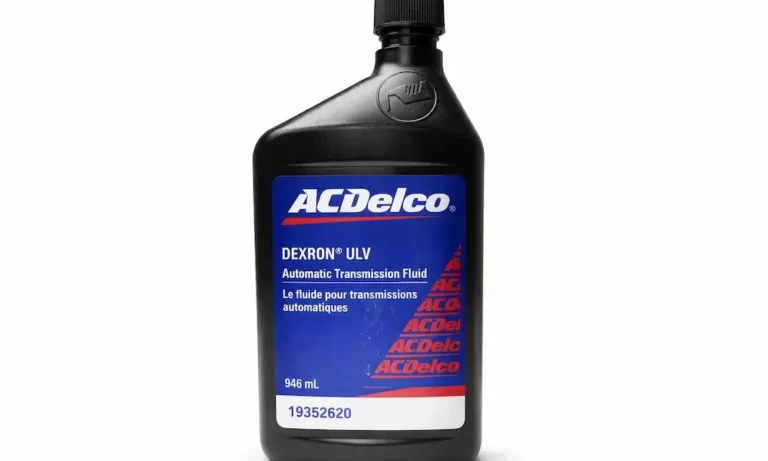
ACDelco DEXRON ULV (Part #10-4107)
This is the OEM fluid. It’s the safest pick for warranty compliance. Grab it at any GM dealership parts counter or through major retailers. If you’re not sure what else to use, start here.
Valvoline ULV ATF
Valvoline ULV ATF is a full-synthetic formulation with licensing for both DEXRON ULV and MERCON ULV. It’s built to handle leaks, wear, and heat degradation. Valvoline emphasizes consistent viscosity stability across temperature extremes, which is exactly what a 10-speed valve body demands. You’ll find it at AutoZone and O’Reilly Auto Parts.
AMSOIL Signature Series Fuel-Efficient Synthetic ATF
AMSOIL’s ULV entry is one of the more respected options among enthusiasts and heavy towers. Their Signature Series ULV ATF is specifically recommended for DEXRON ULV and MERCON ULV applications. The focus here is film strength — maintaining a protective layer between clutch surfaces even at ultra-thin viscosities under load. If you tow regularly, this one deserves a hard look.
Kendall VersaTrans ULV ATF
Kendall VersaTrans ULV is approved for MERCON ULV and recommended for GM DEXRON ULV applications. One important note from Kendall: this fluid is not for older transmissions requiring higher viscosity, and it’s absolutely not for CVTs. Use it only where ULV is explicitly required.
Transtar Multi-Vehicle ULV
Transtar’s Multi-Vehicle ULV covers DEXRON ULV, MERCON ULV, and AISIN AW-2 in one bottle. It also crosses over to Mercedes-Benz 236.15 and Nissan Matic P specs. Shops that service a wide variety of vehicles love this one for inventory simplicity.
Motul ATF ULV
Motul ATF ULV is a European-branded option that covers a wide range of American, Asian, and European vehicles specifying ULV-grade fluid. Motul highlights two specific wins: better cold-temperature response and measurable friction reduction at operating temperatures.
| Brand | Product Name | Certifications | Base |
|---|---|---|---|
| ACDelco | DEXRON ULV (10-4107) | DEXRON ULV | Full Synthetic |
| Valvoline | ULV ATF | DEXRON ULV, MERCON ULV | Full Synthetic |
| AMSOIL | Signature Series ULV | DEXRON ULV, MERCON ULV | Full Synthetic |
| Kendall | VersaTrans ULV | MERCON ULV / GM recommended | Full Synthetic |
| Transtar | Multi-Vehicle ULV | DEXRON ULV, MERCON ULV, AISIN AW-2 | Full Synthetic |
| Motul | ATF ULV | DEXRON ULV recommended apps | Full Synthetic |
The Mobil 1 Mix-Up That Catches People Off Guard
This one trips up a lot of owners. Mobil 1 makes a product called “Synthetic LV ATF HP.” The name sounds like it belongs in a 10-speed. It doesn’t.
That “HP” stands for DEXRON HP — a spec designed for GM’s 8-speed transmissions, not the 10-speed. It runs thicker than ULV. Don’t put it in your 10L80. Standard Mobil 1 Synthetic ATF and Mobil Multi-Vehicle ATF are for older DEXRON III and MERCON V applications — they’re even further off.
Always check the label for an explicit DEXRON ULV (GMW16444) or MERCON ULV (WSS-M2C949-A) listing.
What Happens If You Use the Wrong Fluid
Using DEXRON VI in a 10L80 isn’t a “good enough” workaround. Here’s what actually happens:
- Shift flares: Thicker fluid reaches clutch pistons too slowly. The engine revs between gear changes — a condition technicians call a “flare.”
- Solenoid stress: Solenoids fight harder to push a more viscous fluid, which accelerates wear and can trigger electrical failures.
- Localized overheating: ULV fluids carry heat away efficiently. Thicker fluids can get trapped in tight clearances and create hot spots.
And here’s the bigger picture: unlike DEXRON III, which was broadly backward compatible, DEXRON ULV is not backward compatible with older transmissions. The chemistry and viscosity targets are genuinely different generations of fluid.
The 9-Speed Trap: Don’t Assume More Gears Means ULV
Here’s where people get confused: GM’s 9-speed transverse transmissions (the 9T45, 9T50, 9T65) share development history with Ford’s 9-speed units. But GM officially specifies DEXRON VI for most of those applications — not DEXRON ULV.
| GM Transmission | RPO Code | Fluid |
|---|---|---|
| 6T40 / 6T45 | MNH, MH8 | DEXRON VI |
| 8L80 / 8L90 | MFC, N8X, MTH | DEXRON HP |
| 9T45 / 9T50 / 9T65 | M3F, M3H, M3V | DEXRON VI |
| 10L80 / 10L90 | MQB, MQC, MHS | DEXRON ULV |
| 10L1000 (Allison) | MKM, MGM | DEXRON ULV |
The fix is simple: check the RPO code on the sticker in your glovebox or door jamb. Cross-reference it with the GM TechLink transmission fluid capacities guide. Don’t guess based on gear count.
Common 10-Speed Failure Modes and Why Fluid Quality Matters
CDF Drum Sleeve Movement
One of the most documented internal failures in the 10L80 and 10R80 is an internal clutch drum sleeve shifting out of position. When it moves, it blocks hydraulic ports that control clutch engagement. Ford issued a technical service bulletin addressing harsh or delayed engagement in the 10R80 tied to this issue. Using a thermally stable ULV fluid helps the hydraulic system maintain consistent pressure and reduces the severity of the problem.
Torque Converter Shudder
TCC shudder feels like driving over a rumble strip during light acceleration. It’s caused by friction modifier breakdown in the fluid — the torque converter’s lockup clutch starts microscopically slipping and sticking. Brands like Valvoline and AMSOIL specifically formulate their ULV fluids with friction modifiers designed to prevent this over tens of thousands of miles.
Outer Shell Wear
The outer transmission shell, which houses several clutch assemblies, develops grooves where clutch plates interact with it over time. Depleted anti-wear additives or improper fluid viscosity accelerate this process. In severe cases, the shell can split entirely. Fresh, correctly-spec’d ULV fluid keeps those anti-wear packages active.
Service Tips to Protect Your Investment
Change Intervals for Severe Use
GM may call it “lifetime fluid,” but lubrication experts disagree — especially if you tow, haul, or drive in stop-and-go traffic. Under severe service conditions, a fluid change every 30,000 to 50,000 miles is smart maintenance.
Always Run the Service Fast Learn After a Fluid Change
Your transmission control module learns shift timing based on your old fluid’s friction characteristics. When you put in fresh fluid, the TCM needs a “Service Fast Learn” or “Adaptive Learn” reset to relearn smooth shift timing. Skipping this step causes harsh shifts with perfectly good new fluid.
Watch Your Transmission Temperature
When temps exceed 210–220°F, ULV fluid oxidizes quickly. If you tow heavy loads regularly, a larger transmission cooler or a deep-sump pan adds fluid capacity and keeps temps in check.
Quick Checklist: Choosing the Right DEXRON ULV Equivalent
Before you buy, run through this list:
- ✅ Label explicitly states DEXRON ULV or covers GMW16444
- ✅ Viscosity is approximately 4.5 cSt at 100°C
- ✅ Full synthetic base oil only
- ✅ Not a generic “multi-vehicle” fluid unless ULV is listed by name
- ❌ Not DEXRON VI, DEXRON HP, or MERCON LV
- ❌ Not Mobil 1 LV ATF HP (that’s DEXRON HP for 8-speeds)
The bottom line: DEXRON ULV isn’t interchangeable with older ATF specs, and the right equivalent needs explicit certification — not just a similar-sounding name. Stick to licensed products from ACDelco, Valvoline, AMSOIL, Kendall, Transtar, or Motul, verify your RPO code, and reset your TCM after every service.