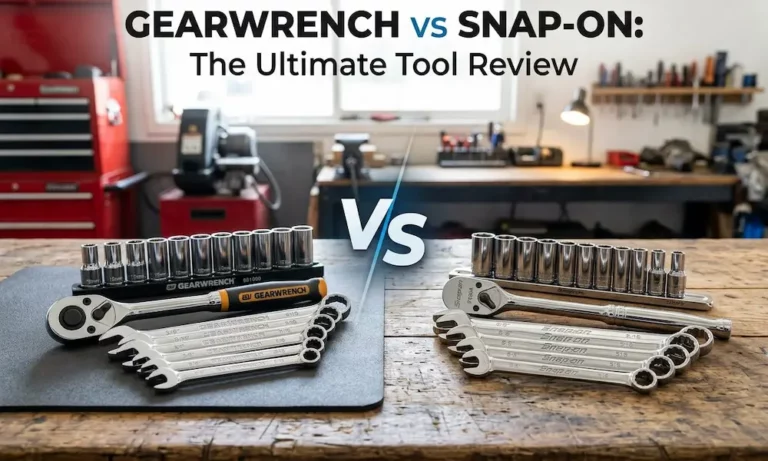
Choosing between GearWrench and Snap-on isn’t simple. One costs a small fortune, the other won’t empty your wallet. But is the price difference justified? This breakdown cuts through the brand loyalty noise and gives you the real answer. Stick around — your next tool purchase depends on it.
The Short Version: What Each Brand Actually Is
Before you compare tools, you need to understand what you’re actually buying into.
Snap-on started in 1920 with a revolutionary idea — interchangeable sockets. That single concept built a company now worth nearly $5 billion. Today, Snap-on operates across 130+ countries with over 85,000 products and roughly 13,000 employees.
GearWrench launched in 1996 under the Apex Tool Group with one job: solve the tight-space problem. Their patented 5-degree ratcheting wrench sold over 100 million units in six years. That’s not luck — that’s a real problem solved well.
| Feature | Snap-on | GearWrench |
|---|---|---|
| Founded | 1920 | 1996 |
| Revenue | ~$4.7–5B | ~$1.3B (parent company) |
| Ownership | Public (NYSE: SNA) | Private Equity (Bain Capital) |
| HQ | Kenosha, WI | Huntersville, NC |
| Signature Innovation | Interchangeable Sockets | 5-Degree Ratcheting Wrench |
How You Buy Them Is Just as Important as What You’re Buying
This is the biggest difference most people overlook in the GearWrench vs Snap-on debate.
Snap-on uses nearly 4,600 franchised tool trucks that drive directly to your shop. Your franchisee shows up weekly, replaces broken tools on the spot, and even extends you credit. It’s a mobile store, a warranty center, and a bank rolled into one visit.
GearWrench sells through Amazon, Home Depot, Advance Auto, and industrial distributors. You shop when you want, pay upfront, and you’re done. No relationship required.
The trade-off? Snap-on’s convenience and service are baked into the price — and you’re definitely paying for them. GearWrench positions itself as a “MEGA value” alternative, letting you buy a full master set for what you’d pay for an empty Snap-on cabinet.
Warranty experience highlights the gap clearly:
- Snap-on: Broken tool? Your guy swaps it on his next visit. Done.
- GearWrench: Submit a photo through their EZ Warranty portal, skip the mail-in hassle, but still wait for shipping.
Both warranties are solid. One just fits better into your workday.
Ratchet Mechanics: Where the Real Engineering Battle Happens
When pros argue GearWrench vs Snap-on, ratchets are the main event. Both brands pour serious engineering into their ratcheting systems, and the differences are measurable.
Snap-on Dual 80
Snap-on’s Dual 80 system uses an 80-tooth gear with a dual-pawl mechanism. Multiple teeth engage at once, spreading the load and reducing internal wear. The result is a 4.5-degree swing arc and an exceptionally smooth, quiet action that pros describe as the best feel on the market.
GearWrench 120XP
GearWrench counters with double-stacked 60-tooth pawls that create 120 ratcheting positions and a 3-degree swing arc. In a cramped modern engine bay where you’ve got centimeters of clearance, that extra resolution matters.
| Ratchet Spec | Snap-on Dual 80 | GearWrench 120XP |
|---|---|---|
| Positions | 80 | 120 |
| Swing Arc | 4.5° | 3° |
| Mechanism | Dual-Pawl | Double-Stacked 60-Tooth Pawls |
| Origin | USA | Taiwan |
| Serviceability | User-rebuildable | Complex, replacement often easier |
| Backdrag | Very low | Can be slightly higher |
One real-world issue: backdrag. High backdrag means the ratchet spins a loose fastener in circles instead of clicking past it. Snap-on ratchets earn consistent praise for minimal backdrag thanks to precise machining. Some 120XP users report slightly more resistance — not a dealbreaker, but worth knowing before you buy.
Snap-on ratchets are also designed to be user-rebuilt with available repair kits. A GearWrench’s lower price point makes replacement more practical than rebuilding — two totally different philosophies on tool longevity.
Wrench Design: Grip Technology and Ergonomics
Snap-on Flank Drive Plus
Snap-on’s Flank Drive Plus features serrations machined into the open end. These teeth bite the flat sides of the bolt — not the corners — so you get a stronger grip on rounded or rusted fasteners. Independent tests consistently rate it as the industry leader for breaking stubborn bolts without slipping.
One note: aviation techs report that the aggressive teeth can mar delicate aerospace fasteners. Right tool, right job — always.
GearWrench X-Beam
GearWrench’s answer to fatigue is the X-Beam design — a handle twisted 90 degrees so your palm presses against a wide, flat surface instead of a narrow edge. They claim up to 500% more contact area, which genuinely reduces hand strain during long shifts. Techs call them “fantastically comfortable” for high-torque work. The downside: the bulkier handle can be harder to maneuver in very tight spots.
| Wrench Feature | Snap-on Flank Drive Plus | GearWrench X-Beam |
|---|---|---|
| Open-End Grip | Serrated teeth grip flanks | Smooth, off-corner loading |
| Handle Shape | Standard flat/long pattern | 90° twisted ergonomic handle |
| Best For | Damaged/rusted fasteners | High-torque long shifts |
| Fastener Contact | Sides/flanks | Off-corners |
Steel Matters: What’s Inside Your Tools
Both brands use the same two alloy families. The difference is in how they’re applied and processed.
Chromium Vanadium (Cr-V) goes into hand ratchets, wrenches, and non-impact sockets. Chromium boosts strength and corrosion resistance. Vanadium refines the grain structure so the steel can be hardened without becoming brittle. Both brands finish these tools in mirror chrome for extra corrosion protection and easy cleaning.
Chromium Molybdenum (Cr-Mo) goes into impact sockets. Molybdenum adds toughness — the socket flexes microscopically with each impact blow instead of cracking. That’s why impact sockets are thicker and finished in matte black manganese phosphate, not chrome. Chrome flakes under impact vibration.
| Steel Type | Best For | Key Property | Typical Finish |
|---|---|---|---|
| Cr-V | Hand tools, wrenches | Hard, wear-resistant | Mirror chrome |
| Cr-Mo | Impact sockets | Tough, shock-resistant | Black oxide/phosphate |
Snap-on’s vertical manufacturing integration means they control heat treatment in-house — every step from raw alloy to finished tool. GearWrench, through Apex Tool Group’s industrial manufacturing, runs sophisticated processes too, though batch consistency can vary slightly more.
Solving Tight Spaces: Pass-Thru vs. Low Profile
Both brands tackled the cramped engine bay problem. They went completely different directions.
GearWrench Pass-Thru System
The Pass-Thru socket is hollow. Threaded bolts pass straight through the socket and ratchet head — no deep-well socket needed, no length limit. The system is 50% thinner and 40% stronger than standard ratchet-and-socket combos because it eliminates the drive tang (traditionally the weakest point). For long studs or shock absorber nuts, it’s genuinely a job-saving tool with no equivalent in standard square-drive setups.
The catch: it requires a dedicated Pass-Thru handle. You can’t mix it with your existing extensions or ratchets.
Snap-on Low Profile Sockets
Snap-on’s approach keeps standard square-drive compatibility intact. Short socket bodies paired with slim-head ratchets clear most tight spaces without requiring you to switch systems. The flexibility of using your existing extensions and adapters is a real daily-use advantage.
The limit: you’re still capped by socket depth. The GearWrench Pass-Thru has no such ceiling.
The Money Reality: Who Should Buy What
The GearWrench vs Snap-on decision tracks closely with where you are in your career. Most experienced mechanics don’t pick one brand — they build a hybrid toolbox.
| Career Stage | Smart Move | Why |
|---|---|---|
| Student/Apprentice | GearWrench master sets | Max piece count, minimum spend |
| Junior Tech | Snap-on ratchets + GearWrench sockets | Invest where daily feel matters most |
| Established Pro | Selective Snap-on Flank Drive upgrades | Prioritize slip prevention on core tools |
| Diesel/Aero Specialist | Tool truck for precision specialty tools | Torque and access demands justify the cost |
Snap-on’s Student Excellence Program (SEP) offers up to 50% off for apprentices — worth knowing if you’re just starting out.
The tool truck’s weekly credit model lets you pay off big purchases in small installments. Convenient, yes. But that premium price already builds in the service cost — so you’re financing the experience, not just the steel.
Real-World Performance: Does the Price Gap Hold Up?
Lab torque tests show GearWrench consistently meeting or exceeding the strength of truck brands for their price point. In some high-tooth-count ratchet tests, GearWrench units handle higher ultimate loads than pricier competitors.
Where Snap-on pulls ahead is usability under load — mechanism slop, handle deflection, and how precisely the tool fits the fastener. The Flank Drive Plus open end is less likely to spread or slip under heavy torque, which is exactly what separates a successful repair from a stripped bolt on a rusted chassis.
For diesel and heavy equipment work, Snap-on’s mass and precision are often treated as requirements, not upgrades. For general automotive repair — tight spaces, speed, and everyday sockets — GearWrench’s 120XP and Pass-Thru system earn their place in serious shop toolboxes.
The smartest move isn’t brand loyalty. It’s matching the right tool to the right job — and spending your money where it actually changes your work.