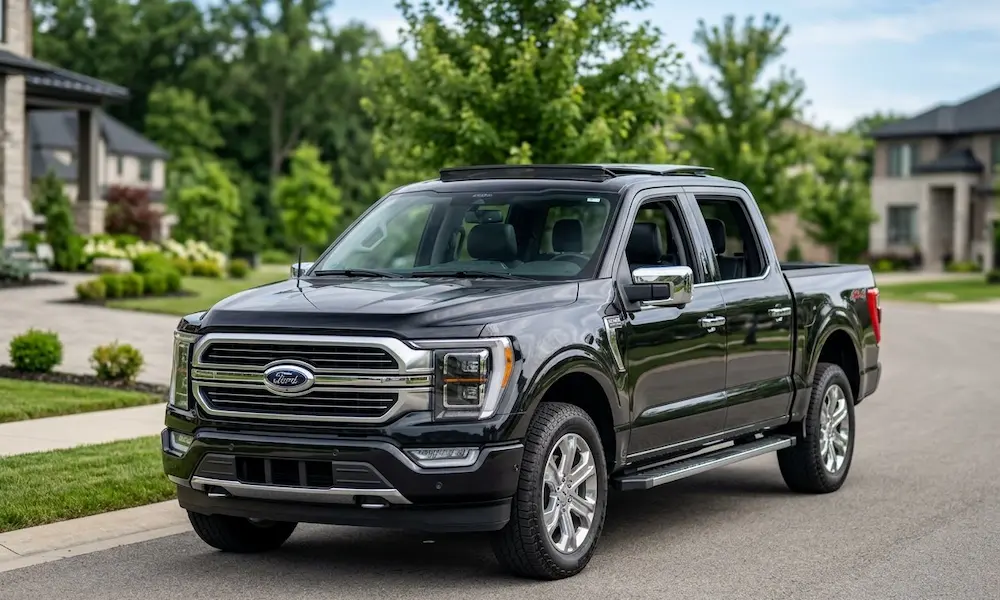
You’re shopping for a Ford F350 diesel and want straight answers about fuel economy. Here’s the reality: you won’t find an EPA sticker, and dealer claims are often wildly optimistic. This guide breaks down real-world ford f350 diesel gas mileage based on actual road tests and owner data—so you know exactly what to expect before you buy.
Why Your F-350 Doesn’t Have an EPA Rating
Let’s clear up the confusion right away. The F350 doesn’t get an official EPA fuel economy rating, and it’s not because Ford is hiding anything.
The cutoff is simple: vehicles with a Gross Vehicle Weight Rating (GVWR) over 8,500 pounds are exempt from the consumer-facing MPG labels you see on cars and light-duty trucks. Your F350? It typically weighs between 10,000 and 14,000 pounds GVWR, putting it firmly in heavy-duty territory.
This exemption makes sense when you think about it. A family sedan’s fuel economy is predictable. An F350’s? It depends entirely on whether you’re cruising empty on the highway or hauling 25,000 pounds up a mountain pass. A single “combined MPG” number would be useless—and misleading.
Instead of MPG stickers, heavy-duty trucks follow greenhouse gas regulations measured in grams per ton-mile. That’s great for environmental policy, but it doesn’t tell you what you’ll see at the pump.
Here’s where it gets sketchy: some dealers fill this information void with made-up numbers. One 2024 F350 dealer listing claimed “15 city/21 highway” as an “EPA-estimated” rating. That’s fiction. Edmunds confirms the F350 is “Not EPA Tested,” and those dealer numbers exceed even the best professional road tests.
Don’t trust dealer brochures. Trust real-world data.
Real-World Highway MPG: The Best-Case Scenario
When automotive journalists test the ford f350 diesel gas mileage, they’re giving you the truck’s absolute best performance—steady highway speeds, no cargo, ideal conditions.
Car and Driver tested a 2023 Super Duty with the 6.7L Power Stroke on their 75-mph highway loop and hit 20 MPG. That’s impressive for an 8,000-pound truck.
Autoweb saw similar results, averaging 19 MPG during their 2024 F-350 test with the High-Output diesel.
The most interesting test? TFL Truck drove a 2023 F-350 Dually from Detroit to Denver—685 miles at interstate speeds—and recorded 17.6 MPG. That’s remarkable for a dual-rear-wheel truck, which has significantly more rolling resistance than a single-rear-wheel setup.
What this means for you: If you’re planning a cross-country trip with an empty bed, 18-20 MPG is realistic in a single-rear-wheel F350. Dually owners should expect 16-18 MPG.
But here’s the catch: that’s not your daily average.
Daily Driving: What Owners Actually See
Professional tests happen on highways. You live in the real world—with traffic lights, cold starts, idling, and diesel particulate filter regeneration cycles.
Owner-reported data tells a different story. Fuelly, which aggregates data from 71 F-350 owners, shows a combined average of 14.1 MPG. MotorWeek averaged 15 MPG in mixed driving.
Reddit threads and forums confirm this range. One 2018 F-350 owner reported “14.9 average” over thousands of miles. Another noted “19-20 MPG on the highway, down to 13 MPG city.”
Why the 4-6 MPG drop from highway tests? Diesel engines hate short trips and idling. Your DPF regeneration cycle (which burns extra fuel to clean the exhaust filter) can happen every 200-400 miles. One expert noted that idling for just one hour is equivalent to driving 25 miles in fuel consumption.
Your realistic expectation: 14-16 MPG for daily mixed driving is where most F350 diesel owners land.
Towing: Where Fuel Economy Takes a Dive
Here’s where the F350 earns its keep—and burns through diesel doing it.
The ford f350 diesel gas mileage under load isn’t just about weight. It’s about aerodynamics and speed. Pushing a tall, flat-fronted trailer through the wind at 75 mph destroys efficiency.
One owner towing a 17,000-pound trailer at 75 mph reported 7-8 MPG. Another owner towing a 13,000-pound fifth wheel at 55 mph? Just over 12 MPG.
That 4-5 MPG difference isn’t about trailer weight—it’s about speed. Aerodynamic drag increases exponentially. Slowing from 75 to 55 mph can nearly double your towing fuel economy.
For heavy haulers, the numbers get brutal. One F350 owner reported 11-13 MPG towing 23,000-26,000 pounds, but that’s likely at moderate speeds. Push that same load to 75 mph, and you’re looking at single digits.
Towing fuel economy breakdown:
- Light trailers (under 10,000 lbs): 11-13 MPG
- Mid-weight (10,000-18,000 lbs): 9-12 MPG
- Heavy loads (20,000+ lbs): 7-10 MPG
Speed matters more than weight. Drive 55-60 mph instead of 75 mph, and you’ll save a fortune.
Standard vs. High-Output: Does It Matter?
Since 2023, Ford offers two versions of the 6.7L Power Stroke: the Standard Output (475 hp, 1,050 lb-ft) and High-Output (500 hp, 1,200 lb-ft).
Will the High-Output kill your fuel economy? Not if you’re driving unloaded.
The engines share identical tuning—boost pressure, injection timing, everything—until you demand power beyond the Standard Output’s limits. During highway cruising, both engines operate identically, meaning fuel economy differences are negligible.
You’ll only see a difference when towing heavy loads at high speeds, where the High-Output engine is working harder. For daily driving and light towing, save your money and stick with the Standard Output.
Configuration Choices That Impact MPG
Every option you tick on the order sheet affects your long-term fuel costs. Some differences are minor. Others add up fast.
4×2 vs. 4×4: The Permanent Penalty
A 4×4 drivetrain adds weight and complexity—front differential, transfer case, extra driveshafts. Even when you’re not using four-wheel drive, these components create parasitic drag.
The result? You’ll lose about 1 MPG consistently compared to an identical 4×2 truck. Engaging 4×4 when you need it costs another 1-2 MPG.
Most buyers accept this trade-off for all-weather capability, but if you live in a warm climate and rarely leave pavement, a 4×2 is the efficiency winner.
Single vs. Dual Rear Wheels: Stability Over Efficiency
Dually trucks add two extra tires, which means more rolling resistance and weight. Older data suggested a 5 MPG penalty, but the modern 10-speed transmission has narrowed that gap.
The TFL Truck test proving a dually can achieve 17.6 MPG highway shows the penalty is now closer to 1-2 MPG in mixed driving compared to a single-rear-wheel truck.
If you’re towing over 18,000 pounds regularly, the dually’s stability and safety advantages far outweigh the modest fuel penalty. If you’re not? Stick with SRW and save the weight.
Axle Ratio: The Towing vs. Efficiency Trade-Off
Axle ratios are where things get technical, but the concept is simple: numerically lower ratios (like 3.31) favor highway efficiency, while higher ratios (like 4.10) favor towing grunt.
Here’s the good news: the 10-speed automatic transmission (standard since 2020) has completely changed this equation.
The 10-speed’s wide gear range compensates for a “tall” 3.31 axle, giving you strong low-end performance even with the efficiency-focused gearing. One 2024 owner with a 3.31 axle tows 14,000 pounds with “no issues,” and the difference between 3.31 and 3.55 with the 10-speed is “so minute.”
The real penalty hits when you jump to a 4.10 or 4.30 axle (common on dually models). You’ll gain maximum towing capacity but sacrifice 1-2+ MPG on unloaded driving.
Quick reference:
| Axle Ratio | Best For | Unloaded Highway MPG | Towing Performance |
|---|---|---|---|
| 3.31 | Maximum efficiency, light towing | Best (18-20 MPG possible) | Good with 10-speed |
| 3.55 | All-around balance | Negligible loss vs. 3.31 | Excellent |
| 4.10/4.30 | Max towing, heavy hauling | 1-2+ MPG penalty | Best |
For most buyers, the 3.55 is the sweet spot.
Used Market: Power Stroke Generations Explained
Shopping used? The engine generation matters more than the model year for ford f350 diesel gas mileage.
7.3L Power Stroke (1994.5-2003): The Legend
This pre-emissions engine is bulletproof and simple. Real-world MPG sits around 12-16 MPG, which is respectable for a truck this old. Watch out for wild claims of 20-30 MPG—those come from modified engines in lighter trucks, not stock F350s.
6.0L Power Stroke (2003.5-2007): Good MPG, Expensive Repairs
Owners report 15-17 MPG combined, which rivals modern diesels. But this engine has well-documented reliability issues. Unless it’s been “bulletproofed” (expensive), maintenance costs will erase any fuel savings.
6.4L Power Stroke (2008-2010): Avoid This One
This is the engine to skip. Ford’s first DPF-equipped diesel has an aggressive regeneration cycle that destroys fuel economy. Owners report 10-12 MPG stock, with frequent DPF problems.
The only way to achieve decent MPG (14-18 range) is an emissions delete and tune—which is illegal for on-road use under the Clean Air Act. Don’t buy a 6.4L unless you enjoy pain.
6.7L Power Stroke (2011-Present): The Modern Standard
This is the engine you want. Reliable (especially 2015+), efficient, and proven. Expect 14-16 MPG combined, with 18-20 MPG possible on highway trips.
Early versions (2011-2014) had some teething issues, but 2015+ trucks are rock-solid.
Diesel vs. Gas: The $10,000 Question
The 6.7L diesel costs $9,000-$13,000 more than the 7.3L “Godzilla” gas V8. Is it worth it?
It depends entirely on how much you tow.
Unloaded driving:
- 6.7L Diesel: 14-16 MPG mixed
- 7.3L Gas: 10-14 MPG mixed
The diesel wins, but only by 2-4 MPG. At current fuel prices, you’d need to drive 100,000+ miles just to break even on the upfront cost.
Towing heavy loads:
- 6.7L Diesel: 9-12 MPG
- 7.3L Gas: 5-8.5 MPG
Here’s where the diesel dominates. It delivers nearly double the towing fuel economy.
If you tow a fifth-wheel trailer 20,000 miles per year, the diesel pays for itself in 3-4 years. If you tow twice a year for weekend trips? Stick with the gas engine and pocket the savings.
The diesel also has higher maintenance costs—DEF fluid, two batteries, expensive fuel filters, and larger oil capacity. Factor that into your math.
What to Expect: Real-World MPG Matrix
Here’s your cheat sheet for ford f350 diesel gas mileage based on how you’ll actually use the truck.
| Driving Condition | SRW (Single Rear Wheel) | DRW (Dual Rear Wheel) |
|---|---|---|
| Highway (unloaded) | 18-20 MPG | 16-18 MPG |
| City (unloaded) | 13-15 MPG | 12-14 MPG |
| Mixed (unloaded) | 14-16 MPG | 13-15 MPG |
| Towing under 10,000 lbs | 11-13 MPG | 11-13 MPG |
| Towing 10,000-18,000 lbs | 9-12 MPG | 9-12 MPG |
| Towing 20,000+ lbs | 8-11 MPG | 8-11 MPG |
Your mileage will vary (literally) based on speed, terrain, and driving style. But these numbers represent real-world averages from thousands of miles of owner data and professional testing.
The Bottom Line: Match the Truck to Your Needs
The ford f350 diesel gas mileage isn’t a single number—it’s a spectrum based on how you configure and use the truck.
For maximum efficiency: Choose a 4×2 SRW with a 3.31 axle ratio. You’ll sacrifice some capability, but you’ll see the best possible fuel economy.
For all-around versatility: A 4×4 SRW with a 3.55 axle hits the sweet spot between efficiency and towing confidence.
For serious hauling: Accept that a DRW with a 4.10 axle will cost you 1-2 MPG, but it’s the price of stability and safety when towing 20,000+ pounds.
And remember: speed kills MPG when towing. Drop from 75 to 60 mph, and you’ll save hundreds of dollars per year in fuel costs.
Don’t chase unrealistic dealer claims or EPA ratings that don’t exist. Use real-world data, configure your truck for your actual needs, and you’ll know exactly what to expect every time you fill up.