Finding your Ford PCM calibration number shouldn’t feel like solving a riddle. But between faded stickers, cramped engine bays, and confusing code formats, it often does. This guide cuts through the confusion and shows you exactly where to look — and what you’re looking at when you find it.
What Is a Ford PCM Calibration Number?
Your Ford’s Powertrain Control Module (PCM) is the brain running your engine, transmission, and emissions systems. The calibration number is essentially the software version ID — it tells technicians, parts suppliers, and emissions testers exactly what software strategy your module is running.
Get the wrong calibration, and you could end up with a failed emissions test, a misfiring engine, or a module that flat-out refuses to work.
There’s not just one code to know about. Ford uses several overlapping identifiers, and they all serve different purposes.
The Different Types of Ford PCM Calibration Codes
Before you go hunting for stickers, you need to know what you’re looking for. Ford’s EEC-V calibration system uses multiple code types on the same label. Here’s how they break down:
| Code Type | Format Example | What It Tells You |
|---|---|---|
| Engineering Part Number | XC3F-12A650-BB | Hardware + software revision |
| Tear Tag (Catch Code) | NVK0, VVQ2 | Specific software family/strategy |
| DPC Number (Diesel) | DPC-422 | Circuit board type for 7.3L trucks |
| Calibration Number | 7-10B | Emissions and performance tune ID |
| Hardware ID | BT4A-12B684-DA | Physical module classification |
The Engineering Part Number
Every Ford PCM carries the base code 12A650 at its core. The full number looks something like XC3F-12A650-BB, where:
- The prefix (XC3F) identifies the truck platform and model year
- 12A650 identifies the part type as a powertrain control module
- The suffix (BB, BC, BD) tracks software revisions
As Ford refines calibrations through updates, that suffix advances — same hardware, different internal software.
The Tear Tag (Catch Code)
This is the one tuners and technicians care about most. The Tear Tag is a short four-character code — three letters and one number, like NVK0 or VVQ2. The letters identify the software strategy family. The number tracks the revision.
The name comes from Ford’s old manufacturing process, where labels had a perforated section that workers tore off and stapled to assembly documentation. These codes are typically printed in the largest font on the module’s main sticker.
DPC Numbers for Diesel Trucks
If you’re working on a 7.3L Powerstroke, you’ll run into DPC numbers. These three-digit codes (202 through 492) identify the internal circuit board layout. They determine whether your module supports an automatic or manual transmission and what emissions configuration it’s wired for. Getting this wrong means the replacement module simply won’t work.
Where to Find the Ford PCM Calibration Number on Your Vehicle
Now for the part you actually came here for. Ford put these codes in several places, and the right spot depends on your model year and vehicle type.
Location 1: The Driver’s Door Jamb Label
This is your first stop for any Ford built after January 18, 1999. Open the driver’s door and look at the Safety Compliance Certification Label on the door jamb or B-pillar.
Find the field marked “SPR” (Spring). Your calibration number sits in the bottom right corner of the label, directly to the right of the SPR characters. It’s typically four to seven characters long.
This is the fastest, easiest lookup method — no tools, no crawling under the dash.
Location 2: The Physical PCM Module
Sometimes the door label is missing, damaged, or just not detailed enough. Going directly to the module is your next move. Where you’ll find it depends on your vehicle:
| Vehicle | Year Range | Module Location | Access Notes |
|---|---|---|---|
| F-150 | 2004+ | Passenger side firewall | Remove plastic cover |
| F-250/F-350/F-450 | 2004+ | Passenger side firewall | May need to unbolt module to see rear label |
| 7.3L Powerstroke (OBS) | 1994.5–1997 | Left side firewall, engine bay | Check connector end of housing |
| 7.3L Powerstroke (Super Duty) | 1999–2003 | Rear of engine bay, left side | Label near harness connector |
| Mustang | 2003–2004 | Passenger door jamb or kick panel | Remove kick panel if sticker missing |
| Mustang | 2005–2009 | Under hood, passenger side near fuse box | Silver box, direct visibility |
| Mustang | 2010+ | Silver bracket near fuse box | Sticker may be on bracket, not module |
| Ford Escape | 2013+ | Varies by engine | 1.6L: wheel well liner; 1.5L EcoBoost: engine mount |
| Ford Edge | 2007–2010 | Engine compartment | Visible on silver housing |
Quick tip for Super Duty owners: On the F-250 and F-350, the calibration label sometimes faces the firewall. You’ll need to unbolt the module and rotate it to read the sticker. A phone camera makes this a lot easier than trying to read it by feel.
For 7.3L Powerstroke owners, finding the PCM code on the older body style trucks requires checking the connector end of the module housing, which pokes through the firewall into the engine bay. Heat and vibration beat up these labels, so have a backup plan ready.
Location 3: Supplemental and Specialty Stickers
Some older Fords spread the calibration data across multiple locations. Before 1999, Ford used Emission Calibration Labels that could appear in several spots:
- Driver’s door jamb
- Passenger’s door jamb
- Under the hood on the shock tower
- Inside the trunk or under the hatch lid
For the 2003–2004 Mustang specifically, check the passenger side door jamb for a rectangular white sticker carrying the Tear Tag. If that sticker’s gone, pull the passenger kick panel under the dash.
If you have a truck or SUV with a trailer package, there’s also a dedicated trailer calibration sticker. It’s usually on the driver’s door jamb or inside the glove box and carries brake controller gain and sway control settings specific to your truck’s configuration.
Reading the Calibration Number Electronically
Physical labels fade, peel, and get covered in grease. For 2021 and newer Ford vehicles, stickers are increasingly absent altogether. Electronic identification is now the professional standard.
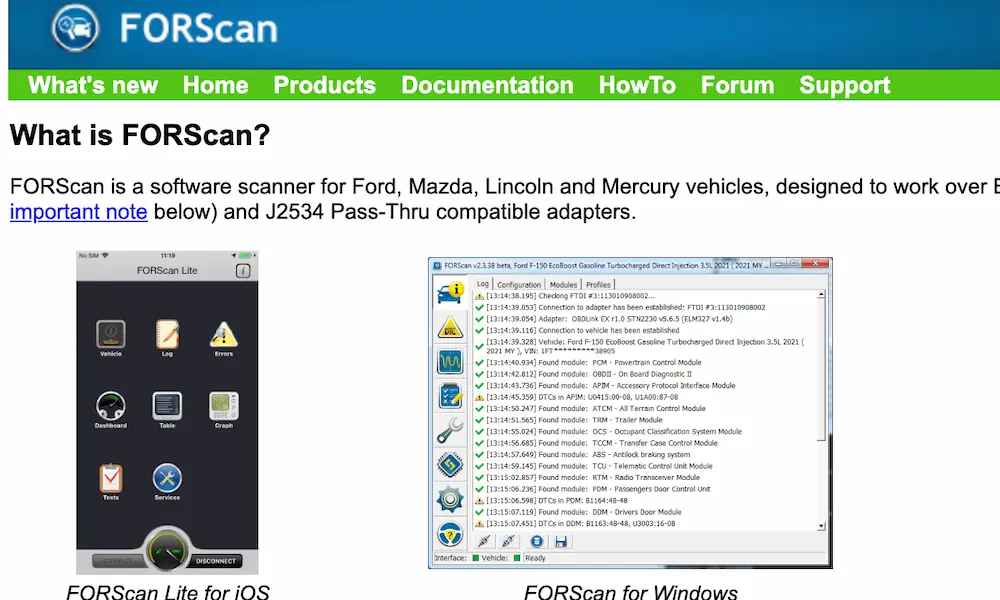
Using an OBD-II Scan Tool
Plug a scan tool into the OBD-II port under the steering column. Turn the ignition to “On” without starting the engine. Navigate to the Vehicle Info or Module ID screen. On newer models, you’re looking for these identifiers:
- ECU Strategy — the software roadmap
- ECU Strategy SWPN — the software part number
- PCM Filename — the specific digital file loaded into the module
- Calibration ID — the alphanumeric emissions and performance tune identifier
If the electronic strategy and the physical label don’t match, trust the electronic readout. It reflects whatever calibration is actually running right now — which might have changed during a previous service visit or recall.
Using As-Built Data
If the module is unresponsive or the label is unreadable, use the vehicle’s VIN. Ford’s service portals let technicians pull the original factory programming configuration for any VIN. This gives you the software code the vehicle shipped with, which is your baseline for ordering the correct replacement.
| Step | Action | Tool Needed | What You Get |
|---|---|---|---|
| 1 | Inspect physical sticker | Flashlight or phone camera | Part number + Tear Tag |
| 2 | Check door jamb label | None | Emissions calibration ID |
| 3 | Electronic scan | OBD-II scan tool | Active software strategy |
| 4 | VIN lookup | Motorcraft or Ford portal | Original factory software code |
| 5 | Cross-reference TSBs | Ford TSB database | Any superseded calibration numbers |
Why the Calibration Number Matters Beyond Parts Ordering
Emissions Testing
State emissions inspectors don’t just check for a lit check engine light. The testing equipment reads your calibration ID directly and verifies it against the vehicle’s approved emissions profile. A module with the wrong Tear Tag fails inspection — even with zero trouble codes.
Recalls and Software Updates
Ford issues recalls that fix software problems rather than physical parts. Recall 24S33, for example, affects certain hybrid models where a software error in the hybrid powertrain control module could cause the vehicle to shift into a forced neutral condition while driving. The fix is a calibration update. A technician verifies whether the vehicle has the faulty original calibration or the corrected version by checking the electronic strategy ID against the recall documentation.
Always cross-reference your calibration number against Ford’s current TSB database. Technical Service Bulletins frequently supersede older calibration numbers, and ordering based on a label that’s been updated by a bulletin means you might install the wrong software version.
Replacing a PCM: It’s Not a Simple Swap
Installing a replacement module isn’t plug-and-play. Modern Ford PCMs need to be VIN-programmed before they’ll function. That requires a Ford-approved J2534 tool or Ford Vehicle Communications Module (VCM) with IDS or FDRS software. You’ll also need a battery maintainer connected throughout the process — a voltage drop during programming corrupts the calibration.
Don’t forget the anti-theft system. The Passive Anti-Theft System (PATS) links your transponder keys to the module. After a swap, you need to re-learn the keys to the new unit, or the engine won’t start.
When ordering from suppliers like NAPA, Cardone, or Flagship One, give them the full engineering part number (the 12A650 number), the Tear Tag, and for diesel applications, the DPC number. The hardware part number alone isn’t enough — multiple software versions share the same physical unit.
Performance Upgrades and What They Mean for Your Calibration
If your Ford has an aftermarket performance tune or a Ford Performance supercharger kit, the factory calibration has been replaced. Shops typically place a sticker on the radiator support documenting the updated software strategy.
Keep this in mind when diagnosing problems or ordering parts. Some aftermarket calibrations change how the module responds to faults — and in some cases, can affect safety system behavior. Ford has flagged situations where non-factory calibrations failed to properly detect software errors, which is a good reason to document any tune thoroughly and stick with authorized calibrations when possible.
The Ford PCM calibration number location isn’t one single answer — it’s a systematic process. Start with the door jamb, move to the physical module if needed, and back everything up with an electronic scan. Get that right, and every diagnostic, repair, and parts order that follows becomes a whole lot cleaner.