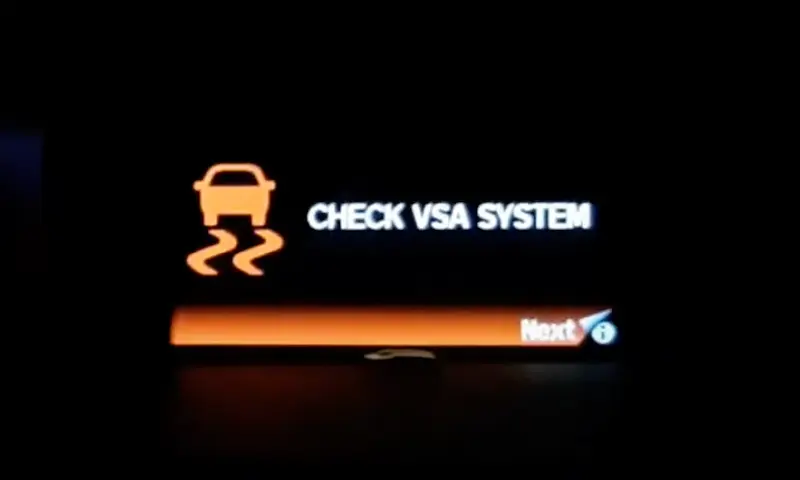
Ever seen those pesky ABS and VSA lights glaring at you from your Honda’s dashboard? If you’ve scanned and found code 61-11, you’re dealing with a voltage issue that’s messing with your vehicle’s stability and braking systems. While it might sound serious, the good news is that this problem is often fixable without breaking the bank.
What Is Honda Code 61-11?
Honda’s 61-11 code isn’t your standard OBD-II code. It’s a Honda-specific diagnostic trouble code that indicates a “Modular Control Unit Power Source Circuit (IC) Low Voltage” condition. In plain English? The computer brain controlling your ABS/VSA system isn’t getting enough juice to function properly.
This code appears when the microprocessor inside your Honda’s ABS/VSA hydraulic modulator detects that its supply voltage has dropped below the minimum threshold needed for proper operation. When this happens, your vehicle plays it safe by disabling the advanced braking and stability features while keeping your basic brakes working.
Common Signs Your Honda Has a 61-11 Code
When this code pops up, your car will typically show you several warning signs:
- ABS warning light illuminated on the dashboard
- VSA (Vehicle Stability Assist) warning light turned on
- Disabled anti-lock braking functionality
- Loss of traction control features
- Normal braking continues to work (thankfully!)
The most noticeable symptom is simply those warning lights staring you in the face every time you drive. Your car will still stop when you hit the brakes, but it won’t have the advanced safety features that prevent skidding and loss of control in emergency situations.
Most Common Causes of a Honda 61-11 Code
In most cases, this code isn’t actually caused by a faulty ABS module itself. Instead, look to these far more common culprits:
1. Battery Issues
A weak, aging, or failing battery is often the primary suspect. When your battery can’t maintain proper voltage (12.4V or higher when the engine is off), your ABS/VSA module will cry for help with this code.
2. Charging System Problems
If your alternator isn’t producing enough voltage (should be 13.5-14.5V while running), or if the voltage regulator is failing, your electrical system can’t maintain proper power levels.
3. Connection Problems
Corroded battery terminals, loose connections, or damaged ground straps can cause voltage drops that trigger this code. Even a tiny bit of corrosion can create enough resistance to cause problems.
4. Blown Fuses
Check the fuses related to your ABS/VSA systems and “Battery Sensor” (BMS) in both the engine bay and dashboard fuse boxes.
5. Battery Current Sensor Issues
Many modern Hondas have a current sensor on the negative battery terminal. When this sensor fails, it can create symptoms that mimic a low-voltage condition.
6. ABS/VSA Module Failure
This is the least common cause, but internal failures in the ABS/VSA modulator can trigger this code. Only suspect this after ruling out all other possibilities.
How to Diagnose a Honda 61-11 Code
Before rushing to replace expensive parts, follow this methodical approach to diagnose the true cause:
Step 1: Battery Voltage Test
- With the engine off and all accessories turned off, use a multimeter to measure voltage across your battery terminals
- You should see at least 12.4V (preferably 12.6V)
- If it’s below 12V, your battery needs charging or replacement
Step 2: Charging System Check
- Start the engine and measure voltage at the battery terminals
- A healthy system should show between 13.5V and 14.5V at idle
- Less than 13V suggests a weak alternator or voltage regulator
- More than 15V indicates an overcharging condition
Step 3: Visual Inspection
Perform a thorough check of:
- Battery terminals for corrosion or looseness
- Engine-to-chassis ground straps for damage
- All related fuses (ABS, VSA, and Battery Sensor)
- Wiring harness near the ABS modulator for damage
Step 4: Battery Current Sensor Test
If your Honda has a battery current sensor (typically found on the negative battery cable):
- Inspect for physical damage
- Check for proper connection
- Consider replacing if all other systems check out OK
How to Fix Honda 61-11 Code
Once you’ve identified the cause, here are the appropriate fixes:
Battery Issues
If your battery tested below 12.4V:
- Try charging it first with a quality battery charger
- If it won’t hold a charge, replace it with an OEM-equivalent or premium AGM battery
- Expect to pay $120-200 for a quality replacement
Alternator Problems
If your charging voltage is below 13V or above 15V while running:
- Have the alternator and voltage regulator tested at an auto parts store
- Replace if failing (costs typically range from $350-600 installed)
Connection Issues
For corrosion or loose connections:
- Disconnect the battery (negative terminal first)
- Clean terminals with a wire brush and baking soda solution
- Apply dielectric grease after reconnecting
- Check and tighten all ground straps
Fuse Replacement
If you find blown fuses:
- Replace with identical amperage fuses (never use higher-rated fuses)
- If they blow again immediately, you have a short circuit that needs further diagnosis
Battery Current Sensor
If you suspect the battery current sensor:
- Check for Technical Service Bulletins related to your specific Honda model
- Replacement parts cost $100-150 plus labor
ABS/VSA Module
As a last resort, if all other systems check out:
- Consider replacement of the ABS/VSA modulator assembly
- This is expensive ($1,000-1,400) and should only be done after verifying all other systems
A Note About Special Cases: The SRS Variant
It’s worth mentioning that on 2003-2007 Honda Accords, there’s a similar “61-11” code that relates to the SRS (airbag) system rather than the ABS/VSA. If your ABS/VSA lights aren’t on but your SRS light is illuminated, you may be dealing with this variant instead, which relates to the driver’s seat-belt buckle switch circuit.
The Importance of Addressing Code 61-11 Promptly
While your car will still drive and the basic brakes will work, ignoring this code means you’re missing critical safety features:
- Anti-lock braking that prevents skidding during hard stops
- Traction control that helps maintain grip in slippery conditions
- Stability control that helps prevent rollovers and loss of control
These systems can literally be lifesavers in emergency situations, so it’s worth addressing this code sooner rather than later.
Preventing Future 61-11 Codes
To avoid seeing this code again, consider these preventive measures:
- Replace your battery every 3-5 years, even if it seems fine
- Keep your battery terminals clean and tight
- Follow Honda’s recommended maintenance schedule
- Consider a battery tender if you don’t drive frequently
- Have your charging system tested annually
The Bottom Line on Honda 61-11 Code
In most cases, Honda’s 61-11 code signals a charging system or power distribution issue rather than a catastrophic ABS module failure. By following a methodical approach to diagnosis, you’ll likely find the root cause is something relatively simple and affordable to fix.
Remember that once proper voltage is restored and the code is cleared, your ABS and VSA functions should return to normal. If the code persists after addressing all potential causes, that’s when you might need to consult a Honda specialist or dealership for more advanced diagnostics.
Have you dealt with a Honda 61-11 code before? What was your experience fixing it? Share your story in the comments below!