Got an Accord sitting in the driveway and no idea what oil it actually needs? You’re in the right place. This guide covers every generation’s specs, the Maintenance Minder codes decoded, a sneaky fuel dilution problem on newer turbos, and a step-by-step DIY procedure. Read to the end — the reset procedure alone saves a lot of confusion.
What Oil Does Your Honda Accord Actually Need?
Honda didn’t stick with one oil spec across 25 years of Accords. The viscosity requirements changed significantly as engine tolerances tightened and fuel economy targets got stricter.
Here’s how it evolved:
- 1999–2002 (6th Gen): 5W-30 conventional oil worked fine with those wider engine clearances
- 2003–2007 (7th Gen): Honda shifted to 5W-20 to cut internal drag and improve cold-start emissions
- 2013–present (9th Gen onward): 0W-20 full synthetic is the standard across all engines — including the turbocharged 1.5L and 2.0L, plus the hybrid
The shift to thinner oils wasn’t a cost-cutting move. Tighter machining tolerances in modern engines actually need lighter oil to flow properly at startup. Using the wrong viscosity — especially something thicker — can starve critical components in the first seconds after a cold start.
Honda Accord Oil Specs by Generation: Full Table
Use this table to find the exact spec for your Accord. Always verify the final fill level using your dipstick regardless of what the table says — there are known capacity discrepancies in some V6 models.
| Generation & Years | Engine | Recommended Oil | Capacity (w/ Filter) | Drain Plug Torque |
|---|---|---|---|---|
| 6th Gen (1999–2002) | 2.3L I4 | 5W-30 | 4.5 qts | 33 lb-ft |
| 6th Gen (1999–2002) | 3.0L V6 | 5W-30 | 4.6 qts | 33 lb-ft |
| 7th Gen (2003–2007) | 2.4L I4 | 5W-20 | 4.4 qts | 33 lb-ft |
| 7th Gen (2003–2007) | 3.0L V6 | 5W-20 | 4.5 qts | 33 lb-ft |
| 8th Gen (2008–2012) | 2.4L I4 | 5W-20 | 4.4 qts | 29 lb-ft |
| 8th Gen (2008–2012) | 3.5L V6 | 5W-20 (0W-20 compatible) | 4.5–5.5 qts* | 29 lb-ft |
| 9th Gen (2013–2017) | 2.4L I4 | 0W-20 | 4.4 qts | 30 lb-ft |
| 9th Gen (2013–2017) | 3.5L V6 | 0W-20 | 4.5 qts | 30 lb-ft |
| 10th Gen (2018–2022) | 1.5L Turbo I4 | 0W-20 | 3.7 qts | 30 lb-ft |
| 10th Gen (2018–2022) | 2.0L Turbo I4 | 0W-20 | 5.1 qts | 30 lb-ft |
| 11th Gen (2023–2026) | 1.5L Turbo I4 | 0W-20 | 3.7 qts | 30 lb-ft |
| 11th Gen (2023–2026) | 2.0L Hybrid | 0W-20 | 4.2 qts | 30 lb-ft |
*The 3.5L V6 has a documented capacity discrepancy between sources. Always do a dipstick check after filling.
Quick note on additives: Honda strongly discourages adding oil stabilizers or aftermarket additives. Modern synthetic oils already carry a full additive package. Adding stabilizers can cause overfilling and foaming — neither of which is good for your engine.
How Honda’s Maintenance Minder Actually Works
Honda’s Maintenance Minder system replaced fixed mileage intervals starting in the mid-2000s. It’s smarter than a simple timer — but it’s not reading your oil directly.
The system uses an algorithm built into the engine control unit. It tracks engine speed, cylinder head temperature, ambient temperature, trip length, and load. From those inputs, it estimates how fast your oil is degrading.
What this means in practice:
- Highway driving in mild weather → oil change interval could stretch to 12,000 miles
- Frequent cold starts and stop-and-go city driving → interval could drop to 3,000 miles
The display counts down from 100% after each service. Here’s what each alert level means:
- 15% → “Service Due Soon” + wrench icon appears
- 5% → “Service Due Now”
- 0% → “Service Past Due” + negative mileage counter starts
Maintenance Minder Codes Explained
When the oil life drops below 15%, you’ll see a combination of letter codes and numbers. Here’s the full breakdown:
| Code | Type | What It Means |
|---|---|---|
| A | Main | Replace engine oil only |
| B | Main | Oil + filter change, brake inspection, suspension/fuel/exhaust visual check |
| 0 | Main | Oil + filter (standard on 2016+ models) |
| 1 | Sub | Rotate tires, check pressure and wear |
| 2 | Sub | Replace air filter, cabin filter, inspect drive belt |
| 3 | Sub | Replace transmission fluid |
| 4 | Sub | Replace spark plugs, inspect valves, replace timing belt + water pump (V6 only) |
| 5 | Sub | Replace engine coolant |
| 6 | Sub | Replace rear differential fluid (AWD only) |
| 7 | Sub | Replace brake fluid |
| 9 | Sub | Full brake service + safety inspection |
So if you see B12 on your dash, that means: oil + filter change, tire rotation, and replace the air and cabin filters. Don’t ignore subcodes — they bundle together to save you extra shop visits.
The 1.5T Fuel Dilution Problem You Need to Know About
If you own a 2018–2024 Accord with the 1.5-liter turbocharged engine, pay close attention here.
What’s happening: Direct-injection engines spray fuel directly into the combustion chamber at high pressure. During cold starts and short trips, some atomized fuel condenses on the cold cylinder walls, gets scraped down past the piston rings, and ends up in your oil pan. On longer drives, the oil gets hot enough to vaporize this fuel back out through the PCV system. But on short commutes, the oil never gets that hot — and gasoline builds up in the crankcase.
Why it matters: Gasoline thins engine oil significantly. Even small amounts of dilution can drop your 0W-20 oil down to the equivalent of a 0W-10 or even 0W-8. At that viscosity, the oil film protecting your turbo shaft bearings, crankshaft journals, and piston rings breaks down.
Studies show that dilution above 2.4% accelerates internal wear. Honda issued ECU software updates to help, but driving habits remain the biggest factor.
How to protect your engine:
- Shorten your oil change intervals. If you do mostly short trips, don’t trust the Maintenance Minder. Change your oil every 3,000–5,000 miles instead
- Check your dipstick regularly. Pull it every third fuel fill-up. If the level is rising or smells like raw gasoline, change the oil immediately
- Take a weekly highway run. Drive at sustained speeds for 20–30 minutes at least once a week — this heats the oil enough to boil off accumulated fuel
- Skip the cold idle warmup. An idling cold engine warms slowly and builds up fuel condensation fast
DIY Honda Accord Oil Change: Step-by-Step
Tools and Parts You’ll Need
| Item | Spec | Purpose |
|---|---|---|
| Socket wrench | 17mm | Drain plug removal |
| Filter wrench | End-cap or band style | Oil filter removal |
| Torque wrench | Click or digital, lb-ft rated | Drain plug torque |
| Drain pan | 5+ quart capacity | Catching old oil |
| Floor jack + stands | Heavy-duty | Safe vehicle lift |
| OEM oil filter | Part 15400-PLM-A02 | Filtration |
| Crush washer | Part 94109-14000 (14mm aluminum) | Drain plug seal |
On the OEM filter: Honda’s current standard part 15400-PLM-A02 consolidates several older filter part numbers (15400-RTA-003, 15400-PT7-005, 15400-PLC-004, and others) into one universal fitment. It’s the correct filter for nearly every Accord from the 7th generation onward.
On the drain plug washer: Always replace the aluminum crush washer with every oil change. Honda uses different washer sizes across its driveline — the engine oil pan uses the 14mm washer (part 94109-14000). Using the wrong size causes slow leaks at the drain port.
The Procedure
1. Warm up the engine. Drive for 5–10 minutes first. Warm oil drains faster and carries more contaminants out with it.
2. Lift the car safely. Use a hydraulic jack and place jack stands under the proper lift points. Never rely on a jack alone.
3. Remove the undercarriage panel. Twist the plastic clips 90 degrees counter-clockwise to release the aerodynamic under-cover and expose the oil pan.
4. Drain the oil. Position your drain pan under the 17mm drain plug and carefully remove it. Let it drain completely — usually 5–10 minutes.
5. Replace the crush washer. Peel off the old 14mm aluminum washer and install a fresh one every single time. Reusing the old washer is a common cause of drain plug weeping.
6. Remove the old oil filter. Use your filter wrench and turn counter-clockwise. Before installing the new filter, inspect the mounting surface on the engine block — confirm the old rubber gasket didn’t stick behind. A double gasket causes an immediate pressurized leak.
7. Install the new filter. Apply a thin film of fresh oil to the new filter’s rubber gasket. Hand-tighten until snug — no wrench needed on install.
8. Reinstall the drain plug. Torque it to spec using your torque wrench. Use the values from the table above for your specific generation. Don’t overtighten — you’ll strip the aluminum pan threads.
9. Fill with fresh oil. Pour in the correct amount for your engine through the filler cap on top of the engine.
10. Start the engine and check for leaks. Run the engine for 60 seconds and look under the car. Then shut it off, wait 2 minutes, and take a final dipstick reading to confirm the level is correct.
Resetting the Maintenance Minder After Your Oil Change
Don’t skip this step. If you don’t reset the system, it keeps counting down from wherever it left off — which means your next service alert shows up hundreds of miles too early.
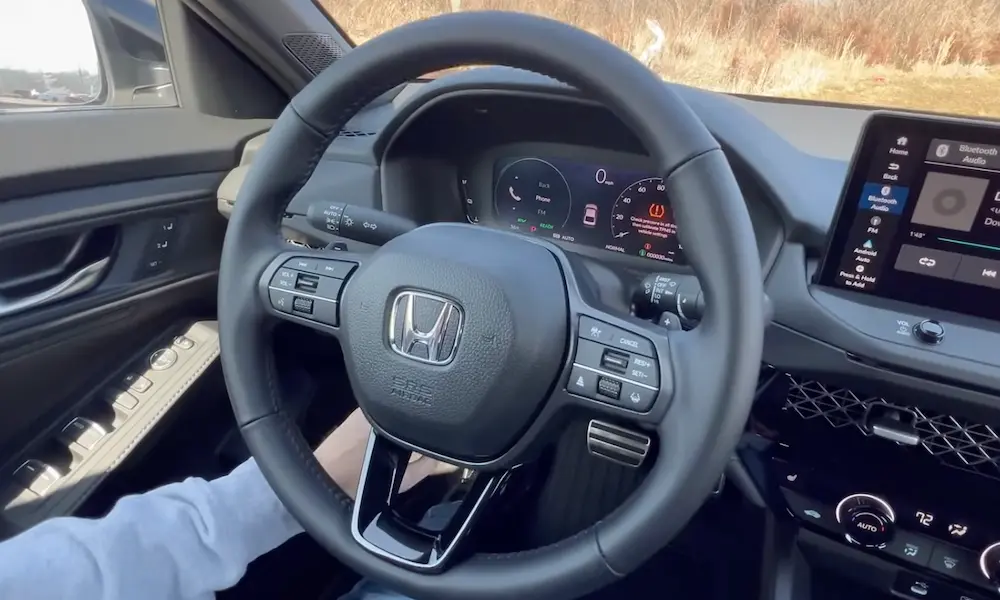
10th and 11th Gen Accords (Steering Wheel Controls)
- Press the engine start button twice without pressing the brake pedal — you’re putting it in ON mode, not starting the engine
- Press the HOME button on the steering wheel
- Scroll with the left selector wheel until the maintenance icon appears, then press to enter
- Hold the selector wheel for 10 seconds to enter reset mode
- Scroll to select the completed service items (or clear all codes)
- Press the selector wheel one more time to confirm — oil life returns to 100%
7th, 8th, and 9th Gen Accords (Instrument Cluster Button)
- Turn the ignition key to ON without starting the engine
- Press the SEL/RESET knob on the instrument cluster until the oil life percentage appears on the display
- Hold the knob for 10 seconds until the oil life indicator starts blinking
- Release, then press and hold again for 5+ seconds
- The blinking stops and oil life resets to 100% — reset complete
Quick Reference: Honda Accord Oil Change Intervals by Driving Style
| Driving Pattern | Recommended Interval | Notes |
|---|---|---|
| Highway-dominant, mild climate | Up to 12,000 miles (Maintenance Minder) | Follow the system |
| Mixed city/highway | 5,000–7,500 miles | Maintenance Minder still reliable |
| Mostly short trips, cold climate | 3,000–5,000 miles | Override the Minder — check dipstick often |
| 1.5T or 2.0T turbo, short trips | 3,000–5,000 miles | Fuel dilution risk — don’t stretch intervals |
| 1.5T or 2.0T turbo, highway driving | Follow Maintenance Minder | Weekly highway runs help purge fuel contamination |
A Honda Accord oil change isn’t complicated — but getting the viscosity, capacity, filter part number, and drain plug torque exactly right makes a real difference over 200,000 miles. Use the specs for your generation, replace the crush washer every time, and don’t ignore that Maintenance Minder reset.