Your Kia’s horn just stopped working, and you’re not sure where to start. It could be a $10 fuse or a $500 clock spring — the difference matters. This guide walks you through every common cause, from the steering wheel to the horn unit itself, so you can stop guessing and start fixing.
Why Your Kia Horn Stops Working
A Kia horn not working isn’t usually one single problem. The horn system has three main parts: the switch inside your steering wheel, the fuse and relay that control power, and the horn unit itself behind the grille. Any one of these can fail independently.
Here’s what makes Kia’s system trickier than older cars: modern models don’t run full power through the steering wheel button. Instead, the button sends a small signal to the Body Control Module (BCM), which then tells a relay to power the horn. More steps mean more things that can break.
The good news? Most failures follow a clear pattern. Let’s trace the signal from your thumb to the horn.
The Clock Spring: The Most Overlooked Culprit
If your Kia horn works when you hit the key fob panic button but stays silent when you press the steering wheel, the clock spring is almost certainly your problem.
The clock spring is a coiled ribbon cable inside the steering column. It keeps electrical connections alive while your steering wheel turns. Over time, that ribbon fatigues and cracks — and when it does, your horn, airbag system, and steering wheel controls all lose connection at once.
The telltale sign: Your horn only works at certain steering angles. That means the broken wire inside the clock spring is making intermittent contact depending on wheel position.
Watch for this combination of symptoms:
- Airbag warning light on the dashboard
- Horn completely dead or intermittent
- Steering wheel audio controls not responding
If your airbag light comes on alongside the horn failure, don’t ignore it. According to this NHTSA recall document for the 2006–2008 Optima and Rondo, high resistance in the clock spring can prevent airbag deployment — a serious safety issue, not just an annoyance.
Kia Clock Spring Warranty Extensions You Should Know About
Kia has acknowledged clock spring failures across multiple models. Several are covered by extended warranty programs filed with NHTSA:
| Model | Years | New Warranty Term |
|---|---|---|
| Forte / Forte Koup | 2014–2015 | 15 Years / Unlimited Miles |
| Rio | 2012–2013 | 15 Years / Unlimited Miles |
| Sorento (XM) | 2011–2015 | 15 Years / Unlimited Miles |
If you own one of these models, check with your Kia dealer before paying for anything. You might get a free repair even with high mileage.
Important: Don’t attempt clock spring replacement yourself unless you know what you’re doing. The steering wheel houses the driver airbag, which can deploy with explosive force. A professional always disconnects the battery and waits for the capacitors to discharge before touching anything in that column.
Check the Fuse First — It Takes Two Minutes
Before you dig into anything else, check the horn fuse. It’s the easiest win and costs nothing if it’s blown.
Your Kia’s horn fuse lives in the engine compartment fuse box. Fuse ratings vary by model — the Kia owner’s manual fuse guide lists exact ratings for your specific trim. Most fall between 10A and 20A depending on the platform.
Don’t just eyeball the fuse — use a multimeter to test for continuity. A fuse can look perfectly fine and still have an invisible internal break.
Never replace a blown fuse with a higher-rated one. That’s how wiring harness fires start. If the new fuse blows again immediately, there’s a short somewhere in the circuit.
The Relay: Easy to Test, Easy to Swap
If the fuse is fine, the relay is next. On older Kia models — think 2010–2015 Optima, older Sorento — the horn relay is a standard plug-in unit in the engine fuse box. Here’s a quick video showing horn relay location and replacement on the Kia Optima.
Quick relay test: Press the horn and listen for a faint click from the relay.
- Click but no horn sound → The relay is working. The fault is between the relay and the horn units.
- No click at all → The signal isn’t reaching the relay. Look at the clock spring or horn switch.
You can also swap the horn relay with an identical relay from another circuit — like the rear defogger — to test it with a known-good component.
The Problem With Newer Kia Models
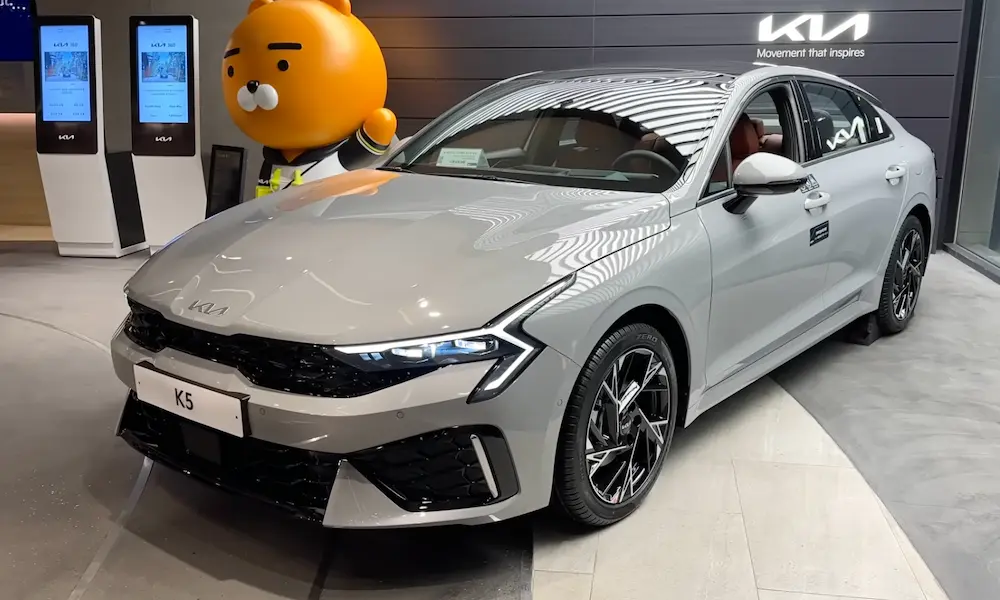
Here’s where it gets expensive. In newer platforms like the Sportage NQ5, Sorento MQ4, and K5 DL3, the horn relay is soldered directly onto the Smart Junction Block’s circuit board. There’s no plug-in relay to swap.
If that integrated relay fails, the entire junction block assembly needs replacement. For a 2023–2025 Kia Sportage, that part alone runs $382–$490, plus $200–$400 in labor. The days of a $15 relay fix are over on these platforms.
To diagnose this properly on a newer Kia, a technician needs a scan tool to check whether the BCM is even receiving the horn request signal from the steering wheel. If the BCM sees the request but nothing happens, the integrated relay is suspect.
The Horn Unit Itself: Corrosion Is a Real Problem
Your Kia uses two horn units — one high-pitch, one low-pitch — mounted behind the front grille. If only one fails, you’ll notice a thin, weak sound. If both fail, complete silence.
These units sit right in the path of road spray, salt, and debris. That location makes them vulnerable to two specific failure modes:
| Failure Type | What Happens | What You’ll Notice |
|---|---|---|
| Contact Carbonization | Electrical arcing deposits carbon on internal contacts | Intermittent sound or clicking without tone |
| Diaphragm Corrosion | Moisture and road salt seize the steel diaphragm | Muffled or completely silent horn |
| Ground Path Failure | Mounting bolt oxidizes, breaking the ground circuit | Total silence, fixed by cleaning the mount |
| Coil Failure | Electrolysis destroys the copper windings internally | Dead horn, infinite resistance on multimeter |
The 2020–2025 Kia Soul Horn Warranty (WTY041)
Kia issued a major warranty extension in early 2025 for certain Soul models specifically because of internal corrosion and contact carbonization problems. This program — WTY041 — covers Soul (SK3) vehicles built between November 15, 2018, and August 13, 2024.
What the program covers:
- Extended warranty from 5 years/60,000 miles to 10 years/120,000 miles
- Free horn assembly replacement if the horn is dead or producing distorted sound
- No proactive replacement — the part must actually fail first
If you own a Soul in that range and your horn keeps failing repeatedly, take it to a Kia dealer. Don’t pay out of pocket.
How to Diagnose a Kia Horn Not Working: Step by Step
Use this sequence to isolate the fault without throwing parts at the problem:
Step 1 — Test with the key fob
Lock your car from outside and listen for the horn chirp. If the horn works on lock but not on the steering wheel, the fault is in the steering wheel switch or clock spring. Skip straight to that inspection.
Step 2 — Check the fuse
Pull the horn fuse and test it with a multimeter. Replace if blown, then retest.
Step 3 — Listen for the relay click
Press the horn and listen. Click with no sound = power side fault. No click = signal side fault.
Step 4 — Test power at the horn connector
Disconnect the horn’s electrical connector. With the horn button pressed, probe the positive terminal with a test light or multimeter.
- Power present, horn silent → Replace the horn unit
- No power → Trace back toward the relay and wiring
Step 5 — Check the ground path
Many Kia horns ground through their mounting bracket. Use a multimeter to verify continuity between the horn’s metal housing and a clean chassis point. A corroded mounting bolt can kill the circuit completely — and it’s an easy fix if that’s the culprit.
Step 6 — Bench test the horn
Remove the horn unit and connect it directly to a 12V battery using fused jumper wires. If it stays silent, it’s dead and needs replacement. This testing method works across Kia models including the Forte, Sportage, Sorento, Soul, Rio, and Optima.
What Repairs Actually Cost
Understanding the cost range helps you decide between dealer, independent shop, and DIY:
| Repair | Parts | Labor | Total Estimate |
|---|---|---|---|
| Horn Unit – Seltos | ~$27 | $220–$322 | $247–$349 |
| Horn Unit – Niro | ~$60 | $207–$304 | $267–$364 |
| Clock Spring – Soul | ~$173 | $120–$176 | $293–$349 |
| Clock Spring – Sorento | ~$188 | $101–$149 | $289–$337 |
| Smart Junction Block – Sportage | $382–$490 | $200–$400 | $582–$890 |
DIY horn replacement is reasonable — some owners source aftermarket FIAMM horn units for around $18 and do the swap in 20 minutes. But use genuine OEM Kia parts when possible. Aftermarket units may have different connector types or slightly different sound profiles, and a mismatched connector repair can introduce new fault points down the road.
Clock spring replacement, on the other hand, isn’t a casual weekend job. Airbag module removal is involved, and improper handling can cause an accidental deployment.
One Thing Most People Miss
If your Kia’s airbag light turns on at the same time as your horn stops working, treat it as a safety emergency — not just an electrical quirk. Both systems share the clock spring. A failed clock spring doesn’t just silence your horn; it may prevent your airbag from deploying in a crash.
Check your warranty status first, test the fuse second, and listen for the relay click third. In most cases, those three steps will tell you exactly where the problem lives — and whether it’s going to cost you $10 or $1,000.