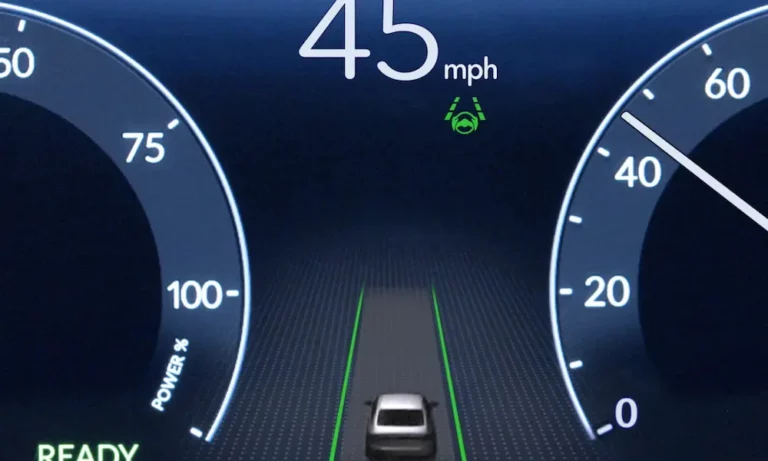
You’re cruising down the highway, trusting your car’s lane keeping assist to help you stay centered, when suddenly it ping-pongs between the lines or shuts off completely. Frustrating, right? The good news is that most lane keeping assist problems have identifiable causes—and many have fixes you can tackle yourself. Let’s dig into what’s going wrong and how to get your system back on track.
What Lane Keeping Assist Actually Does (And Doesn’t Do)
Here’s where things get confusing. Not all lane systems are created equal, and your car might not do what you think it does.
Lane Departure Warning (LDW) just yells at you. It uses a camera to spot lane lines and beeps or vibrates your steering wheel when you drift. But it won’t actually steer for you. If you’re asleep at the wheel, you’re still going into the ditch.
Lane Keeping Assist (LKA) is the reactive helper. It waits until you’re about to cross a line, then gives your steering wheel a quick nudge back. Think of it like a friend tapping your shoulder when you’re wandering off. The system doesn’t try to keep you centered—it just stops you from leaving the lane.
Lane Centering (LC) is the proactive co-pilot. It constantly adjusts your steering to keep you smack in the middle of your lane. This is what most people think they have when they actually have basic LKA.
The confusion? Manufacturers love creative names. Toyota calls it “Lane Tracing Assist.” Honda has “Road Departure Mitigation.” Subaru went with “EyeSight.” They’re all slightly different systems with different capabilities.
According to the Insurance Institute for Highway Safety, about 50% of drivers don’t fully understand what their system can and can’t do. That gap between expectation and reality is often the “problem.”
The Ping-Pong Effect: Why Your Car Bounces Between Lines
This is the most common complaint. Your car corrects left, then overcorrects right, creating a zigzag pattern that makes passengers queasy.
It’s a timing issue. Your LKA system waits until you’re near the line before reacting. When it finally kicks in, it applies a steering correction to push you away. But if the system’s reaction time is slow (even by milliseconds), or if the correction is too aggressive, you overshoot and drift toward the opposite line. Then the whole dance repeats.
The technical term is “control loop instability.” Your car is using a PID controller (Proportional-Integral-Derivative) to manage steering. If the proportional gain is set too high, you get aggressive corrections and oscillation on straight highways.
What makes it worse:
- Wheel misalignment (we’ll get to this)
- Poor camera calibration after windshield replacement
- Worn suspension components that delay steering response
- Systems that lack predictive algorithms
Some newer vehicles with true Lane Centering smooth this out by continuously making tiny adjustments rather than waiting for an emergency. But if you’ve got basic LKA, ping-ponging on the highway might just be how your system operates by design.
When Your Camera Can’t See the Road
Your lane keeping assist is only as good as its eyes—and those eyes are fragile.
Rain, Snow, and Weather Chaos
Cameras hate precipitation. When rainfall exceeds about 20mm per hour (a moderate storm), your camera’s view range drops to nearly zero. Raindrops scatter light, reduce contrast between the paint and asphalt, and physically block the lens.
Snow is worse. It buries the lane lines completely and coats your windshield with ice or slush. The system simply gives up and displays a “Lane Keeping Not Available” message.
The bigger danger: Your car can’t judge road friction. In heavy rain, LKA might command a steering angle designed for dry pavement. On wet roads, that same input could cause your tires to lose grip. That’s why most owner’s manuals tell you to disable LKA in severe weather.
Sun Glare: The Instant Blindness
Ever drive directly into the sunrise? Your camera sensor can’t handle it either. Direct sunlight saturates the pixels, creating a whiteout effect. The system sees nothing but glare and shuts down without warning.
This creates a dangerous handoff moment. If you’ve been relying on the system and it suddenly bails during your morning commute, you might not react fast enough to keep the car centered.
Shadows Tricking Your Car’s Brain
Here’s a weird one. Strong shadows from trees, bridges, or passing trucks create high-contrast lines on the road. Primitive camera algorithms can mistake these shadows for actual lane markers and steer toward them.
Tesla’s Vision-only system (no radar backup) is particularly notorious for this. Drivers report phantom braking when passing under overpasses because the shadow looks like an obstacle to the camera’s neural network.
Faded Lines and Construction Zones
Your system needs crisp, high-contrast lane markings. On older highways where paint has worn down to ghostly remnants, the contrast ratio drops below detection thresholds. The camera literally can’t find the lines.
Construction zones are nightmares. You’ve got ghost lines (old markings), temporary lines, and sometimes no lines at all. Your car gets confused and might lock onto the wrong path, steering you toward barrels or merging lanes.
Concrete roads with faded white lines provide minimal contrast, especially under bright midday sun. The system frequently drops out on these surfaces.
The Windshield Replacement That Broke Everything
Got your windshield replaced and now your lane keeping assist acts drunk? You’re not alone.
Your windshield isn’t just glass—it’s a calibrated optical component. The camera behind your rearview mirror is calibrated to look through a specific thickness and curvature of glass. Light bends (refracts) as it passes through.
If your replacement windshield has even slightly different optical properties—different thickness, curvature, or glass composition—the camera receives a geometrically shifted image. A 1-degree angular error at the sensor translates to several feet of lateral position error at 100 meters down the road.
The result: Your car thinks it’s centered when it’s actually hugging the right line. Or it corrects too early or too late.
The Calibration They Skipped
After any windshield replacement on an ADAS-equipped vehicle, the camera must be recalibrated. This involves:
Static calibration: Parking your car on a level surface in a controlled environment with target boards positioned at precise distances. Cost: $250-$400.
Dynamic calibration: Driving on well-marked roads at specific speeds while the system learns.
Many quick-replacement shops skip this step to save time and money. Insurance companies sometimes pressure shops to use cheaper aftermarket glass that doesn’t meet OEM optical standards. The calibration gets skipped, and you drive off with a system that’s operating with bad data.
If your lane keeping assist has been wonky since your last windshield replacement, improper calibration is likely the culprit.
Wheel Alignment: The Hidden Troublemaker
This one surprises people. Your lane keeping assist problem might not be electronic at all—it could be your wheels.
LKA systems rely on the Steering Angle Sensor (SAS) to understand vehicle direction. The system assumes that when the sensor reads 0°, you’re driving straight.
But if your rear axle has a thrust angle error (it’s slightly misaligned), your car “dog tracks”—the rear wheels push diagonally. To drive straight, you have to hold the steering wheel slightly off-center.
The conflict: Your LKA sees the car drifting toward a line and applies corrective torque. But the mechanical misalignment fights back. You end up in a constant tug-of-war. The system interprets your counter-steering as resistance and throws “Hands on Wheel” warnings.
Owners of Kia EV9s and Toyota RAV4s report persistent pulling to one side. Dealerships attempt software fixes, but the real solution is a precision four-wheel alignment that zeros the thrust angle.
Check this first: If your car pulls consistently to one side with LKA on, get an alignment before you blame the electronics.
Manufacturer-Specific Gremlins
Different brands have different weak points.
Ford BlueCruise: The Curve Dropout
Ford’s hands-free system has a reputation for disengaging abruptly in tighter curves. The system calculates that it doesn’t have enough steering authority to safely navigate the turn and dumps control back to you—sometimes with minimal warning.
There’s also the “BlueCruise No Longer Available” error. Technical Service Bulletins (TSB 22-2494 and 23-2122) point to expired map data in the Gateway Module. If your vehicle fails to update Over-the-Air, the feature locks out.
A specific OTA update (version 6.13.0) for the Mustang Mach-E reportedly broke lane centering for many users, requiring a dealer reset.
Honda/Acura: The Overheating Camera
Honda Sensing systems suffer from a critical design flaw: poor thermal management. The camera unit sits between the windshield glass and the headliner, essentially in a greenhouse.
When interior temperatures spike (especially in summer sun), the camera processor overheats. Once it exceeds about 185°F, the system enters thermal protection mode and shuts down completely. You get a “Camera Too Hot” message, and all ADAS features (LKA, ACC, emergency braking) disappear until the unit cools.
Honda/Acura also had issues with sticky steering in 2022-2024 Civics—a mechanical problem with the electric power steering rack that mimics LKA fighting you.
Toyota: The Right-Side Hugger
Toyota’s Lane Tracing Assist has a documented tendency to position the vehicle toward the right side of the lane. Owners report feeling uncomfortably close to semi-trucks in adjacent lanes.
This appears to be a calibration philosophy—the system prioritizes the solid white fog line over the dashed center line, possibly to keep you away from oncoming traffic. But it makes highway driving nerve-wracking.
Toyota trucks (2018-2019 Tacoma/Tundra) had a separate issue: water intrusion into the front radar sensor, causing corrosion and false braking events. Toyota issued Special Service Campaign K0B to seal or replace affected sensors.
Tesla: Phantom Braking Epidemic
Tesla removed radar sensors from Model 3 and Model Y vehicles around 2021, relying entirely on cameras (Tesla Vision). Without radar to verify depth and distance, the system must infer 3D information from 2D images.
The problem: Shadows from overpasses or trees are frequently misinterpreted as solid obstacles. The car slams on the brakes at highway speeds for no visible reason. Radar waves would pass through shadows, eliminating this false positive, but Tesla’s vision-only approach has no backup verification.
The National Highway Traffic Safety Administration has investigated these incidents, but the architectural choice to remove redundant sensors remains controversial.
Subaru EyeSight: The Overly Cautious Nanny
Subaru’s stereo-camera system is accurate but sensitive. It shuts down for almost anything: sun glare, heavy rain, dirty windshield, or even an unrelated Check Engine Light.
Dashboard reflections can blind the cameras—if you place a white paper or light-colored object on your dash, the reflection in the windshield triggers a system fault.
Subaru is also weirdly sensitive to washer fluid. Using certain aftermarket washer fluids (especially orange Rain-X) that contain silicones can coat the fluid level sensor, tricking the car into thinking it’s empty. Some Subaru models disable EyeSight entirely when washer fluid is “low” as a safety precaution.
What You Can Actually Fix Yourself
Some lane keeping assist problems need a dealer. But many don’t.
Clean Your Windshield (Properly)
The camera zone needs to be spotless. Use glass cleaner without ammonia (it can damage coatings). Don’t use Rain-X or water-repellent treatments in the camera area—Subaru explicitly warns against this.
Check for chips, cracks, or distortion in the glass directly in front of the camera. Even minor damage can scatter light and degrade image quality.
Check Your Alignment
If your car pulls to one side, or if you have to hold the steering wheel off-center to drive straight, get a four-wheel alignment. Tell the shop you have ADAS and need the thrust angle zeroed.
Cost: $100-$150. It’s cheaper than chasing phantom electronic problems.
Verify Camera Calibration
If you recently had your windshield replaced and the system has been off ever since, you likely need recalibration. Find a shop certified for ADAS calibration (not just any glass shop).
Ask specifically if they used OEM or OEM-equivalent glass and if they performed static or dynamic calibration. If they say “it should be fine,” find another shop.
Reset the System
Sometimes the computer just needs a reboot. Check your owner’s manual for the reset procedure. For many vehicles, it’s as simple as:
- Turn off the ignition
- Disconnect the negative battery terminal for 10 minutes
- Reconnect and start the vehicle
- Drive on well-marked roads for 10-20 minutes to let the system relearn
Check for Software Updates
Many manufacturers release over-the-air updates or dealer-installed patches to fix known bugs. Ford, Tesla, and others regularly update ADAS software.
Call your dealer’s service department with your VIN and ask if there are outstanding software updates for your lane keeping system.
The Bottom Line
Your lane keeping assist problem probably falls into one of these buckets:
Environmental (rain, glare, faded lines): Not much you can do except disable the system in those conditions.
Maintenance (dirty windshield, misalignment, bad calibration): You can fix this.
Design limitation (basic LKA that ping-pongs by design, thermal shutdowns): This is how your system works. You can’t “fix” it, but understanding it reduces frustration.
Hardware failure (broken camera, sensor, or module): Dealer repair required.
The hard truth is that current lane keeping systems are still fragile. They work great in ideal conditions—dry roads, crisp markings, moderate temperatures, and perfect vehicle maintenance. Step outside those parameters, and they struggle.
Until manufacturers deploy more robust sensors (4D radar or Lidar) and better control algorithms, you need to treat your lane keeping assist like a helpful but unreliable co-pilot. Keep your hands on the wheel, your eyes on the road, and don’t trust it to do more than it’s designed to do.
When it works, it’s a genuine safety feature that reduces run-off-road crashes. When it doesn’t, understanding why it’s failing helps you troubleshoot—or at least stops you from throwing money at the wrong fix.