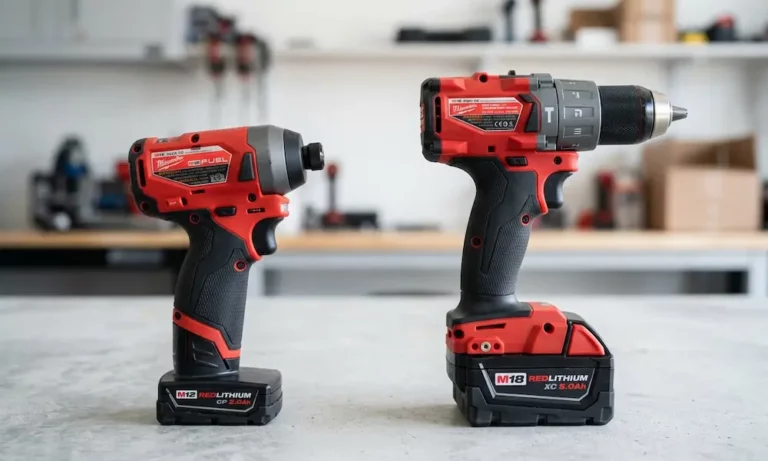
Choosing between the Milwaukee M12 vs M18 isn’t as simple as “more volts equals better.” The right pick depends on your trade, your workspace, and your body at the end of an 8-hour shift. This post breaks down the real differences so you can stop guessing and start working smarter.
They’re Built for Different Jobs — Not the Same Job at Different Power Levels
A lot of people treat this like a simple power comparison. It’s not.
The M12 and M18 are two distinct platforms engineered around totally different physical and electrical constraints. The M12 runs at 12 volts and is built for precision, portability, and tight spaces. The M18 runs at 18 volts and is built for high torque, sustained speed, and heavy-duty output.
Here’s the key electrical difference: higher voltage means lower current draw to achieve the same power. That reduces heat buildup inside the tool. That’s why the M18 handles long, demanding cuts without bogging down, while the M12 stays cool and compact for detailed work.
The M12 uses three lithium-ion cells in a slim triangular “stem” configuration. That keeps the handle narrow — which matters a lot for electrical trim work or plumbing installs where your hand position is everything. The M18 uses 15 or more cells in a slide-on battery pack. More energy, more weight, more bulk.
Neither design is wrong. They’re just built for different situations.
Motor Tiers: Brushed, Brushless, and Fuel — Here’s What They Mean
Milwaukee sorts its tools into three motor tiers. Both the M12 and M18 platforms have all three.
Brushed motors use physical carbon brushes to deliver power. They’re reliable and cheaper, but friction creates heat and wear. Brushed tools are bigger and run shorter on a charge — fine for light-duty maintenance, not ideal for all-day professional use.
Brushless motors cut out the physical contact entirely. A circuit board handles polarity and magnetic fields instead. The result: less heat, less wear, more power density, and longer tool life. Brushless tools are also physically smaller because brushless motors pack more power into less space.
Fuel tools are the top tier. Fuel doesn’t just mean brushless — it means three Milwaukee technologies working together:
- Powerstate motor — higher-grade magnets and more copper windings for maximum torque
- Redlithium battery — Milwaukee’s optimized cell chemistry
- Redlink Plus intelligence — full system communication between tool and battery, with thermal protection under extreme load
If you’re doing professional work daily, Fuel is where you want to be on both platforms.
Battery Deep Dive: Capacity, Weight, and the Tech That Changed the Game
Capacity Tiers Across Both Platforms
| Battery Classification | Capacity Range | Best For |
|---|---|---|
| Compact Performance (CP) | 1.5–3.0 Ah | Precision work, overhead tasks, lightweight handling |
| Extended Capacity (XC) | 4.0–8.0 Ah | General construction, carpentry, medium-duty repairs |
| High Demand (HD) | 9.0–12.0 Ah | Demolition, large saws, outdoor power equipment |
The M12 platform tops out at 6.0 Ah and focuses on CP and XC tiers. The M18 spans everything, including HD batteries powerful enough to replace corded tools entirely.
High Output and Forge: What’s the Difference?
High Output batteries use larger 21700 lithium-ion cells instead of the standard 18650 size. They run 50% cooler and deliver 50% more power than standard Redlithium packs of the same capacity. For something like an M18 Fuel hammer drill, that means maintaining higher RPM under load all day.
Forge batteries go further with tabless cell technology. Traditional cells have narrow “tabs” connecting internal components — that bottleneck limits current flow and generates heat. Remove the tabs and you get near-instant power delivery and dramatically faster charging. The Forge 6.0 Ah battery delivers power equivalent to a High Output 12.0 Ah pack in a much smaller, lighter package. Less arm fatigue. Same professional output.
Forge batteries also feature Cool-Cycle active cooling. Compatible chargers push air through internal channels in the battery to cool it during and after use — so even a hot battery coming off a demanding job can start charging at full speed immediately.
Real Weight Numbers That Matter
Weight is where the M12 platform wins — clearly and consistently.
| Battery | Weight | Strategic Advantage |
|---|---|---|
| M12 CP 2.0 Ah | ~0.40 lbs / 180g | Minimal footprint for precision work |
| M12 XC 3.0 Ah | 0.88 lbs / ~400g | Balanced runtime for service techs |
| M18 CP 2.0 Ah | 0.95 lbs / 423g | Lightest M18 option for overhead drilling |
| M18 XC 5.0 Ah | ~1.60 lbs / 728g | All-day framing and carpentry standard |
| M18 HD 12.0 Ah | ~3.40 lbs / 1,526g | Maximum power for demolition |
An M12 impact driver with a CP 2.0 Ah battery weighs roughly 2.0 lbs. Swap to an M18 equivalent with an XC 5.0 Ah battery and you’re over 3.5 lbs. That’s a 75% weight increase. Do that overhead for 8 hours and your shoulder knows the difference.
Head-to-Head: How Similar Tools Actually Compare
Impact Drivers
The M12 Fuel impact driver delivers 1,300–1,500 inch-pounds of torque — more than enough for deck screws, trim fasteners, and smaller lag bolts. The M18 Fuel pushes up to 2,000 inch-pounds. That extra torque handles timber screws and heavy concrete anchors without stalling.
| Metric | M12 Fuel Impact Driver | M18 Fuel Impact Driver |
|---|---|---|
| Max Torque | 1,500 in-lbs | 2,000 in-lbs |
| Max RPM | 3,600 RPM | 3,900 RPM |
| Impacts Per Minute | 4,000 IPM | 4,400 IPM |
| Bare Tool Weight | 1.6 lbs | 2.24 lbs |
| Tool Length | 5.0 inches | 4.47 inches |
One surprising fact: the newest M18 Fuel impact driver is actually shorter than the M12 Fuel version, though the M12 still wins on width and overall weight.
Oscillating Multi-Tools
The M12 Fuel oscillating tool uses a 3.9-degree oscillation angle. That tighter arc gives you more controlled cuts in delicate materials — baseboards, thin drywall, trim work. Finish carpenters love it.
The M18 Fuel runs a 4.2-degree angle. More aggressive. Faster through hardwood, thick metal pipe, and demo work. It also uses advanced internal counterweights so it stays comfortable despite the more powerful cutting action.
Same category, different purpose. The M12 cuts precisely. The M18 cuts fast.
Cutting and Demo Tools
The M12 Fuel 5-3/8″ circular saw cuts 2x4s cleanly with one hand. But it struggles on long rip cuts through thick or wet-treated plywood. The M18 Fuel 7-1/4″ circular saw matches corded performance, powering through stacked lumber without hesitation.
For reciprocating saws, the M12 Hackzall excels at one-handed plumbing and HVAC work in tight spaces. For cutting 4×4 posts or cast iron pipe, you need the longer stroke length and higher motor output of the M18 Fuel Sawzall.
Which Trades Live on Which Platform?
MEP Trades: Electricians, Plumbers, HVAC
These pros are the M12 platform’s home crowd. Cramped spaces, constant overhead work, one-handed operations — the M12 fits that workflow better than any 18V tool can.
Exclusive M12 tools built for these trades include:
- M12 Copper Pipe Cutters — auto-adjust to pipe diameter, cut in tight quarters
- M12 PEX Expansion Tools — purpose-built for plumbing pipe installs
- M12 Cable Stapler — exclusive to M12, no M18 equivalent exists
- M12 Plastic Pipe Shears — fast, clean cuts in PVC
The M12 platform also owns the inspection and lighting category — thermal imagers, inspection cameras, and ultra-compact work lights that fit in a service bag without trouble.
Framing, Demolition, and Concrete Trades
The M18 platform isn’t optional here — it’s essential. Masonry and structural work demands energy levels that a 12V architecture physically can’t provide.
M18-exclusive heavy tools include:
- SDS Max Rotary Hammers — large-diameter drilling in concrete
- Framing Nailers — high-speed, high-force structural assembly
- High-Torque Impact Wrenches — breaks loose 1/2″ and 3/4″ bolts in industrial settings
- Outdoor Power Equipment — chainsaws, string trimmers, and blowers running on High Output batteries
Automotive Mechanics
Mechanics run a hybrid setup. M12 Fuel high-speed ratchets and stubby impact wrenches access engine components blocked from larger tools. For tire rotations and suspension work on consumer vehicles, the M18 mid-torque wrench is the standard. For commercial trucks and heavy equipment, you need the M18 high-torque.
Charging: Faster Isn’t Just Convenient, It’s Productive
Sequential vs. Simultaneous Charging
Standard multi-voltage chargers like the 48-59-1812 work with both M12 and M18 batteries, but they charge them one at a time — finish the first, then start the second. That’s fine for solo users. For a full crew? It’s a bottleneck.
Simultaneous chargers deliver full power to every bay at the same time. On a job where crews rotate through dozens of batteries a day, that difference is real money.
| Charging System | ~80% Charge Time | ~100% Charge Time | Notes |
|---|---|---|---|
| Standard Multi-Voltage | N/A | 30–60 min (compact) | Sequential only |
| Rapid Multi-Voltage | 20–30 min | 45–90 min (XC) | 40% faster than standard |
| Simultaneous Super Charger | 15 min (Forge 6.0) | 25 min (Forge 6.0) | Active cooling + adaptive power |
The Super Charger also uses Charge Adapt technology — it monitors all attached batteries and routes power first to whichever pack reaches 80% fastest. That means somebody always has a charged tool in hand.
Price Reality: What You’ll Actually Spend
| Equipment Tier | M12 Fuel | M18 Fuel |
|---|---|---|
| Bare Tool (Impact Driver) | $99–$130 | $129–$199 |
| 2-Tool Combo Kit | $199–$230 | $349–$450 |
| 5.0–6.0 Ah Battery | $99–$149 | $149–$199 |
The M12 entry cost is meaningfully lower. But there’s a smarter way to build out your tool inventory.
Milwaukee promotional kits at retailers like Home Depot often include free tools or free batteries. Because the retailer prorates the value of included items on the receipt, you can return the portion you don’t need and get the tool or battery you actually want at a steep discount. It’s a legitimate way pros expand their kit without paying full price on everything.
A Known M12 Issue Worth Knowing About
The M12 battery clip design gets mixed reviews in professional settings. The battery inserts into the handle and locks with two plastic tabs. On high-vibration tools like the Hackzall or the SDS hammer drill, heavier XC 6.0 Ah batteries put stress on those tabs — and the tabs can snap or the battery can vibrate loose mid-use.
Milwaukee addressed this in newer High Output M12 batteries (2.5 Ah and 5.0 Ah) with a reinforced plastic housing and a tighter clip mechanism. If you’re running older XC M12 batteries on heavy vibration tools, it’s worth knowing this is a documented issue — not a one-off defect.
The Smartest Move: Run Both Platforms Together
Here’s what the best-equipped professionals actually do: they don’t pick one platform. They run both, using a single multi-voltage charger to support the entire kit.
Use M18 for framing, drilling large holes, demolition, and anything that needs sustained torque. Switch to M12 for assembly, trim work, tight-access tasks, and anything you’re doing overhead for extended periods.
Milwaukee’s Packout storage system keeps both platforms organized on the same cart or van shelf. No logistical penalty. One ecosystem, two voltage levels, used where each one makes the most sense.
The Milwaukee M12 vs M18 debate ends when you stop seeing them as competitors and start using them as a team.