Your Ram 1500 shifts smoothly at 50,000 miles, but you’re staring at a $15/quart bottle of dealer fluid wondering if there’s a better option. You’ve heard about “lifetime fill,” but forums are full of people calling BS. Here’s what you need to know about mopar zf 8&9 speed atf equivalent options that won’t wreck your transmission.
Why Your Transmission Fluid Actually Matters
The ZF 8HP in your Ram or the 9HP in your Jeep Cherokee isn’t your grandfather’s slush-box. These transmissions use ultra-low viscosity fluid (5.6 cSt at operating temp) to reduce drag and boost fuel economy. Traditional fluids like ATF+4 are around 7.5 cSt—they’re too thick for these modern gearboxes.
Here’s the catch: thinner fluid means less cushion between metal parts. Your transmission relies heavily on chemical additives (friction modifiers, anti-wear agents) to protect gears when that fluid film gets razor-thin. Use the wrong fluid, and you’ll get shuddering, harsh shifts, or worse—internal damage.
The ZF 8HP uses a torque converter lock-up clutch that operates with continuous micro-slip to dampen vibrations. If your fluid’s friction modifiers break down, that smooth slip becomes a violent shudder you’ll feel through the seat.
What Makes Mopar’s OEM Fluid Special (And What Doesn’t)
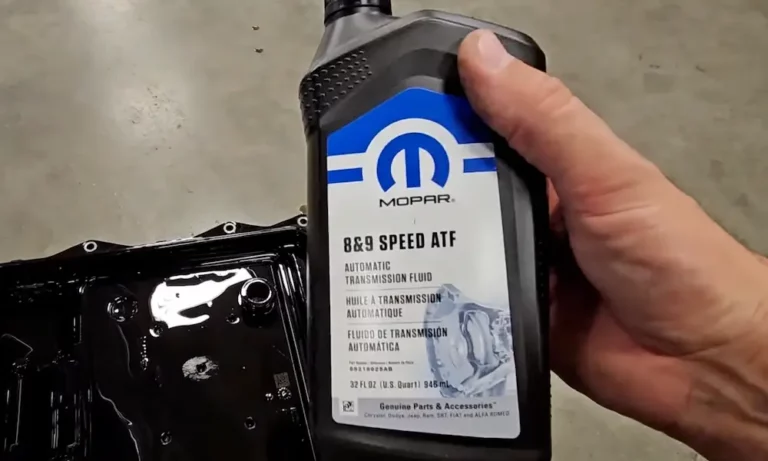
Mopar’s 8 & 9 Speed ATF (part number 68218925AB) is rebranded ZF LifeguardFluid. It’s made by Shell or Petronas, depending on which plant fills your bottle. The fluid is dyed green so you don’t confuse it with the red ATF+4 used in older Chrysler transmissions.
The Chemical Breakdown
The Mopar fluid uses Group III hydrocracked base oil—it’s “synthetic” by US legal definition but not the same as true PAO (Group IV) or ester (Group V) synthetics. The additive package includes alkyl acetamide and calcium sulphonate for friction control and detergency.
Here’s what the specs look like:
| Property | Mopar OEM Value | Why It Matters |
|---|---|---|
| Viscosity @ 100°C | 5.6 cSt | Controls shift timing and fuel economy |
| Viscosity @ 40°C | 26.0 cSt | Affects cold-start protection |
| Brookfield @ -40°C | 8,850 cP | Pumpability in extreme cold |
| Pour Point | -42°C | Lowest temp before fluid waxes |
| Viscosity Index | ~170 | Stability across temperature range |
The 5.6 cSt viscosity is the critical number. Too thick, and shifts get sloppy. Too thin, and you risk clutch slippage.
The “Lifetime Fill” Lie Dealers Won’t Tell You
Stellantis and ZF market this as “fill for life,” but dig into the technical docs and you’ll find something different. ZF recommends fluid changes every 50,000-75,000 miles or 8 years for normal driving. If you tow, haul, or drive aggressively—basically how most Ram owners use their trucks—that interval drops.
“Lifetime” means the warranty period, not the actual life of your truck. Heat breaks down antioxidants, gears shear the viscosity modifiers, and clutch material contaminates the fluid. You can’t cheat chemistry.
Valvoline MaxLife: The Budget King
Valvoline MaxLife Multi-Vehicle ATF dominates Ram forums as the go-to alternative. At $6-8/quart, it’s half the price of dealer fluid.
The Specs Don’t Lie
- KV @ 100°C: 5.91 cSt (OEM: 5.6)
- KV @ 40°C: 28.82 cSt (OEM: 26.0)
- Viscosity Index: 156
- Brookfield @ -40°C: 10,200 cP
MaxLife is about 5.5% thicker at operating temperature and 11% thicker when cold. It’s also slightly worse in extreme cold. But here’s the thing—it works.
Why Ram Owners Love It
The Valvoline formula includes seal conditioners that can help high-mileage transmissions. Guys on r/ram_trucks report running MaxLife past 100,000 miles without issues. Some even claim shift quality improved after switching from old OEM fluid.
The real hack? MaxLife’s low cost lets you do multiple drain-and-fills. Your torque converter holds fluid you can’t drain from the pan—a single service only replaces 60% of total capacity. With MaxLife, you can afford to drain and fill 3-4 times, flushing out nearly all the old fluid for less than one OEM fill.
Verdict: If your truck’s out of warranty and you want value, MaxLife is your answer. It’s not a perfect viscosity match, but it’s proven in hundreds of thousands of real-world miles.
Amsoil Signature Series: When You Need Maximum Protection
Amsoil Signature Series Fuel-Efficient ATF (ATL) takes a different approach. Instead of matching OEM specs exactly, it prioritizes protection.
Thicker = Stronger
- KV @ 100°C: 6.3 cSt (12.5% thicker than OEM)
- Pour Point: -65°C (versus -42°C OEM)
- Brookfield @ -40°C: 7,676 cP
Amsoil uses PAO Group IV base stock, not hydrocracked Group III. That means better natural stability and lower pour points. In a head-to-head cold flow test, Mopar fluid turned to gel at -40°C while Amsoil stayed liquid.
Who Should Use It
You need Amsoil if you:
- Tow heavy (approaching your truck’s limit)
- Live in Canada or Alaska (extreme cold demands it)
- Plan to keep your truck 200k+ miles (thicker film = less wear)
The 6.3 cSt viscosity provides a bigger safety margin against metal-to-metal contact in the planetary gears. You might sacrifice a fraction of an MPG compared to OEM fluid, but you won’t notice it at the pump.
Trade-off: Amsoil costs $12-15/quart. But if you’re towing a 9,000-lb camper through Montana winters, it’s cheap insurance.
Liqui Moly Top Tec 1800: The European Standard
Liqui Moly Top Tec 1800 is what BMW dealers use for ZF 8HP service in Germany. It’s formulated to meet ZF TE-ML 11 spec.
The Goldilocks Fluid
- KV @ 100°C: 5.8-6.0 cSt (closer to OEM than Amsoil or MaxLife)
- KV @ 40°C: 27.5-28.0 cSt
Top Tec 1800 sits between the ultra-thin OEM fluid and the thicker performance options. It’s close enough to OEM that you won’t alter shift hydraulics, but with better additive chemistry than the baseline Mopar fluid.
BMW X5 owners on Bimmerpost report excellent results with Top Tec 1800, specifically for eliminating torque converter shudder. If you want a premium fluid that respects the original engineering intent, this is it.
Cost: Expect to pay $10-12/quart. Availability in the US can be spotty—you’ll likely order online.
Ravenol: Two Fluids for Two Transmissions
Here’s where it gets interesting. While Mopar consolidates one fluid for both the 8HP and 9HP, Ravenol offers separate formulations:
Ravenol ATF 8HP
- KV @ 100°C: 5.6 cSt (exact OEM match)
- KV @ 40°C: 26.0 cSt (exact OEM match)
- Color: Green
Ravenol ATF 9HP
- KV @ 100°C: 5.5 cSt (slightly thinner)
- KV @ 40°C: 24.7 cSt (significantly thinner)
- Color: Green
The 9HP transmission uses dog clutches—physical interference teeth instead of friction plates. These clutches need extremely precise speed synchronization. The thinner 9HP fluid reduces drag torque, helping the computer match shaft speeds faster.
If you own a Jeep Cherokee, Pacifica, or Renegade (all use the 9HP), Ravenol’s dedicated 9HP fluid is technically superior to the universal Mopar 8&9 blend. It’s optimized specifically for your transmission’s hardware.
Red Line D6: For Performance Junkies
Red Line D6 ATF uses Polyol Ester (Group V) base stocks. Esters are polar molecules that cling to metal surfaces—think of it as lubrication that sticks around even when the engine’s off.
The Performance Numbers
- KV @ 100°C: 6.3 cSt (same as Amsoil)
- Shear stability: Industry-leading
Red Line markets D6 as the most shear-stable ATF available. Under high loads, cheaper fluids lose viscosity permanently as the polymer chains in their viscosity modifiers get chopped up by gears. Red Line’s ester base relies less on these polymers, maintaining viscosity longer.
Who needs it: Hellcat owners, heavily modified trucks, or anyone regularly pushing their transmission to the limit. At $15-18/quart, it’s overkill for a stock daily driver.
What About Castrol and Idemitsu?
Castrol Transmax ATF 8-Speed is competent but not exciting:
- KV @ 100°C: 6.1 cSt
- Widely available at auto parts stores
It’s a middle-ground synthetic that works fine but doesn’t excel anywhere. If you can’t find MaxLife or don’t want to wait for shipping on Liqui Moly, Castrol gets the job done.
Idemitsu ATF Type TLS-LV (the Toyota WS equivalent) is actually thinner than ZF spec at 5.3 cSt. It’s designed for Aisin transmissions. While some cross-reference charts list it, it’s not the right choice for Mopar ZF applications.
The Complete Comparison Chart
| Fluid | KV @ 100°C | KV @ 40°C | Pour Point | Cost/Quart | Best For |
|---|---|---|---|---|---|
| Mopar OEM | 5.6 cSt | 26.0 cSt | -42°C | $12-15 | Warranty vehicles |
| Valvoline MaxLife | 5.9 cSt | 28.8 cSt | -48°C | $6-8 | Budget-conscious owners |
| Amsoil Signature | 6.3 cSt | 30.8 cSt | -65°C | $12-15 | Towing/extreme cold |
| Liqui Moly 1800 | 5.8 cSt | 27.5 cSt | N/A | $10-12 | OEM-plus performance |
| Ravenol 8HP | 5.6 cSt | 26.0 cSt | -42°C | $11-13 | 8-speed precision |
| Ravenol 9HP | 5.5 cSt | 24.7 cSt | -54°C | $11-13 | 9-speed optimization |
| Red Line D6 | 6.3 cSt | 30.7 cSt | -60°C | $15-18 | High-performance |
| Castrol Transmax | 6.1 cSt | 30.5 cSt | -48°C | $9-11 | Mainstream alternative |
How to Actually Change Your Transmission Fluid
Don’t let anyone tell you this is a simple drain-and-fill. ZF transmissions are picky.
The Filter Situation
The 8HP uses a plastic pan with an integrated filter. You can’t replace just the filter—you need a new pan assembly. Reusing the old pan with new fluid is stupid. The filter might be saturated with clutch material, contaminating your fresh fluid immediately.
Temperature is Critical
You check the fluid level with the engine running through a fill plug on the side of the case. The fluid must be between 30°C and 50°C (86-122°F) when you set the level.
- Too cold: You’ll overfill (fluid hasn’t expanded yet)
- Too hot: You’ll underfill (fluid has expanded too much)
Get it wrong, and you’ll either get aeration and foaming (overfill) or clutch slippage (underfill).
The Thermal Bypass Trick
These transmissions use a thermostat valve that blocks fluid from the cooler until it reaches operating temp. During a fluid change, you need to get that valve open or you’ll leave old fluid trapped in the cooler lines. Run the engine, shift through all gears, and let it fully heat cycle before draining.
Common Problems These Fluids Fix
Torque Converter Shudder (8HP)
This is the #1 complaint in Ram 1500 forums. You feel a vibration at low speeds when the lock-up clutch engages. It’s caused by glazed clutch material or depleted friction modifiers.
Fresh fluid—especially MaxLife or Amsoil with strong friction modifier packages—often cures this completely. The new additives restore the smooth friction coefficient the clutch needs for micro-slip operation.
9HP Harsh Shifts and Clunks
The 9HP’s dog clutches are notoriously sensitive to fluid viscosity. If the fluid’s too thick or degraded, the transmission can’t synchronize shaft speeds fast enough. You get a harsh “bang” when the dog teeth engage.
Using a dedicated 9HP fluid (Ravenol) or at minimum fresh OEM fluid ensures the drag torque is within the computer’s calibration window.
My Recommendations: What I’d Actually Use
Still Under Warranty?
Use Mopar 68218925AB or ZF LifeguardFluid 8/9. The Magnuson-Moss Act protects your right to use equivalents, but why risk dealer hassle if something breaks? Use OEM until the warranty expires.
Out of Warranty Daily Driver?
Valvoline MaxLife. It’s proven, it’s cheap, and it encourages frequent changes. Changing your fluid every 40,000 miles with MaxLife beats running “premium” fluid for 100,000 miles. Fresh fluid always wins.
Towing Heavy or Extreme Cold?
Amsoil Signature Series ATL. The 6.3 cSt viscosity provides better wear protection under load, and the -65°C pour point is unbeatable for cold climates. If you’re in Calgary pulling a horse trailer, don’t cheap out.
Own a 9HP (Cherokee, Pacifica)?
Ravenol ATF 9HP. The thinner formulation (24.7 cSt @ 40°C) is specifically engineered for dog clutch synchronization. It’s the most technically correct choice for this transmission family.
Performance Application?
Red Line D6. If you’ve got a Hellcat or a heavily modified truck making serious power, the ester base stock and superior shear stability justify the premium price.
The Bottom Line on Mopar ZF 8&9 Speed ATF Equivalents
Your transmission doesn’t care about the label on the bottle. It cares about viscosity, friction characteristics, and thermal stability. The OEM Mopar fluid is good, but several aftermarket options match or exceed its performance for specific use cases.
The real secret? Change your fluid. Whether you choose Mopar, MaxLife, Amsoil, or Ravenol, regular service at 50,000-mile intervals will outlast any “lifetime fill” marketing nonsense. A $200 fluid change beats a $5,000 transmission rebuild every time.
Don’t overthink it—pick a fluid from this list that matches your budget and driving style, follow proper service procedures, and your ZF transmission will outlive the rest of your truck.