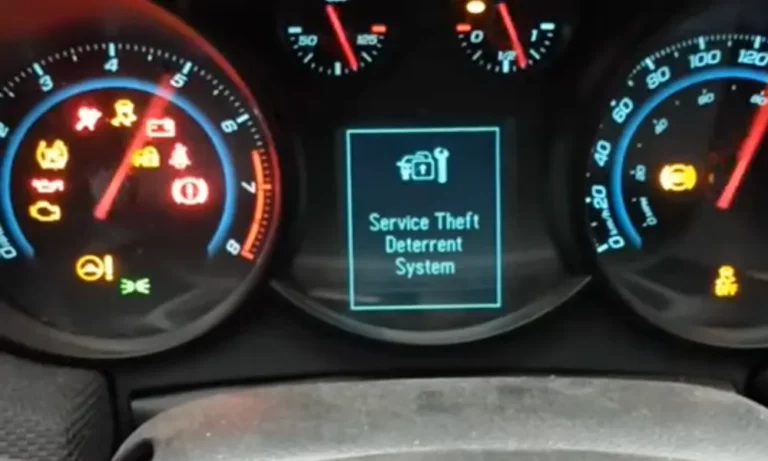
You’re staring at your dashboard, and it says “Service Theft Deterrent System.” Your car won’t start. Panic sets in. Before you call a tow truck or throw money at a dealership, read this. Most causes behind this warning are fixable without spending a fortune — and we’ll walk you through every single one.
What Is a Service Theft Deterrent System?
Your car’s service theft deterrent system is the electronic security layer that stops unauthorized people from starting your vehicle. Think of it as a digital bouncer checking ID before letting anyone turn the engine on.
Here’s the key thing most people don’t know: when this warning appears, it rarely means someone tried to steal your car. It almost always signals a communication breakdown between your key, your Body Control Module (BCM), and your engine’s computer.
The system works through a digital “handshake.” Your key sends an encrypted signal. Your car’s security module checks it. If everything matches, the engine starts. If anything interrupts that conversation — a weak battery, a worn sensor, a glitchy module — you get the warning and a no-start condition.
Why Does This Warning Show Up? (The Real Causes)
1. Your Battery Is the Most Common Culprit
Over 90% of service theft deterrent system alerts trace back to a low-voltage condition. Modern security modules need at least 9.6 volts during startup. Drop below that, and the BCM panics.
Here’s what catches people off guard: a battery can read 12.6 volts sitting still but collapse to 9 volts under the load of cranking. In the eyes of your theft deterrent system, that battery is dead.
Loose or corroded terminals make this worse. They create electrical noise that scrambles the digital handshake between modules.
What to do: Get a load test — not just a voltage check — at any auto parts store. They’re usually free.
2. Your Key Has a Problem
Every modern key has a transponder chip inside it. When you insert it or bring it near the ignition, an antenna ring around the ignition cylinder powers that chip up and reads its encrypted code.
If the chip is cracked, worn, or out of sync, your car sees an unrecognized key and locks down.
The two-key test is your best friend here:
- Try your spare key
- If it starts the car normally, your primary key is the problem
- If both keys fail, the issue is inside the vehicle
For push-to-start vehicles, a weak key fob battery can also cause this. The BCM expects a certain signal strength. A dying fob battery produces an erratic signal, and the system interprets that as a tampering attempt.
3. The Passlock Sensor Is Drifting (GM Trucks and SUVs)
If you drive a Chevy Silverado, GMC Sierra, Tahoe, or similar truck from the late 1990s through mid-2000s, the Passlock system is a prime suspect.
Passlock doesn’t read your key at all. It reads the lock cylinder itself using a Hall effect sensor. As the cylinder wears down over time, the voltage it generates drifts out of range. Your BCM sees that out-of-range reading, assumes someone’s trying to hotwire the car with a screwdriver, and triggers a 10-minute lockout.
This is the most common reason older GM trucks display the service theft deterrent system message.
4. The Body Control Module Is Failing
The BCM is the brain behind your car’s cabin electronics and security logic. It’s the module that validates your key, sends the “OK to start” signal to the engine computer, and manages your alarm system.
When it starts failing, the symptoms get weird fast. According to CarParts.com, a struggling BCM shows up in multiple systems at once — not just security.
| Symptom | What It Means |
|---|---|
| Random alarm going off | BCM misreads a door sensor as a breach |
| Headlights flickering | Internal power driver failing inside the BCM |
| No-start with theft warning | BCM isn’t sending the “start enable” signal to the PCM |
| Central locking acting up | BCM relay or logic gate failure |
| Dashboard “ghosting” or blank clusters | BCM dropped off the CAN-BUS network |
Moisture is the BCM’s biggest enemy. Many BCMs sit near the driver’s footwell or under the dashboard — prime spots for water from spilled drinks, sunroof drain leaks, or condensation. Corrosion on the BCM’s pins creates resistance that corrupts the low-voltage security signals it depends on.
How to Reset a Service Theft Deterrent System (Step-by-Step)
The 10-Minute Relearn (Try This First)
This procedure resyncs the security system without any tools. It works for minor glitches and signal desync issues on most GM vehicles.
- Insert your key and turn the ignition to the ON position (don’t crank)
- Leave it there — don’t touch anything
- Watch the security light on your dashboard
- Wait for the security light to stop flashing or turn off (usually 10–12 minutes)
- Turn the key to OFF and wait 30 seconds
- Try to start the car normally
If it doesn’t work on the first try, this didn’t fix it — move to the next step.
The 30-Minute Relearn (After a New BCM, PCM, or Lock Cylinder)
This is three back-to-back 10-minute cycles. You need it when a component has been replaced and the modules need to re-establish their shared security password.
| Procedure | Duration | When to Use |
|---|---|---|
| 10-Minute Relearn | ~12 minutes | Minor glitches, existing key desync |
| 30-Minute (3×10) Relearn | ~35 minutes | New BCM, PCM, or lock cylinder installed |
| Scan Tool Relearn | Under 5 minutes | Professional shop with a bidirectional scan tool |
Critical warning: Keep your battery fully charged during either relearn. If voltage drops below 12V mid-process, the modules can fail to sync — and you’ll potentially have a much bigger problem on your hands.
Try the Door Lock Trick
Some drivers reset their service theft deterrent system by using the physical key in the door lock. Insert your key in the driver’s door, turn it to the unlock position, and hold it there for 30 seconds. This signals the system that you’re an authorized user and can clear minor alarm states.
Brand-Specific Differences You Should Know
GM (Chevy, GMC, Buick, Cadillac)
GM uses text warnings on the Driver Information Center, making diagnosis relatively straightforward. Their system evolution went from the resistor-pellet VATS system in the 1980s → Passlock sensor systems in trucks → Passkey III transponder keys in modern vehicles. GM’s own Technical Service Bulletins acknowledge that BCM software bugs can trigger unexpected alarm behavior, requiring a full module reprogramming.
Ford (SecuriLock / PATS)
Ford’s system uses dashboard light codes instead of text messages. Normal startup: security light comes on briefly, then turns off. Failure state: light blinks rapidly at about 2 times per second, or stays solid.
Honda and Toyota
These brands show a green key icon or a car-with-lock symbol. Honda Accords in particular suffer from a steering wheel lock issue — if the wheel is turned after shutting the car off, it can bind the ignition. Try pulling the steering wheel slightly to one side while turning the key to relieve the pressure.
Chrysler, Dodge, Jeep (SKREEM)
Chrysler’s SKREEM module combines keyless entry and the immobilizer into one unit. A failing SKREEM causes the engine to start for exactly two seconds and then die — repeatedly. It’s a telltale pattern. CarParts.com also notes that nearby electronic devices can cause interference that triggers the security light on Chrysler vehicles.
Diagnostic Trouble Codes to Know
When resets don’t work, a scan tool pulls specific codes that point directly at the problem:
- P1631 — The PCM and BCM aren’t speaking the same security language. Password mismatch between modules.
- U0140 — BCM has completely dropped off the vehicle’s data network. Often caused by a power or ground failure inside the module.
- B3055 — The exciter ring isn’t detecting any transponder chip in the key at all.
U-prefix codes are especially telling. If you find a U0140, don’t replace the BCM yet — first check for a failed power or ground connection to the module. Many “dead” BCMs are actually just poorly grounded.
What Does This Actually Cost to Fix?
Here’s where things get real. Modern security systems tie the cost of repairs to software authentication, not just parts.
Key Replacement Costs
| Key Type | Hardware | Programming Labor | Total |
|---|---|---|---|
| Basic Transponder Key | $50–$100 | $50–$100 | $100–$200 |
| Flip-Style Key Fob | $150–$300 | $100–$150 | $250–$450 |
| Smart Proximity Fob | $250–$600 | $150–$200 | $400–$800 |
| Luxury Smart Key | $500–$800 | $150–$250 | $650–$1,050 |
BCM Replacement Costs
A new BCM for a GM vehicle runs $550–$560 for the part, plus $115–$170 in labor according to RepairPal. But the real cost is the dealer-level programming required to VIN-match it to your car.
Money-saving option: Third-party services like ECU Maverick and White Auto & Media offer mail-in BCM cloning for $250–$300. You send your original module, they clone it to a replacement unit, and ship it back ready to plug in. No dealer visit. No SPS programming fees. Worth considering if your original BCM’s memory is still readable.
Can a Faulty Theft Deterrent System Cause Your Car to Stall While Driving?
This question comes up a lot — and the answer is nuanced.
Most systems only check the security token once, during the initial startup. Once the engine runs and the handshake is confirmed, the BCM stops polling the key. A dying fob battery mid-drive shouldn’t kill your engine.
However, if the BCM itself experiences a total failure while you’re driving, it may cut power to the ignition relay. On many platforms, the BCM physically holds that relay closed while the car runs. BCM dies → relay opens → engine cuts out instantly. That means immediate loss of power steering and brake assist at speed.
In vehicles like the Chevy Cruze and Malibu, owners have reported intermittent stalling with the service theft deterrent system message appearing afterward. In most of those cases, investigators found that another fault — a fuel pump, a sensor — caused the stall first. The voltage spike from the sudden shutdown then caused the BCM to glitch and throw the security warning as a secondary symptom.
What’s Coming Next for Theft Deterrent Technology
The regulatory landscape is shifting fast. The Infrastructure Investment and Jobs Act requires all new vehicles produced after 2026 to include passive impairment monitoring technology — systems that detect signs of drunk or impaired driving and limit vehicle operation.
Despite what you might have seen online, it’s not a remote government kill switch. It’s a passive monitoring system using cameras and steering input detection. But it will integrate directly with existing theft deterrent architecture — meaning the same BCM that manages your immobilizer today will manage impairment detection tomorrow.
For commercial fleets, remote immobilization already exists today. Systems from providers like Navixy use “queue until stationary” logic — the disable command is sent while moving, but the BCM waits until the vehicle stops and shifts into Park before cutting the starter. Safe, smart, and already deployed in rental fleets worldwide.
The bottom line on the service theft deterrent system warning? Start with your battery. Test your keys. Try the 10-minute relearn. Pull the codes before replacing anything expensive. Most of the time, the fix is simpler — and cheaper — than the warning makes it sound.