Your 68RFE is slipping, throwing codes, or dropping into limp mode — and you’re wondering if a valve body upgrade actually fixes it. It does, but only if you pick the right one. This guide breaks down exactly what fails, why it fails, and what to do about it. Read to the end before you spend a dime.
What the 68RFE Valve Body Actually Does
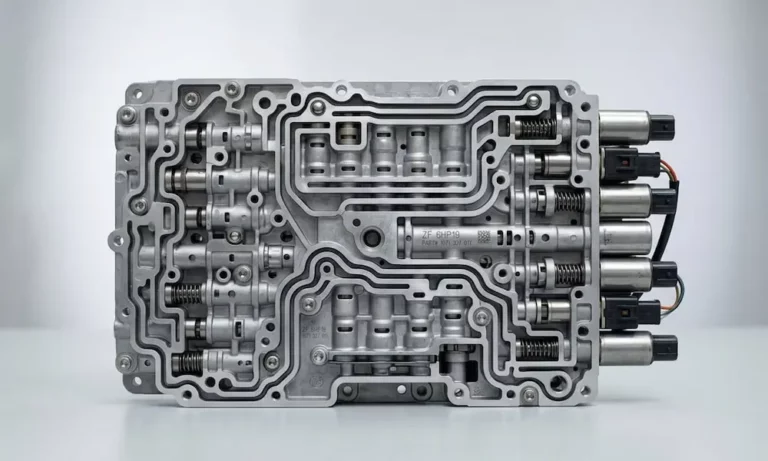
Think of the valve body as the brain of your transmission. It converts electronic signals from the Transmission Control Module into hydraulic pressure, which engages and releases clutch packs to change gears.
The 68RFE uses a clutch-to-clutch shifting strategy. There are no bands. That means the valve body handles everything — timing the release of one clutch pack while simultaneously engaging another. Get that timing wrong by even a fraction of a second and you either get a flare (engine revs spike with no load) or a tie-up (two gears fight each other). Neither is good.
The valve body lives inside your transmission pan and consists of a channel plate, a separator plate, solenoid block, and a series of precision valves and passages. When any of these components wear out or warp, the whole system falls apart fast.
Why the Stock 68RFE Valve Body Fails
The stock unit has three major weak points. Each one can trigger a chain reaction of damage if you ignore it.
Warped Channel Plate and Cross-Leaks
The factory channel plate is cast aluminum. Under repeated heat cycles from towing, it warps. The aluminum expands and contracts at a different rate than the steel separator plate and surrounding fasteners, creating microscopic gaps between surfaces.
Those gaps become cross-leaks — pressurized fluid escaping its intended circuit and bleeding into an adjacent passage. The clutch pack that needs pressure doesn’t get it, so it slips. The clutch pack that shouldn’t be getting pressure gets it anyway, creating friction and heat. The overdrive clutches are hit hardest because they use thinner plates that warp quickly under heat stress.
Solenoid Switch Valve Bore Wear
The Solenoid Switch Valve (SSV) directs fluid to either the low-reverse circuit or the overdrive circuit. It cycles constantly, and that repetitive motion wears the aluminum bore into an oval shape. Once the bore goes egg-shaped, fluid pressure leaks past the valve.
This is why P0871 — the overdrive pressure switch code — is one of the most common 68RFE trouble codes. When the TCM sees inconsistent pressure in the overdrive circuit, it puts the truck into limp mode (stuck in 4th gear) to protect the hard parts. SSV bore wear is so widespread that it’s a primary driver of aftermarket demand for 68RFE valve body upgrades.
Plastic Accumulator Pistons and Weak Retaining Plates
Accumulators act as hydraulic shock absorbers between gear changes. The stock 68RFE uses plastic pistons with only two seals each. They crack, wear down the aluminum bores, and eventually let fluid bypass them entirely. Shifts become lazy and inconsistent.
The steel retaining plate that holds these pistons is another problem. Under repeated high-pressure impacts, it flexes. The mounting screws loosen and sometimes snap off entirely. If the plate shifts position, the pistons lose their seal and line pressure goes erratic — which burns clutches in a hurry.
Here’s a quick reference for what symptoms point to which hydraulic failures:
| Symptom | Probable Cause | Common Codes |
|---|---|---|
| Slipping in 4th, 5th, or 6th | Overdrive cross-leak or SSV wear | P0871, P0734, P0735 |
| Harsh or erratic downshifts | Solenoid wear or contaminated fluid | P0750, P0841 |
| Delayed Park-to-Drive engagement | Low line pressure or L/R switch valve leak | P0868 |
| Highway-speed shuddering | Torque converter lockup pressure loss | P0740 |
| Sudden drop to neutral or limp mode | Catastrophic leak or electronic failure | Various |
What a 68RFE Valve Body Upgrade Actually Changes
A quality upgrade doesn’t just replace worn parts — it fixes the design flaws that caused them to wear in the first place.
Billet Channel Plate
This is the most important upgrade in the entire package. Billet aluminum channel plates are CNC-machined from solid 6061 aluminum blocks instead of poured castings. The material is harder, denser, and more dimensionally stable under heat.
RevMax machines their plates to a flatness tolerance of 0.0003 inches across the entire surface. That eliminates warping-induced cross-leaks entirely. Their billet designs also feature fluid passages nearly twice as deep as stock, which delivers higher fluid volume and more consistent pressure during rapid shift sequences.
Thicker Separator Plate With Bonded Gaskets
High-performance separator plates run 2.5 to 3 times thicker than factory units. That extra thickness stops the plate from flexing under the high line pressures used in tuned trucks. Most quality upgrades use bonded plates — meaning a heat-resistant gasket material is chemically fused directly to both sides of the steel. No loose gaskets to blow out, even when fluid temps climb during summer towing.
Billet Accumulator Pistons and Heavy Plate
Billet aluminum pistons replace the factory plastic units. Quality upgrades use a “triple double” seal design — five seals total — which prevents the piston from tilting in the bore and creates a much tighter fit. The retaining plate gets replaced with thick steel or billet aluminum, secured with additional mounting points so vibration can’t loosen the screws over time.
Comparing the Top Manufacturers
The aftermarket for 68RFE valve body upgrades is competitive. Here’s how the major players stack up:
| Manufacturer | Product | Key Tech | Best For |
|---|---|---|---|
| RevMax | Billet HD V2.0 | Haas CNC, 0.0003″ flatness, dyno-tested | Performance, towing, hot shot work |
| Next Gen Drivetrain | Project Carbon DIY Kit | PulseDelete, laser-cut plate | Enthusiasts and DIY builds |
| ATS Diesel | Performance Valve Body | Electronic pressure integration | Tuned trucks with pressure boxes |
| BD Diesel | Sleeved SSV Valve Body | Cast bore sleeving, bonded plates | Reliable stock replacement and towing |
| Tier One | High-Pressure Billet VB | Anti-flexion billet design | Off-road and high-power Ram builds |
RevMax’s V2.0 design solves a specific headache — earlier billet designs were so thick they required a specialized pan and filters. The V2.0 fits under a stock pan with standard filters. All units ship after dyno testing against a factory baseline.
Next Gen’s PulseDelete technology takes a different approach. Instead of cushioning shifts with accumulators, it removes accumulation from select gears entirely. The result is faster, crisper shifts that reduce clutch slip time. Commercial haulers and performance enthusiasts both like this one.
ATS focuses on pairing their valve body with electronic pressure management. Their kits often include a fresh solenoid pack — smart for older trucks where the original electronics are already showing wear.
Solenoid Compatibility: Don’t Get This Wrong
Before you order anything, check your solenoid connector color. The 68RFE has gone through three distinct solenoid pack generations, and they are not interchangeable without modifications.
- White connector (2007.5–2010): Six-solenoid design. Considered very reliable. Can service trucks through 2018 with the correct range sensor plate.
- Gray connector (2011–2018): Dropped one solenoid and removed several check balls. Can’t go into a 2007–2010 truck — the older TCM expects to see that sixth solenoid.
- Blue connector (2019–present): Introduced with the fifth-gen Ram. Specific to the newer electronics. Not interchangeable with white or gray.
Getting this wrong means the transmission won’t shift correctly from day one. Check the connector before you buy.
Line Pressure and Tuning: What the Valve Body Can’t Do Alone
Here’s something that trips up a lot of buyers. A 68RFE valve body upgrade doesn’t automatically increase your line pressure. Line pressure in the 68RFE is computer-controlled.
Stock trucks run about 160–170 psi. A built transmission handling a tuned Cummins typically needs 225–325 psi to keep the clutches from slipping under high torque. The upgraded valve body provides the structural strength to handle those pressures — but you need a TCM tune or a pressure enhancer module to actually command them. Without the tune, you’ve got a stronger valve body running stock pressures. It won’t fail as fast, but you’re not getting full protection.
The Relearn Process After Installation
The 68RFE is an adaptive transmission. It memorizes the wear patterns and hydraulic characteristics of your old valve body. Drop in a fresh, high-efficiency unit and the TCM is still working off old data. You have to retrain it.
There are two steps:
- Quick Learn — Done with a scan tool while the truck sits still. The computer cycles each solenoid and records a new Clutch Volume Index for every clutch pack. The truck will lurch and clunk during this — that’s normal. It’s finding each clutch engagement point from scratch.
- Drive Learn — After the quick learn, drive 25–50 miles of light-throttle, stop-and-go city driving. No heavy loads, no hard acceleration. The TCM uses this time to refine and stabilize shift patterns based on real-world data.
Skip the relearn, and your freshly upgraded transmission can chew through clutches in days. It’s not optional.
Supporting Upgrades That Protect Your Investment
A 68RFE valve body upgrade delivers the best results when you address the rest of the platform at the same time.
Thermal management matters most. The stock thermal bypass valve is supposed to route fluid through the cooler, but it’s known to stick closed. Fluid temps climb past 220°F — the point where ATF+4 starts breaking down — fast. A thermal bypass delete or upgraded valve keeps fluid circulating through the cooler constantly.
Filtration is another easy win. The 68RFE runs two filters: a sump filter and a spin-on canister. That spin-on filter uses a plastic threaded adapter that cracks and loosens over time. Replace it with a steel adapter. It’s inexpensive and it’s prevented more than a few complete fluid pressure failures. High-efficiency filters from PPE include internal magnets to trap metallic debris before it reaches your precision valves.
The torque converter needs attention if you’re building for performance. The stock single-disc converter shudders, slips, and sends metallic debris straight into the valve body. A billet triple-disc converter eliminates that problem and holds up under the torque of a tuned Cummins.
Rebuild vs. Replacement vs. Built: What’s the Real Cost?
| Option | Cost Range | Weakness |
|---|---|---|
| Standard rebuild | $3,100–$6,300 | Often reuses cast valve body and plastic pistons |
| OEM remanufactured | $6,000–$8,500 installed | Factory warranty, but same design flaws remain |
| Fully built transmission | $6,500–$13,000+ | Highest upfront cost, solves the failures permanently |
A standard rebuild looks cheap until you’re back in the shop 18 months later with the same problems. Most basic rebuilds reuse the original cast aluminum valve body and plastic pistons. For a stock, lightly-used truck that only tows occasionally, that might be fine. For a tuned truck that pulls heavy loads regularly, it’s paying twice for the same failure.
A fully built transmission costs more upfront, but the best shops back their work with warranties that specifically cover performance use — something dealer reman units won’t touch.
The 68RFE valve body upgrade sits at the center of everything that makes or breaks this transmission. Get the billet channel plate, the thicker separator plate, the upgraded accumulators, and the right solenoid pack for your model year. Pair it with a proper relearn and a TCM tune, and this transmission can handle whatever the Cummins throws at it.