Picking the right Honda Ridgeline year can save you thousands — or cost you just as much if you get it wrong. This guide breaks down every generation, flags the years to avoid, and tells you exactly which model year gives you the best value for your money. Stick around — the answer might surprise you.
Why the Honda Ridgeline Is Worth Buying at All
The Ridgeline isn’t a typical pickup. Honda built it on a unibody platform instead of the old-school body-on-frame setup. That means a smoother ride, better handling, and an interior that feels more like an SUV than a work truck.
It also packs a clever in-bed trunk, a dual-action tailgate, and one of the most capable all-wheel-drive systems in its class. The average Ridgeline lasts over 183,000 miles, and nearly 40% can hit 200,000 miles with regular maintenance. That’s a serious return on your investment — if you pick the right year.
The Worst Years for Honda Ridgeline (Skip These)
Before you start hunting for deals, know which years to walk away from.
2006: The Founding Disaster
The 2006 Ridgeline is the one year every mechanic will tell you to avoid. The cylinder number four failure is legendary for all the wrong reasons. The fourth cylinder in the 3.5-liter V6 would blow its rings between 100,000 and 150,000 miles. A full engine replacement ran upward of $5,000.
On top of that, instrument clusters froze, radio displays failed, and the five-speed automatic developed torque converter hesitation between 40 and 45 mph. There’s a reason these trucks are cheap. Keep your wallet closed.
2007–2008: Better, But Still Risky
The 2007 model brought excessive oil consumption — about one quart every 500 to 1,000 miles — thanks to poorly designed piston rings. The clear coat also peeled off roofs and hoods in large chunks.
The 2008 added air conditioning compressor and heater core failures to the list. These are fixable issues, but they require expensive dashboard teardowns to repair. Neither year is worth the gamble on the used market.
2017–2019: Second-Generation Growing Pains
The 2017 Ridgeline won Truck of the Year awards, but its long-term reliability tells a different story. The direct-injection fuel system was prone to injector clogging from manufacturing debris. Honda eventually issued a warranty extension covering fuel injectors for 10 years or 150,000 miles on 2017–2019 models — but that coverage may already be expired on used units.
The six-speed automatic also clunked and overheated during light towing. Many mechanics recommend transmission fluid flushes every 20,000 miles just to keep these units healthy. Add the dreaded water intrusion problem — where water leaked through roof seams, cracked rear window frames, or a failed third brake light gasket into the rear carpet — and 2017–2019 becomes a hard pass for most buyers.
| Year | Primary Problems | Risk Level |
|---|---|---|
| 2006 | Cylinder 4 engine failure, electrical faults | Very High |
| 2007 | Oil consumption, paint delamination | High |
| 2008 | AC compressor failure, heater core leaks | High |
| 2017–2019 | Fuel injectors, 6-speed transmission, water leaks | Moderate–High |
Best Year for Honda Ridgeline: The Top Picks
Here’s where it gets good. These are the years that deliver reliability, value, and peace of mind.
2024–2025: The Best Honda Ridgeline Ever Built
If budget isn’t the main concern, the 2024 and 2025 Ridgelines are the best versions Honda has ever made. Full stop.
The 2024 brought a complete interior overhaul. You get a faster 9-inch touchscreen, wireless Apple CarPlay and Android Auto, and a redesigned center console with a wide padded armrest. The new TrailSport trim adds General Grabber all-terrain tires and an off-road-tuned suspension for drivers who see gravel roads or heavy snow.
The 2025 is largely a carryover with one notable bonus: fuel economy improvements push city mileage from 18 to 19 mpg and highway from 24 to 26 mpg. Not massive gains, but free money in every tank.
Both years run the proven nine-speed automatic and come with Honda Sensing safety tech as standard. These are new-car purchases with full warranty coverage and zero mechanical baggage.
2021–2023: Best Modern Used Value With a Fresh Face
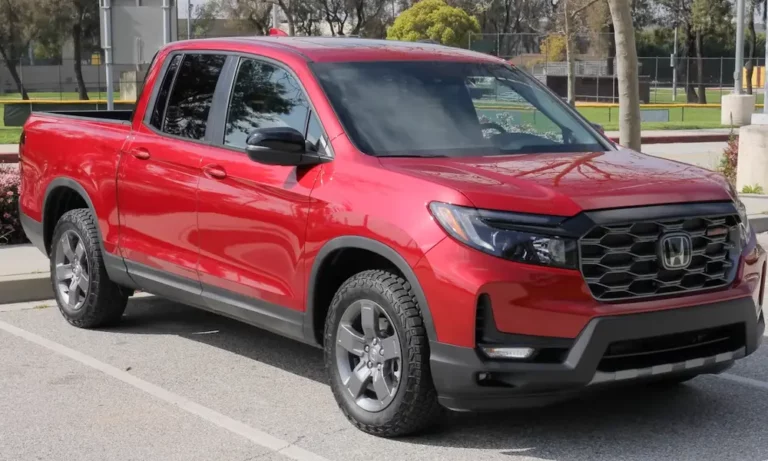
The 2021 model is where the second-generation Ridgeline finally hit its stride. Honda restyled the front end with a squared-off nose and a more aggressive grille — the truck finally looked like a truck. It also brought back the physical volume knob that the 2017–2020 models dropped, which sounds minor but matters daily.
These years use the nine-speed automatic and standard Honda Sensing. There was a rearview camera wiring harness recall for 2020–2024 models due to the harness fatiguing from repeated tailgate use, but the fix was a straightforward harness replacement. Check that it’s been done before you buy.
The 2021–2023 Ridgelines are the sweet spot for used buyers who want modern tech, good looks, and a transmission that won’t give them headaches.
2020: The Best Value on the Used Market
The 2020 model year is what we’d call the value sweet spot. It was the first year Honda dropped the troubled six-speed for the ZF-sourced nine-speed automatic. That single change transformed the truck’s reliability profile completely.
It also introduced standard Honda Sensing across all trims, including adaptive cruise control, lane-keeping assist, and forward collision warning. You get all of that for noticeably less money than a 2021 or newer, simply because the exterior styling is slightly older.
The 2020 lacks the physical volume knob (touchscreen only) and hasn’t received the 2021 exterior facelift, but mechanically it’s rock solid. If you’re buying used and want the best dollars-per-reliability ratio, the 2020 is your answer.
2013–2014: Best Budget Ridgeline
For buyers watching every dollar, the 2013 and 2014 model years are the most reliable first-generation Ridgelines you can buy.
By 2013, Honda had spent nearly a decade ironing out every bug in the original platform. Consumer Reports gave the 2013 model a perfect 5/5 for reliability and owner satisfaction. The 2014 took it further — JD Power scored it 89 out of 100 for quality and reliability, ranking it the number one midsize pickup of that year ahead of the Toyota Tacoma.
The 2014 Special Edition trim featured 18-inch alloy wheels with pewter gray inserts and unique badging — it’s the best-looking first-gen Ridgeline Honda ever made.
You’re skipping modern safety tech and fuel efficiency. But you’re buying a mechanically proven truck with a long track record of durability. For a budget buyer, that trade-off makes complete sense.
2010: The Hidden Gem
The 2010 model doesn’t get enough credit. It was the first year where the Ridgeline’s reliability complaints dropped significantly compared to the rough 2006–2008 era. The 3.5-liter V6 in this period regularly hit 200,000+ miles when owners kept up with timing belt service.
The Takata airbag recall touched 2010 units, but that was an industry-wide issue — not a Ridgeline-specific defect — and most were remedied years ago. Verify the recall status before buying.
| Best Year | Why It Stands Out | Best For |
|---|---|---|
| 2024–2025 | Best tech, best transmission, full warranty | New car buyers |
| 2021–2023 | Refreshed styling, 9-speed, physical volume knob | Modern used buyers |
| 2020 | First 9-speed year, Honda Sensing standard | Value-focused used buyers |
| 2013–2014 | Peak first-gen reliability, JD Power 89/100 | Budget buyers |
| 2010 | Stability milestone, 200K+ mile engine | Older budget buyers |
Key Systems Every Ridgeline Buyer Should Know
The Timing Belt Is Non-Negotiable
Every Ridgeline runs the Honda J-Series 3.5-liter V6. It’s an interference engine, meaning a snapped timing belt = destroyed engine. The 100,000-mile timing belt service is the single most critical maintenance item on any Ridgeline you buy. Always verify it’s been done.
Variable Cylinder Management (VCM): Love It or Hate It
The Ridgeline uses Variable Cylinder Management to shut down three cylinders on the highway and save fuel. Early versions caused uneven engine mount wear and spark plug fouling. Many long-term owners use aftermarket devices to disable VCM entirely, arguing the engine runs cleaner and smoother with all six cylinders always firing.
AWD: Two Systems, Two Different Jobs
The first-generation used VTM-4, which let drivers manually lock the rear differential at low speeds for extraction in mud or snow. The second generation (2017+) uses i-VTM4, a torque-vectoring system that sends up to 70% of power to the rear axle and can push 100% of that to a single rear wheel. This makes second-gen trucks noticeably more stable in snow or wet conditions.
How the Ridgeline Holds Its Value
The Ridgeline retains about 56.9% of its value after five years. That’s lower than the Toyota Tacoma’s roughly 70% retention, which actually makes used Ridgelines a smart buy. You get more truck for your money while still landing a vehicle with Honda’s long-term durability reputation.
The RTL trim consistently offers the best used-market balance — leather seats, power sunroof, and heated front seats without the Black Edition premium price tag.
The Final Rankings at a Glance
Here’s the short version if you’re ready to make a decision:
- Buy new? Go 2024 TrailSport or Black Edition.
- Best modern used? 2021–2023 RTL or RTL-E.
- Best value used? 2020 — first year of the nine-speed.
- Tight budget? 2013 or 2014 — proven, bulletproof, cheap.
- Absolute avoid list? 2006, 2007, 2008, and 2017–2019.
The Honda Ridgeline has earned its reputation as one of the most comfortable and practical midsize trucks on the road. Pick the right year, stay on top of the timing belt, and this truck will go the distance without drama.