So your Chevy Equinox is making a rattling noise at startup, or maybe a mechanic just handed you a repair estimate that made your jaw drop. Either way, you’re dealing with one of the most common — and costly — issues on this platform. This guide breaks down everything you need to know about Chevy Equinox timing chain replacement, from early warning signs to what that repair bill actually covers.
Why the Equinox Timing Chain Fails in the First Place
Here’s the short version: GM designed these engines with a timing chain instead of a belt, promising a “lifetime” solution. Real-world driving conditions had other plans.
The 2.4-liter Ecotec engine, found in the 2010–2017 Equinox models, is the main offender. These engines burn oil excessively due to defective piston rings. When the oil level drops between changes, the hydraulic chain tensioner loses pressure. Without enough tension, the chain starts slapping against the guides — especially during cold starts. Eventually, it jumps a tooth on the sprocket, and you’ve got serious engine damage.
It’s not just one flaw. It’s a chain reaction (pun intended):
- Defective piston rings → excessive oil consumption
- Low oil → tensioner loses hydraulic pressure
- Weak tensioner → chain slap and guide wear
- Worn chain → timing jumps, engine damage
The GM 2.4L Ecotec is what engineers call an interference engine. That means if the timing slips by even a few degrees, the pistons and valves meet each other — violently. That’s when a $2,500 repair turns into a $6,000 engine replacement.
Which Equinox Models Are Most at Risk
Not every Equinox carries the same level of risk. Here’s a quick breakdown:
| Model Year | Engine | Risk Level | Known Issues |
|---|---|---|---|
| 2010–2011 | 2.4L LAF | High | Balance chain wear, oil consumption |
| 2012–2013 | 2.4L LEA | High | Chain wear, class action coverage |
| 2014–2017 | 2.4L LEA | Moderate–High | Ongoing oil consumption |
| 2008–2015 | 3.0L/3.6L V6 | Moderate | Chain elongation, OLM issues |
| 2016–2017 | 3.6L LFX | Low–Moderate | Improved but still susceptible |
If you’re driving a 2010–2013 Equinox with the 2.4L engine, you’re in the highest-risk group. GM acknowledged this through Special Coverage Adjustment 12313D, which covered balance chain wear for up to 10 years or 120,000 miles. There was also a special policy covering excessive oil consumption in 2010–2013 models. However, most of these programs have expired based on the 10-year age limit — so don’t count on free repairs in 2025 and beyond.
Warning Signs You Shouldn’t Ignore
Catch these symptoms early, and you might avoid a catastrophic failure:
Rattling or clattering at startup — This is the most common sign. It usually lasts 2–5 seconds and disappears once oil pressure builds. Don’t ignore this. It’s the tensioner struggling to do its job.
Check engine light with specific codes — The codes P0016, P0017, P0008, and P0009 all point to a timing correlation problem. These aren’t sensor failures — the sensors are accurately reporting that your timing chain has stretched beyond its limit.
Rough idle or engine misfires — When timing drifts, combustion timing goes with it. You’ll feel it.
Decreased fuel economy — The engine’s variable valve timing (VVT) system depends on accurate cam positioning. A worn chain throws that off.
Engine oil low between changes — If you’re topping off oil between oil changes, your piston rings are likely failing. This directly starves your timing chain tensioner.
The Hidden Culprit: Your PCV System
Here’s something most owners don’t know. In cold climates, the Positive Crankcase Ventilation (PCV) system can freeze solid overnight. When that happens, crankcase pressure builds up until it blows out the rear main seal — dumping your oil in minutes.
Lose your oil suddenly, and the timing chain tensioner fails immediately. This PCV freezing issue is almost exclusively a northern U.S. problem, but it’s devastatingly effective at destroying otherwise healthy engines. If you live in the Snow Belt and own a 2.4L Equinox, ask your mechanic about an updated intake manifold with a larger PCV orifice.
What a Proper Timing Chain Replacement Actually Includes
Here’s where people get burned. Some shops replace only the chain itself and call it done. That’s a mistake.
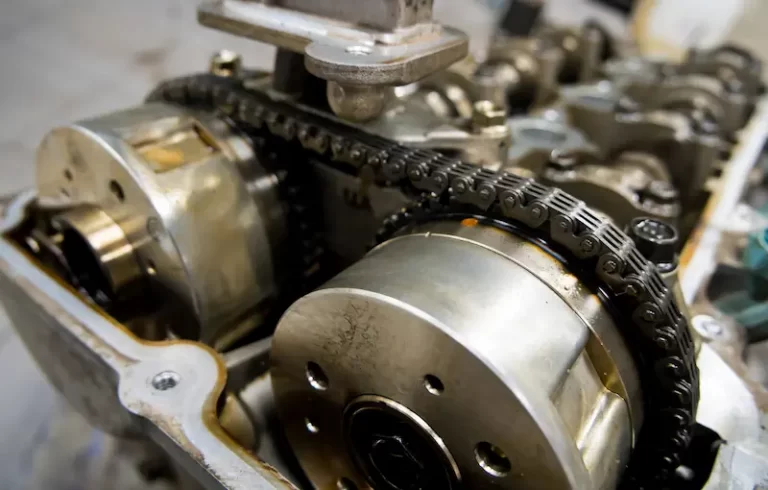
The chain and sprockets wear together as a matched set. If you put a new chain on worn sprockets, the new chain will eat itself within 20,000 miles. A professional-grade repair covers the full system:
| Component | Why It’s Replaced | Priority |
|---|---|---|
| Primary timing chain | Main wear item | Essential |
| Balance shaft chain | Drives water pump in 2.4L | Highly Recommended |
| Hydraulic tensioners | Failure causes chain slap | Essential |
| Chain guide rails | Polymer brittle with age | Essential |
| Camshaft phasers | Critical for VVT function | Highly Recommended |
| VVT solenoids | Clogged by sludge | Recommended |
| Water pump | Labor-intensive to access later | Recommended |
| Front crank seal | Prevents future oil leaks | Essential |
Brands like Cloyes, INA, and ACDelco offer complete kits worth the investment. The extra $150 you spend on quality parts is cheap insurance compared to reopening the engine.
What the Repair Actually Costs
Let’s talk numbers. According to RepairPal’s estimates, timing chain replacement isn’t a quick job. Professional labor guides quote 8 to 13.5 hours for the 2.4L engine. At current shop rates, that adds up fast.
| Repair Scope | Parts Cost | Labor Hours | Total Cost Estimate |
|---|---|---|---|
| Timing chain kit only | $180–$450 | 8–11 hours | $1,200–$2,200 |
| Comprehensive kit with water pump | $350–$650 | 10–13 hours | $1,800–$3,000 |
| V6 three-chain system | $450–$800 | 12–18 hours | $2,500–$4,500 |
| Used engine replacement | $1,500–$3,500 | 15–25 hours | $4,500–$7,500 |
| Remanufactured engine | $3,500–$6,000 | 15–25 hours | $6,500–$11,000 |
Urban dealerships in cities like Chicago or New York can charge over $200 per hour. Independent shops in the Midwest or South often run closer to $120 per hour. Location matters — a lot.
If the chain already jumped and bent valves, you’re looking at a cylinder head job stacked on top of the timing repair, which can push costs past $5,000. At that point, a remanufactured engine from a company like Powertrain Products — which uses updated piston rings and a high-flow oil pump — becomes a smarter long-term investment.
If You Drive in the Rust Belt, Budget More
Rust changes everything. Shops in the Northeast and Midwest regularly deal with corroded engine mount bolts, snapped exhaust fasteners, and seized subframe hardware. A 10-hour job in Ohio can become a 15-hour job when three bolts snap and need extraction. Most shops in corrosion-heavy areas include a contingency line on their estimate for exactly this reason. Don’t be caught off guard.
The V6 Is a Different Beast
If you have the 3.0L or 3.6L V6 Equinox, the timing system is significantly more complex. Instead of one primary chain, the V6 uses a three-chain system: one primary chain and two secondary chains driving four camshafts. More chains mean more wear points.
Early V6 models suffered from oil change intervals that were simply too long for the chain metallurgy. GM eventually released updated “thick-link” chains and revised the Oil Life Monitor software, but many older V6 Equinoxes on the road still carry the original, more vulnerable components.
The V6 repair also often requires lowering the subframe or removing the engine entirely to access the timing cover. That’s why V6 timing repairs routinely cost $2,500–$4,500 in labor and parts alone.
What Shops Use to Do This Job Right
Chevy Equinox timing chain replacement isn’t a backyard job. It requires specialized tools that most home mechanics don’t own:
| Tool | Purpose |
|---|---|
| EN-48953 Cam Phaser Lock | Prevents camshafts from rotating when the chain is off |
| EN-43653 Flywheel Holder | Locks crankshaft for harmonic balancer torquing |
| EN-48749 Chain Retainer | Holds chain on lower sprocket during top-end work |
| EN-45027 Tensioner Retractor | Safely retracts the chain tensioner for installation |
Because the 2.4L Ecotec is an interference engine, a mistake of even one tooth on the sprocket destroys the engine on the first startup. These tools exist to make that mistake impossible. If a shop says they can do this job without them, walk away.
How to Protect Your Engine After the Repair
Once you’ve spent $2,000 or more fixing the timing chain, you don’t want to do it again. Here’s what actually keeps the system healthy:
Change your oil every 5,000 miles with full synthetic. Forget the factory recommendation of 7,500–10,000 miles. Professional technicians agree those intervals are too long for these specific engines. Use an oil that meets the Dexos 1 Gen 3 standard.
Check your dipstick every 1,000 miles. The Equinox doesn’t have an oil level sensor. By the time your oil pressure warning light appears, the damage is already done. If your engine is consuming oil, keep a spare quart in the trunk — always.
Don’t ignore startup rattles. A chain rattle that lasts 2 seconds is an early warning. A chain rattle that lasts 10 seconds is a countdown to failure.
Address the oil consumption problem directly. If your engine burns oil, ask your mechanic about a piston ring replacement. GM’s Special Coverage Adjustment N192291100 previously covered this for free, though most coverage has expired. Fixing the root cause prevents the timing system from failing again.
The Chevy Equinox timing chain replacement is expensive, but it’s not a death sentence for your vehicle. With quality parts, the right shop, and a smarter maintenance routine going forward, these engines can run well past 200,000 miles. The key is not waiting until the chain has already jumped — at that point, the math rarely works in your favor.