Your Silverado’s stuck in park, won’t budge into drive, or shifts like it’s got a grudge against smooth acceleration. Before you spiral into worst-case scenarios involving four-figure repair bills, let’s break down what’s actually happening. Most shifting problems stem from a handful of fixable issues—some cost less than dinner for two. Read on to figure out what’s wrong and what it’ll take to fix it.
What Makes Your Silverado Refuse to Shift
The Brake Light Switch That Controls Everything
Here’s something that’ll surprise you: that little switch behind your brake pedal does way more than turn on brake lights. It’s actually the gatekeeper for your entire shifting system. When this $30 part fails, your transmission stays locked in park no matter how hard you stomp on the brake.
This switch talks to your ABS system, cruise control, and most importantly, the shift interlock solenoid. Without that signal, the transmission thinks you haven’t pressed the brake—so it won’t let you shift.
You’ll know it’s the culprit if your brake lights don’t work (or stay on constantly), your cruise control quits, or your dash lights up like a Christmas tree with Stabilitrak and ABS warnings. The good news? Any mechanic can swap this switch in under 30 minutes. Dealerships charge around $150-$500 for the job, but if you’re handy with a 10mm socket, you can tackle it yourself for the cost of the part.
That Plastic Bushing That Wasn’t Built to Last
If you’ve got a 1999-2013 Silverado, there’s a plastic bushing under your truck that’s probably turned to dust by now. This little connector links your shift cable to the transmission lever, and it lives a rough life—constant movement, road salt, temperature swings, and zero protection from the elements.
When it disintegrates (not if, but when), your shifter moves around inside the cab like everything’s fine. Meanwhile, your transmission’s still in park because the cable isn’t actually connected to anything. It’s the automotive equivalent of pushing on a door that’s not latched.
You can spot this problem by crawling under your truck and looking at where the shift cable meets the transmission. If the cable pops off easily, you’ve found your issue. Dorman makes a repair kit (part 14104) with a new bushing and lever for about $20, though some folks report having to replace it again down the road. Installation takes maybe 45 minutes if you know what you’re doing—remove a nut, drill out the old bushing, pop in the new one with a C-clip. Shops charge $150-$300 for this fix.
Some desperate Silverado owners have zip-tied the cable as a temporary fix. It’ll get you home, but don’t count on it lasting more than a few days.
Solenoids That Stopped Listening
Modern transmissions run on solenoids—electro-hydraulic valves that route pressurized fluid to engage specific gears. When these fail, your shifting goes haywire. Delayed shifts, harsh clunking between gears, getting stuck in one gear, or that dreaded “limp mode” that restricts you to lower gears—all point to solenoid problems.
The usual suspect? Dirty transmission fluid. When fluid breaks down or gets contaminated with metal shavings from normal wear, it clogs those tiny solenoid passages. The valve can’t move properly, and suddenly your transmission’s making decisions based on incomplete information.
Your check engine light will typically throw codes P0750 through P0770 when solenoids act up. These codes tell you exactly which solenoid circuit is having a bad day. Sometimes it’s the solenoid itself, but don’t overlook damaged wiring, corroded connectors, or even a failing Transmission Control Module (TCM) sending bad commands.
Replacement costs depend on how deep the problem goes. A single solenoid might run $300 to replace. If multiple solenoids failed or your mechanic needs to pull the valve body to access them, you’re looking at $600-$1,200. And if contaminated fluid damaged other internal components, well, that’s when the bill starts climbing toward transmission rebuild territory.
The Big-Ticket Problems You Don’t Want
Torque Converter Shudder That Feels Like Road Rumble
If your 2014-2019 Silverado with an 8-speed transmission feels like it’s driving over rumble strips at highway speeds (usually 40-70 mph), you’re probably dealing with torque converter problems. This shudder is so common that GM issued Technical Service Bulletin 18-NA-355 specifically addressing it.
The torque converter does the same job as a clutch in manual transmissions—it connects and disconnects engine power from the transmission. When the internal clutch starts slipping or the lockup mechanism wears out, you get that distinctive vibration.
GM’s first solution? A complete transmission fluid flush using Mobil 1 Blue Label automatic transmission fluid. They started using this fluid in all new vehicles with potentially affected transmissions back in July 2019. Sometimes this $200-$300 flush actually fixes the shudder by improving how the torque converter clutch engages.
When it doesn’t work, you’re looking at torque converter replacement. The parts cost $150-$500 for a standard replacement, but the labor’s where it hurts—4 to 10 hours because mechanics have to drop the entire transmission to access it. Total cost ranges from $600 for a straightforward replacement to $4,800 if there’s additional internal damage.
Many transmission shops recommend upgrading to a billet torque converter when replacing a failed unit. These heavy-duty versions from companies like Circle D address the weaknesses in GM’s factory design and cost $1,000 or more just for the part.
Valve Body Wear That’s Practically Guaranteed
Here’s the uncomfortable truth about 8-speed and 10-speed GM transmissions: the valve body wears out. Not might—will. Both transmission types share this design flaw that’s caused headaches for thousands of Silverado owners.
Inside the valve body, components called accumulators (or dampeners) smooth out pressure pulses from the solenoids. These accumulators move back and forth constantly, gradually wearing the aluminum casting around them. As the bore enlarges, signal pressure drops. Valves don’t move as much as they should. You start feeling shudders, flares (engine revs without acceleration), and increasingly harsh shifts.
GM knows about this. They released a software update that monitors shift timing and clutch apply time. When your TCM detects that it’s taking too much force to get the shifts it wants, it stops letting the transmission shift beyond fifth gear. That’s not fixing the problem—it’s preventing complete lockup while you’re driving down the highway.
The real fix requires valve body replacement, which costs $1,500-$4,000 depending on your transmission type and labor rates. Here’s the kicker: since September 2024, valve bodies for 10-speed transmissions and 8L90 units have been on backorder. Some folks are waiting weeks or months for warranty repairs because the parts simply aren’t available.
Diesel Silverados get hit even harder with valve wear, often experiencing binding issues that need immediate attention.
Which Silverado Transmission You’ve Got Matters
1999-2013: The 4L60E and 4L80E Era
If you’re running one of these four-speed automatics, you’re dealing with a different set of problems than newer trucks. The 4L60E is notorious for worn 3-4 clutch packs, sunshell failures, and torque converter clutch malfunctions.
The valve body in these transmissions uses thin aluminum construction that wears over time. Cross-leakage through the separator plate causes erratic shifting as mileage climbs. Most of the shifting issues on these older models trace back to that shift cable bushing we talked about earlier, or the brake light switch.
2014-2019: When 6-Speed and 8-Speed Showed Up
The 6L80E six-speed brought more sophisticated electronic controls but inherited torque converter reliability issues. Overheating under heavy loads remains problematic, especially if you tow regularly.
The 8-speed (8L90/8L45) transmissions in this generation generated the most complaints. Thousands of owners reported vibration, harsh shifting, and premature torque converter failure at surprisingly low mileage. GM’s multiple TSBs and updated fluid specifications acknowledge these weren’t isolated incidents.
2019-Present: The 10-Speed Gamble
The latest Silverados with 8-speed and 10-speed transmissions continue struggling with valve body wear. That software bandaid from GM helps, but it’s managing symptoms rather than solving the root cause.
If you get the “Service Transmission Now, Unable to Shift Soon” warning on a 2020-2023 model, you’re probably looking at gear shift control module or shift modulator replacement—about $1,000-$1,500.
Heavy-duty 2500/3500 models with Allison transmissions dodge most of these problems. The Allison 1000 is significantly more robust, though it’s not bulletproof. P0735 errors indicating incorrect fifth gear ratio sometimes pop up, usually requiring fluid service or internal clutch work.
How to Actually Diagnose What’s Wrong
Start With the Warning Lights
Your dashboard’s trying to tell you something. Check engine lights, transmission warning indicators, and ABS or Stabilitrak illumination all provide clues. Grab an OBD-II scanner (you can get one for $20-$50 or borrow one free from auto parts stores) and pull the diagnostic trouble codes.
Common transmission codes include:
- P0700: General transmission control system malfunction
- P0735: Gear 5 incorrect ratio
- P0750-P0770 series: Specific solenoid circuit failures
Check Your Transmission Fluid
Healthy automatic transmission fluid looks bright red or pink with a slightly sweet smell. Dark brown or black fluid that smells burnt tells you something’s been overheating or wearing internally.
Here’s the catch: many modern Silverados don’t have traditional dipsticks. Instead, there’s a fill/check plug on the upper backside of the transmission. You’ll need to get the truck up on ramps or jack stands and warm it to operating temperature for an accurate reading. Low fluid levels or contamination point to leaks, internal wear, or overdue maintenance.
Don’t Forget the Fuses
This step gets overlooked constantly, but it’s critical. Bad fuses cause all kinds of weird electrical gremlins that mimic transmission failures.
For 2014-2019 Silverados, check fuses 3, 19, 25, 40, and 58, plus relay 71. The 2006-2013 generation needs fuses 14 and 19 with their associated relay tested.
Don’t just eyeball them—internal failures aren’t always visible. Use a multimeter or fuse testing tool to verify continuity. A $5 fuse could save you from chasing a $500 ghost problem.
Get Under the Truck
Physical inspection reveals things scanners can’t. Slide under and look at where the shift cable connects to the transmission lever. A broken bushing will be obvious—the cable will practically fall off the lever.
Test the brake light switch by pressing the pedal and watching if your brake lights come on. Try shifting out of park. If the lights work but you still can’t shift, the problem’s deeper than the switch.
What GM Has Actually Admitted
Technical Service Bulletins are GM’s way of telling dealerships “yeah, we know about this problem, here’s how to fix it.” They’re not recalls—just documented repair procedures for known issues.
TSB 18-NA-355 (December 20, 2018) addresses torque converter shudder in 8-speed transmissions. The fix: flush with Mobil 1 Blue Label fluid. GM started pre-filling affected vehicles with this fluid at the factory in July 2019, and dealers were supposed to flush all affected vehicles on their lots by August 2019.
TSB 19-NA-206 (August 15, 2019) provides software updates to fix harsh 1-2 shifts and improve overall shift quality. This reprogramming adjusts timing and clutch engagement.
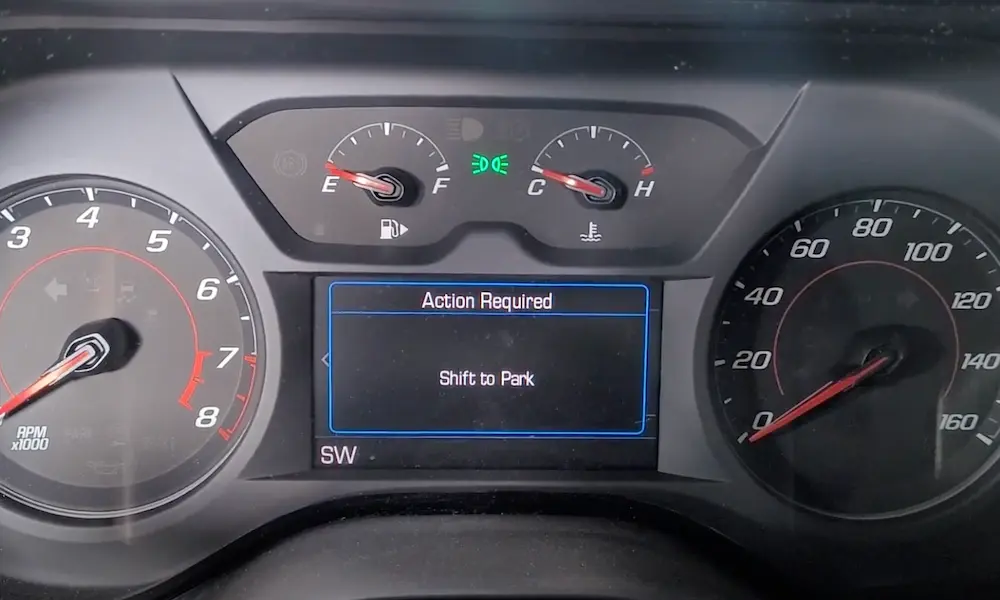
TSB 20-NA-104 (April 10, 2020) covers false “Shift to Park” messages, including shift position switch replacement procedures.
TSB 21-NA-152 (June 22, 2021) addresses how Active Fuel Management (cylinder deactivation) interacts with transmission shifting. The update stops the gear hunting that happens when the engine switches between full and reduced cylinder modes.
For vehicles over 30,000 miles with torque converter issues, GM’s guidance recommends complete torque converter and oil filter replacement—acknowledging that debris from the failing converter has likely contaminated other components.
Keeping Your Transmission Alive Longer
Fluid Changes Matter More Than You Think
Regular transmission service is the single best insurance policy against catastrophic failure. Chevrolet’s official schedule calls for fluid and filter changes at 45,000 miles for severe duty (frequent towing, hot climates, stop-and-go traffic, commercial use).
For “normal” driving, GM doesn’t specify a change interval for 10-speed transmissions. That sounds convenient until you realize most transmission specialists recommend service every 50,000-60,000 miles regardless of how you drive.
The 8-speed benefits from even more frequent changes. Owners report improved shift quality and eliminated shuddering after fluid service at 35,000-50,000 mile intervals.
A complete service includes fluid replacement, new filter, pan gasket, and inspection of everything accessible. Expect to pay $150-$300 depending on your area. Transmission flushes using specialized equipment cost more but exchange fluid in the cooler lines and torque converter—more thorough than a simple drain-and-fill.
Add an External Cooler If You Tow
Supplemental transmission coolers mounted in front of the radiator drop operating temperatures by 20-40 degrees Fahrenheit. If you tow heavy loads, live somewhere hot, or have already dealt with overheating issues, a $200-$400 cooler installation could save you thousands down the road.
Some 8-speed Silverado owners report that combining an external cooler with custom tuning to adjust torque converter lock-up patterns eliminates shuddering without needing converter replacement.
Drive Like You Care About Your Transmission
Avoid aggressive reverse-to-drive shifts without stopping completely. This prevents damage to the reaction shell assembly, especially in 4L60E transmissions.
Use manual mode with paddle shifters to disable fuel management systems that contribute to shift quality problems. L9 mode keeps the transmission in ninth gear while shutting off Dynamic Fuel Management and auto stop-start.
Always engage tow/haul mode when hauling or towing. It adjusts shift points and torque converter strategy to reduce heat buildup.
What These Repairs Actually Cost
The Cheap Fixes
- Brake light switch: $150-$500 at shops, $20-$50 DIY
- Shift cable bushing kit: $150-$300 installed, $20-$50 DIY
- Fluid change: $150-$300 professionally
- Fuse replacement: Under $50 DIY, $100-$150 diagnostic fee at shops
Mid-Range Repairs
- Single solenoid replacement: $300-$500
- Multiple solenoids or valve body access: $600-$1,200
- Gear shift control module: $1,000-$1,500
The Expensive Stuff
- Torque converter replacement: $600-$1,000 basic, $3,000-$4,800 with rebuild and upgrades
- Valve body replacement: $1,500-$4,000
- Complete transmission rebuild or replacement: $3,500-$7,500
Dealerships typically charge 50-100% more than independent transmission specialists, but you get factory-trained techs and manufacturer warranties. Remanufactured transmissions offer middle ground—rebuilt cores with upgraded components at 30-40% less than new.
DIY transmission replacement saves $1,500-$3,000 in labor if you’ve got the skills and tools, but this isn’t a weekend warrior project for most people.
GM’s standard powertrain warranty covers transmissions for 5 years/60,000 miles on new vehicles. Extended warranties might cover failures beyond that, though terms vary wildly. Some owners have successfully claimed warranty coverage just outside the standard window when documented patterns exist.