Your Dodge Avenger won’t start, and you’re staring into an empty engine bay wondering where the battery is. Spoiler: it’s not there. This guide explains exactly where the Dodge Avenger battery location is, how to access it, how to jump-start safely, and how to replace it yourself — without breaking anything. Read to the end, because the replacement steps catch a lot of people off guard.
Why You Can’t Find the Battery in Your Dodge Avenger
Here’s the thing — Chrysler engineers did something unusual with the 2008–2014 Dodge Avenger. They tucked the 12-volt battery inside the driver-side front wheel well, hidden behind the plastic inner fender liner.
This wasn’t laziness or a quirky engineering accident. Moving the battery away from the engine achieved a few smart goals:
- It protected the battery from engine heat, which is one of the main causes of early battery failure
- It freed up engine bay space for different powertrain options
- It moved heavy components away from the front crumple zone for better crash performance
The Chrysler Sebring and Chrysler 200 use the same layout. So if your mechanic friend says “I can’t find the battery,” they might just be used to more conventional setups.
Where Is the Dodge Avenger Battery Actually Located?
The physical battery sits in the lower front corner of the driver-side wheel well, just ahead of the front wheel and behind the bumper fascia. You won’t see it by opening the hood. You’d need to look inside the wheel arch, behind the splash shield fender liner, to spot it.
For everyday tasks like jump-starting or charging, you don’t need to go near the wheel well. That’s what the remote terminals under the hood are for.
| Location Type | Physical Position | Primary Use |
|---|---|---|
| Primary Battery | Driver-side front wheel well, behind liner | Power storage, engine cranking |
| Remote Positive Terminal | Under hood, driver-side engine bay | Jump-starting and charging |
| Remote Negative Post | Under hood, engine block or strut tower | Electrical grounding |
The remote positive terminal sits on the driver’s side of the engine compartment under a red plastic flip-top cover marked with a plus sign. The negative grounding point is usually an unpainted metal bolt on the strut tower or engine block.
How to Jump-Start a Dodge Avenger the Right Way
Dead battery? Don’t touch the wheel well. Use the remote terminals under the hood — that’s exactly what they’re there for. Here’s the correct jump-start sequence:
Before you connect anything:
- Turn both vehicles off
- Engage parking brakes on both cars
- Switch off all lights, the heater, and accessories
Connection order:
- Red cable → dead Avenger’s remote positive terminal (the one under the hood with the red cover)
- Red cable → donor car’s positive terminal
- Black cable → donor car’s negative terminal
- Black cable → unpainted metal on the Avenger’s engine block or strut tower — not the battery itself
That last step matters. Connecting directly to a dead battery risks igniting hydrogen gas emitted by a failing cell. The grounding point on the engine block is safer and works just as well.
Start the donor car and let it idle for a few minutes. Then start the Avenger. Once it’s running, disconnect the cables in exact reverse order — black from Avenger first, then black from donor, then red from donor, then red from Avenger. Snap the red protective cover back onto the remote positive terminal when you’re done.
What Tools You Need to Replace the Battery
Replacing the Dodge Avenger battery isn’t a glove-compartment-and-hope job. You’ll need tools that bridge tire service and electrical work. This YouTube teardown gives you a good visual walkthrough.
| Tool | Spec | Purpose |
|---|---|---|
| Floor jack and jack stands | Standard automotive grade | Lift and secure the vehicle safely |
| Lug wrench or socket | 19mm | Remove the driver-side front wheel |
| Trim clip remover | Flat-head or specialized | Pull fender liner fasteners without snapping them |
| Socket wrench | 10mm | Loosen battery terminal clamps |
| Socket wrench with extension | 13mm | Remove the hold-down bracket bolt |
| Wire brush + terminal cleaner | — | Clean corrosion off battery posts |
The 13mm socket with a long extension is one people often forget. The hold-down bolt sits deep in a recessed spot, and a short socket won’t reach it.
Step-by-Step: How to Replace the Dodge Avenger Battery
This process takes longer than a standard battery swap — expect 45 minutes to an hour if it’s your first time. Work on a flat surface, transmission in park, ignition off.
Step 1: Remove the Front Driver-Side Wheel
Some guides suggest turning the steering wheel hard to the right to create clearance. That works for a peek, but for a full battery removal you’ll want the wheel off entirely. Jack up the car, secure it on jack stands, and pull the wheel.
Step 2: Pull Back the Fender Liner
The inner fender liner attaches with a combination of nylon push-type clips, extruded U-nuts, and body bolts with washers. There are typically 24–26 clips holding it in place. Use a trim removal tool instead of a flathead screwdriver to reduce the chance of snapping clips.
Buy a replacement clip kit before you start — these plastic retainers get brittle over time and break easily. A 40-piece fender clip kit covers most situations and costs next to nothing.
Step 3: Disconnect the Negative Terminal First
Always negative first. Removing the negative cable breaks the circuit, which prevents accidental shorts if your wrench touches both the positive terminal and the frame at the same time. Use a 10mm socket and move the cable well away from the post.
Step 4: Disconnect the Positive Terminal
Same process — 10mm socket, same care. Once both cables are off, tuck them so they can’t accidentally touch the battery posts.
Step 5: Remove the Hold-Down Bracket
The hold-down bracket is stamped steel and secured with a bolt that often requires a 13mm socket with a long extension. This bracket keeps the battery from shifting during cornering. If you see surface rust or stripped threads, grab a replacement bracket while you’re at it.
Step 6: Pull Out the Old Battery
The battery weighs between 30 and 50 pounds. The opening in the wheel well is tight. Take your time and use both hands. Tipping the battery risks spilling sulfuric acid, so keep it level.
Step 7: Install the New Battery
Set the new battery in the tray, secure the hold-down bracket first, then reconnect the terminals. Positive terminal goes on first this time, then negative. This is the reverse of disconnection — and it’s not just a formality. Connecting positive first reduces the risk of sparking.
Reinstall the fender liner, replace any broken clips, bolt the wheel back on, and lower the car.
What Resets After a Battery Swap
Disconnecting the battery erases some of your car’s stored memory. Here’s what to expect when you start the Avenger back up:
Engine and transmission behavior: The ECU and transmission control module use adaptive learning to fine-tune fuel trim, idle speed, and shift points. After a battery swap, both modules reset to factory defaults. The car might feel slightly different during acceleration or gear changes for the first few miles. This is normal — it re-learns your driving patterns quickly.
Radio security code: Many Chrysler vehicles from this era lock the radio after a power loss. You’ll need a four-digit security code to unlock it. Check your owner’s manual for the code card. If it’s missing, your dealership can look it up using your VIN.
Personal settings: Radio presets, clock time, and Bluetooth pairings will also reset. Minor inconvenience, easy fix.
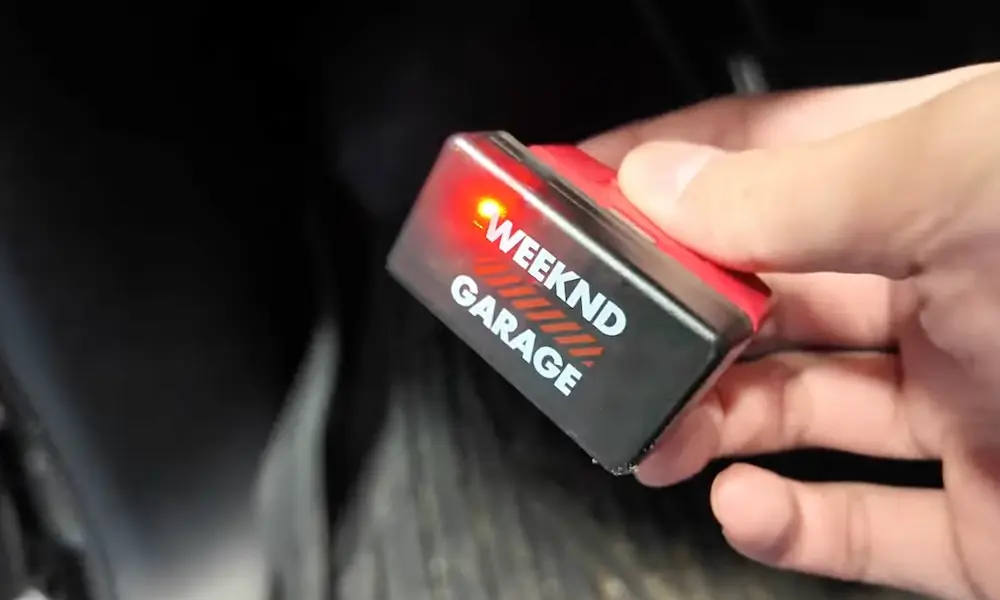
Pro tip: A memory saver tool that plugs into your OBD-II port or cigarette lighter keeps the computers powered during the swap. It prevents all of the above and costs around $20.
Key Fob Battery: Don’t Overlook This One
The Dodge Avenger uses a CR2032 lithium coin cell in the key fob. A weak fob battery causes unreliable locking, unlocking, or remote start — and in some cases, can interfere with the security system’s ability to recognize the key.
| Feature | Spec |
|---|---|
| Battery Type | CR2032 Lithium Coin Cell |
| Voltage | 3 Volts |
| Typical Lifespan | 2–4 years depending on usage |
| Replacement | Pry open the fob shell, swap the cell, match polarity |
Use a name-brand cell for this — cheap batteries perform inconsistently in temperature extremes, which is a real issue across much of the US. You can replace the fob battery yourself in about two minutes.
Keeping the Battery Healthy Long-Term
The Dodge Avenger battery location puts it close to the road surface. That means water, road salt, and debris can reach the terminals through the fender liner, especially in Northeast and Midwest states where winter road salt is heavy.
Corrosion shows up as white or bluish powder on the battery terminals. It acts as an insulator, reducing the charge the alternator delivers and making it harder for the starter to crank the engine. Inspect the terminals every six months — or at least before winter. Clean any corrosion with a wire brush, and apply a thin coat of terminal grease or anti-corrosion spray after reconnecting.
Most lead-acid batteries last 3–5 years. Given the labor involved in accessing the Avenger’s battery, many mechanics suggest replacing it proactively at the four-year mark rather than waiting for a dead-battery morning in January.
Spotting Battery Trouble Before It Leaves You Stranded
The battery usually sends warning signs before it quits entirely. Watch for these:
| Symptom | What It Likely Means | Next Step |
|---|---|---|
| Rapid clicking when starting | Not enough voltage for the starter | Test battery voltage at remote terminals |
| Dimming dashboard or interior lights | Low charge state | Check alternator output while idling |
| Rotten egg smell | Overcharged or leaking battery | Inspect case for swelling or cracks |
| Slow engine crank | Weak cells or high resistance | Run a load test on the battery |
You can test the system quickly with a basic voltmeter at the remote terminals under the hood. A healthy, fully charged battery reads around 12.6 volts with the engine off. With the engine running, the alternator should push that to 13.5–14.5 volts. If it doesn’t increase when you start the car, the alternator — not the battery — may be your real problem.
DIY vs. Professional Service: What to Expect
Many auto parts stores advertise free battery installation. The Dodge Avenger often disqualifies for that service due to the wheel removal and extra labor time involved. Professional shops typically bill 0.7 to 1.5 hours of labor for this job, which adds real cost beyond the battery itself.
For DIYers with a floor jack, jack stands, and basic sockets — this is a completely manageable job. The process just takes more time and prep than a typical battery swap. Have your replacement clips, memory saver tool, and new battery ready before you pull the fender liner off, and the job goes smoothly.