Running low on Honda GN4 and can’t find it locally? Or maybe you’re just wondering if there’s something better for your wallet — or your engine. Good news: there are solid equivalents that protect your Honda just as well, and some that actually outperform it. Read to the end to find the right one for your riding style.
What Makes Honda GN4 10W-40 Special?
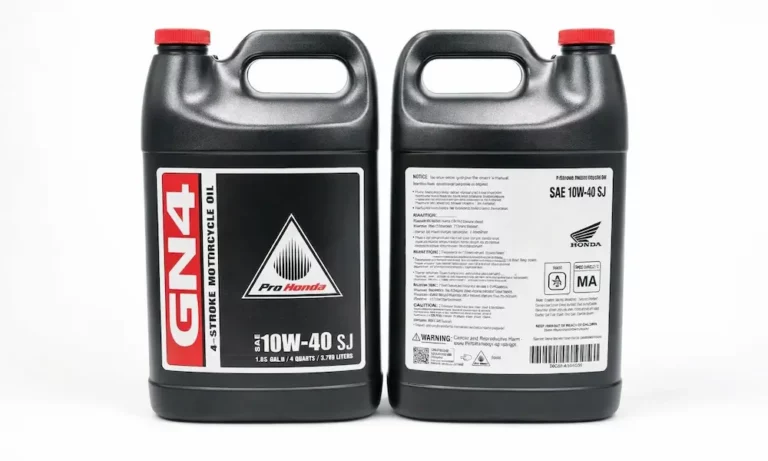
Honda didn’t just grab any oil off a shelf and slap a label on it. Pro Honda GN4 was engineered in 1975 through a collaboration between Honda Powersports R&D and Idemitsu Lubricants. The goal was simple: create an oil tough enough to handle a motorcycle’s shared-sump system — one circuit that simultaneously lubricates the engine, gearbox, and wet clutch.
That’s a very different job than what your car’s oil does.
Here’s GN4’s core technical profile:
| Property | Specification |
|---|---|
| SAE Viscosity Grade | 10W-40 |
| Base Oil | Premium Conventional (Mineral) |
| API Service Category | SJ / SL |
| JASO Classification | MA |
| Manufacturer | Idemitsu Lubricants |
GN4’s formulation deliberately avoids friction modifiers like molybdenum and graphite. Those additives make car engines slippery and efficient, but they’ll cause your wet clutch to slip. It’s a small chemical detail with big consequences.
The One Standard That Matters: JASO T 903
Before you pour anything into your Honda, check for JASO T 903 certification. This Japanese standard exists specifically because motorcycles have wet clutches that car-tested oils can destroy.
JASO MA, MA2, and MB — Know the Difference
- JASO MA: Baseline standard. Provides enough friction coefficient for proper wet clutch engagement. GN4 carries this rating.
- JASO MA2: A step up from MA. Higher friction thresholds for high-torque engines and bikes with catalytic converters.
- JASO MB: For scooters with dry clutches or separate gearboxes. It contains friction modifiers. Never use MB-rated oil in a Honda with a wet clutch.
Any valid Honda GN4 10W-40 equivalent must carry a JASO MA or MA2 rating. If the bottle says “Energy Conserving” under the API donut, put it back. That oil has friction modifiers baked in.
OEM Brand Equivalents: Same Philosophy, Different Badge
The most direct substitutes come from Honda’s Japanese competitors. Yamaha, Kawasaki, and Suzuki face the same engineering challenge and take the same approach.
Yamalube All-Purpose 10W-40
Yamalube is Yamaha’s GN4. It’s a mineral-based 10W-40 designed for broad compatibility across motorcycles and ATVs. It maintains stable clutch performance and consistent shifting — exactly what GN4 promises. For most conventional Honda applications, Yamalube All-Purpose 10W-40 is a functional twin.
Kawasaki Performance Oils (KPO) Range
Kawasaki takes a tiered approach. Their conventional mineral option meets API SN — a newer standard than GN4’s SJ/SL — while still carrying JASO MA2 wet clutch certification.
| KPO Product | Viscosity | Type | Classification |
|---|---|---|---|
| KPO Conventional | 10W-40 | Mineral | API SN, JASO MA2 |
| KPO Semi-Synthetic | 10W-40 | Blend | API SN, JASO MA2 |
| KPO Full Synthetic | 10W-40 | Synthetic | API SN, JASO MA2 |
The KPO Conventional is particularly strong on camshaft wear protection and piston cleanliness. Riders who want more thermal stability can step up to the semi-synthetic or full synthetic without changing brands.
Suzuki Ecstar Series
Suzuki’s Ecstar line follows the same integrated philosophy. The R5000 Mineral 10W-40 uses high-quality natural base stocks and exceeds JASO MA2 requirements. It’s Suzuki’s baseline answer to GN4 — reliable, affordable, and clutch-safe.
The R7000 Semi-Synthetic and R9000 Full Synthetic give you an upgrade path if you ride hard, tour long, or run in hot climates where heat management matters most.
Aftermarket Mineral Alternatives That Actually Deliver
These aren’t generic shelf fillers. These brands build motorcycle-specific mineral oils that rival GN4 on every measurable spec.
Motul 3000 4T 10W-40
Motul 3000 4T brings extreme pressure additives for transmission gear protection — solving the same shear problem GN4 was built to handle. Its flash point sits at a very impressive 232°C, which makes it a great choice for air-cooled Honda engines like those in the TRX ATV range.
| Motul 3000 4T Spec | Value |
|---|---|
| API Standard | SM |
| JASO Standard | MA2 |
| Viscosity @ 40°C | 100.8 mm²/s |
| Viscosity @ 100°C | 15.1 mm²/s |
| Flash Point | 232°C |
| TBN | 6.6 mg KOH/g |
Maxima Premium4 10W-40
Maxima Premium4 uses a proprietary anti-wear, anti-shear additive system. Its viscosity index of 162 is notably high for a conventional mineral oil, meaning it stays more stable across temperature swings than most competitors. Riders often notice more consistent shifting feel from cold start through full operating temperature.
Valvoline 4-Stroke Motorcycle Conventional 10W-40
Valvoline’s motorcycle-specific 10W-40 claims up to 20% better engine cleanliness than typical API SL oils, based on Honda XR250 engine testing. It also delivers 40% better transmission protection against scuffing in FZG gear tests — a real number for real gear protection. It carries JASO MA2 and keeps clutch behavior predictable.
Semi-Synthetic Upgrades: Where Value Meets Performance
If GN4 leaves your gear changes feeling “notchy” — especially after 2,000 miles — a semi-synthetic might be the upgrade you didn’t know you needed.
- Motul 5100 4T 10W-40: Uses Technosynthese and Ester technology. Esters carry a polar charge that lets the oil cling to metal surfaces, improving cold-start protection. Many Honda owners report immediate improvements in shift smoothness after switching from GN4.
- Castrol Actevo 4T 10W-40: Formulated with “Actibond” molecules that bond to engine components even when the bike is off. Since up to 75% of engine wear happens during startup, this matters more than most riders realize.
- Motorex Formula 4T 10W-40: Built with hydrocracked and PAO technology. Its pour point of -36°C makes it exceptional for cold-weather starts, and its viscosity index of 154 keeps gear shifts consistent from cold to fully warmed up.
Full Synthetic Equivalents: Maximum Protection
These oils are best for high-performance Honda sportbikes, touring heavyweights like the Goldwing, or any engine that sees sustained high heat or long service intervals.
- Amsoil Metric Motorcycle Oil 10W-40: In independent comparisons of 32 motorcycle oils, Amsoil has outperformed GN4 in shear stability and deposit control. Riders switching from GN4 report better fuel economy and noticeably smoother gear changes.
- Mobil 1 Racing 4T 10W-40: Built for racing-level heat. It prevents clutch plate glazing under extreme high-temperature conditions — something conventional oils can struggle with on track days.
- Motul 7100 4T 10W-40: 100% Ester-based synthetic. Meets API SN and JASO MA2. A top pick for riders in hot climates with air-cooled engines.
- Shell Advance Ultra 4T: Uses Shell’s PurePlus gas-to-liquid technology, producing a base oil virtually free of crude oil impurities. Shell claims it can improve fuel economy by up to 5 km/L compared to standard 20W-40 mineral oil.
The Shell Advance AX7 10W-40 — a synthetic-technology step below the Ultra — also deserves a mention. Its viscosity index hits 172, making it one of the most shear-stable options in this roundup. Consistent gear engagement over the full drain interval is its standout trait.
The Rotella Option: Diesel Oil in a Motorcycle Engine
It sounds weird, but the powersports community has been running Shell Rotella diesel oil for years. Some formulations carry JASO MA2 certification, which makes them technically safe for wet clutch systems.
- Rotella T4 Triple Protection 15W-40: The 15W cold rating instead of 10W makes minimal difference in warm climates. Both reach 40-weight protection at operating temperature. T4 is significantly cheaper than motorcycle-specific mineral oils and carries high zinc and detergent levels.
- Rotella T6 Full Synthetic 5W-40: Popular in the dirt bike and adventure riding communities. The 5W rating helps oil reach critical parts faster in cold starts. Critics note it may shear down quicker in a motorcycle gearbox than a dedicated motorcycle synthetic.
⚠️ Important Rotella warning: Not all formulations are JASO certified. Always check the back label before buying.
| Rotella Product | JASO Status |
|---|---|
| T4 15W-40 | JASO MA certified ✅ |
| T6 5W-40 | JASO MA2 certified ✅ |
| T4 10W-30 | Generally not JASO MA rated ❌ |
| T6 5W-30 “Multi-Vehicle” | Does not carry JASO MA/MA2 ❌ |
| T6 0W-40 | Confirmed NOT JASO MA2 by Shell ❌ |
Choosing by Temperature and Riding Conditions
Honda’s own technical documentation allows for viscosity adjustments based on ambient temperature. Here’s a quick guide:
| Temperature Range | Recommended Viscosity | Good Equivalent Option |
|---|---|---|
| Below 0°C to 40°C | 10W-40 | GN4, Motul 5100, Motul 3000 |
| 15°C to 50°C+ | 20W-50 | GN4 20W-50, Valvoline 20W-50 |
| Extreme cold starts | 5W-30 / 5W-40 | Rotella T6 5W-40, GN4 5W-30 |
For post-2007 Honda models, Honda often recommends 10W-30 for better fuel efficiency. For older and air-cooled models, 10W-40 stays the gold standard.
Oil Change Intervals by Oil Type
The brand matters less than how often you change it. Here’s what Suzuki’s Ecstar guide — and general industry practice — recommends:
- Conventional Mineral (GN4, Motul 3000, Ecstar R5000): Change every 3,000 km
- Semi-Synthetic (Motul 5100, Castrol Actevo): Extend to 4,000–5,000 km
- Full Synthetic (Amsoil, Shell Ultra, Motul 7100): Up to 6,000–10,000 km, though sticking closer to the standard interval accounts for moisture and combustion byproduct buildup
The Full Breakdown: GN4 Equivalents by Category
Group A — Direct Mineral Equivalents (Near-Identical Profile)
- Kawasaki KPO Conventional 4-Stroke 10W-40
- Suzuki Ecstar R5000 Mineral 10W-40
- Yamalube All-Purpose 10W-40
- Motul 3000 4T 10W-40
- Maxima Premium4 10W-40
Group B — Semi-Synthetic Upgrades (Best Value-to-Performance Balance)
- Motul 5100 4T 10W-40
- Castrol Actevo 4T 10W-40
- Motorex Formula 4T 10W-40
- Bel-Ray EXP Synthetic Ester Blend 10W-40
Group C — Full Synthetic Equivalents (Maximum Protection)
- Amsoil Metric Motorcycle Oil 10W-40
- Shell Advance Ultra 4T 10W-40
- Mobil 1 Racing 4T 10W-40
- Motul 7100 4T 10W-40
Group D — High-Value Diesel Spec Alternatives
- Shell Rotella T4 15W-40 (JASO MA ✅)
- Shell Rotella T6 5W-40 (JASO MA2 ✅)
The right pick depends on what you ride and how you ride it. A commuter Honda CBR or a TRX ATV doing light farm work? Any Group A or Group D option protects it fine. A CBR600RR that sees track days or a Goldwing that logs highway miles in summer heat? Step up to Group B or C — the smoother shifts and better heat management are genuinely worth it.
Whatever brand you pick, keep the viscosity at 10W-40 and confirm that JASO MA or MA2 stamp on the label. That’s the only non-negotiable when replacing Honda GN4.