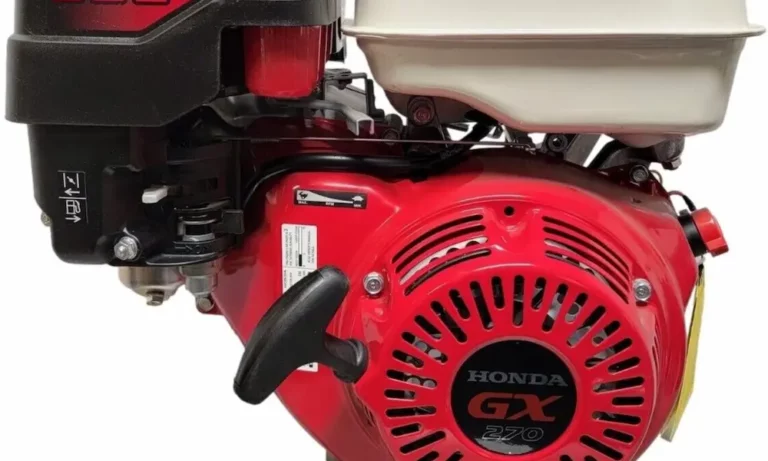
Got a Honda GX270 and not sure how much oil it actually needs? Put in too little and you’ll wreck it. Put in too much and you’ll have a different mess entirely. This guide covers everything — from the exact capacity to the right oil type, gearbox fluids, and maintenance schedule. Read to the end, because the gearbox section catches a lot of people off guard.
What Is the Honda GX270 Oil Capacity?
The Honda GX270 oil capacity for the main crankcase is 1.1 liters (1.16 US quarts or 0.97 Imperial quarts). That’s it. Simple enough — but getting it wrong causes real damage.
This engine uses a splash lubrication system. A small dipper attached to the connecting rod spins through the oil pool and throws a mist across all the internal parts. If the oil level’s too low, that dipper doesn’t reach enough oil. Too high, and the oil foams up and leaks through the seals.
That 1.1-liter figure isn’t a suggestion. It’s a precise engineering requirement.
Engine Specs at a Glance
| Parameter | Specification |
|---|---|
| Oil Capacity (Standard) | 1.1 L / 1.16 US qt |
| Lubrication Method | Splash Type |
| Recommended Oil | SAE 10W-30 |
| API Classification | SJ or later |
| Engine Type | 4-Stroke OHV |
| Displacement | 270 cc |
| Bore x Stroke | 77 x 58 mm |
| Cylinder Angle | 25 degrees |
How to Check the Oil Level Correctly
Here’s where most people make a mistake. The GX270’s cylinder sits at a 25-degree angle, so the engine must be on a perfectly level surface when you check the oil.
When you pull out the dipstick, don’t thread it back in. Just insert it straight down into the filler neck. The oil should touch the upper limit mark. If you screw it in before reading it, you’ll get a false high reading and think you’ve got enough oil when you don’t.
The full oil level sits right at the edge of the filler neck. That’s your target.
What Oil Does the Honda GX270 Use?
Honda recommends SAE 10W-30 as the standard all-temperature oil for the GX270. It needs to meet API Service Classification SJ or later.
Modern SN and SP rated oils actually exceed that spec — and that’s a good thing. The GX270 doesn’t have a pressurized oil filter, so wear particles stay suspended in the oil until you drain it. A high-detergency oil keeps those particles from clumping into sludge on your bearings and cylinder walls. Check out how oil viscosity grades work if you want a deeper breakdown.
Which Oil Grade for Which Temperature?
| Ambient Temperature | Recommended Viscosity |
|---|---|
| All temperatures | SAE 10W-30 |
| Below 0°C (32°F) | SAE 5W-30 |
| Above 10°C (50°F) | SAE 30 |
| 0°C to 40°C (32–104°F) | SAE 10W-40 / 15W-40 |
Cold Weather Use
If you’re starting the GX270 in freezing conditions, switch to 5W-30. Cold oil is thick oil, and thick oil takes longer to reach the valve train. The GX270 is an OHV engine — the rocker arms and valve stems sit at the top of the engine and are the last components to get lubricated on a cold start. A 5W-30 gets there faster and cuts down on that critical dry-start wear.
Hot Weather and Heavy Use
Running a pressure washer or agricultural equipment in summer heat? A straight SAE 30 works well, but only if the temperature stays above 10°C (50°F). It maintains a thicker oil film under load, which reduces consumption and keeps the cylinder walls protected during sustained operation. You can find Honda’s official guidance on 4-stroke engine oils for more detail on this.
Honda GX270 Reduction Gearbox Oil Capacity
This is the part most people skip — and it’s where engines quietly fail.
If your GX270 has a reduction gearbox, it may have its own separate oil reservoir. Checking only the main crankcase and assuming you’re done isn’t enough.
1/2 Reduction Unit With Centrifugal Clutch
This is the most common setup. The clutch unit has a completely separate reservoir with a capacity of 0.3 liters (10 US ounces). Use the same SAE 10W-30 oil you’d use in the engine.
Why keep it separate? Centrifugal clutches generate friction debris every time they engage. If that debris mixed with the engine oil, it would act like fine grit inside your cylinder bore. The 0.3-liter reservoir keeps that contamination isolated and protects the engine’s internals.
1/6 Reduction Units
Some 1/6 reduction gearboxes share the engine’s crankcase oil. Others have their own dedicated reservoir holding 0.15 liters (about 5 oz). These standalone units have a separate filler bolt and a side-mounted oil level check bolt on the gearbox housing.
Check your specific model’s documentation to find out which configuration you have.
Reduction Unit Oil Capacity Summary
| Reduction Type | Capacity | Reservoir |
|---|---|---|
| 1/2 Reduction (with clutch) | 0.3 L / 10 oz | Separate |
| 1/6 Reduction (standalone) | 0.15 L / 5.1 oz | Separate |
| 1/6 Reduction (shared) | N/A | Uses crankcase |
| 1/2 Reduction (no clutch) | N/A | Uses crankcase |
The Oil Alert System: What It Does and When It Trips
Honda’s Oil Alert system uses a float switch inside the crankcase. When the oil drops below a safe level, the float closes a circuit that kills the ignition. The engine stops. The on/off switch stays in the ON position, but the engine won’t restart until you add oil.
One important detail: if you’re running the GX270 on a slope greater than 20 degrees, the oil can pool away from the sensor and trigger a false shutdown — even if the total oil volume is fine. This also matters for the splash dipper. At steep angles, the dipper may not reach the oil surface consistently, which means inadequate lubrication regardless of what the dipstick says.
Keep the engine on reasonably level ground whenever possible.
Oil Change Schedule: Don’t Skip the First One
The GX270 maintenance schedule is straightforward. Follow it and the engine will last a long time. Skip it and you’re rolling the dice.
Maintenance Intervals
| Interval | Action | System |
|---|---|---|
| Before each use | Check oil level | Engine & gearbox |
| First 20 hours | Change oil | Engine & gearbox |
| Every 100 hours or 6 months | Change oil | Engine & gearbox |
| Every 50 hours or 3 months | Change oil (dusty/hot conditions) | Engine & gearbox |
| Every 300 hours | Clean sediment cup | Fuel system |
| Every 300 hours | Check valve clearance | Valve train |
The 20-hour initial oil change is non-negotiable. During break-in, the machined surfaces inside the engine wear against each other to find their final fit. That process sheds metallic particles into the oil. Leave that oil in too long and those particles start grinding the very surfaces you want to protect.
How to Do an Oil Change the Right Way
Run the engine for a few minutes before draining. Warm oil flows faster and carries more suspended particles out with it. The GX270 has drain plugs on both sides of the crankcase, which makes draining easier depending on how the engine is mounted in your equipment.
When reinstalling the drain plug, always fit a new sealing washer and torque it to 18–23 Nm (13–17 ft-lb). Over-tighten it and you’ll strip the threads. Under-tighten it and you’ll have an oil leak.
Oil Bath Air Cleaner: Yes, It Needs Oil Too
Some GX270 variants use an oil bath air cleaner instead of a standard dry paper element. This is common on agricultural and dusty-environment applications. The air cleaner housing itself holds oil, and incoming air passes through it to trap dust particles before they reach the carburetor.
The oil capacity for the GX270 oil bath air cleaner is 60 cc (2.0 US ounces). Use the same engine oil. Fill it to the marked level — not above, not below. Too little and dust gets through to the engine. Too much and the engine draws the oil straight into the combustion chamber, which gives you fouled spark plugs and blue smoke out the exhaust.
| Model | Air Cleaner Oil Capacity |
|---|---|
| GX270 | 60 cc / 2.0 oz |
| GX390 | 80 cc / 2.7 oz |
Why Exact Oil Volume Matters More Than You Think
A deviation of just 100ml from the correct level can affect how efficiently the splash dipper works. It sounds like a small thing until you realize the dipper is the entire lubrication system. There’s no oil pump. No pressurized delivery. Just a small piece of metal spinning through a pool of oil and relying on the right depth to do its job.
The piston rings also depend on proper lubrication. The top and second rings have an end gap of 0.2–0.4 mm, and the oil ring sits at 0.2–0.7 mm. These gaps allow for heat expansion while the oil ring scrapes excess oil off the cylinder wall and returns it to the crankcase. If the oil is contaminated or the level’s wrong, ring sealing degrades and you start burning oil.
Keep the level right, change it on schedule, and use the correct grade. That’s genuinely all it takes to get a very long service life out of the GX270.