Got a check engine light and a P0325 code staring you down? Your Honda’s knock sensor is probably the culprit. This guide covers everything — symptoms, tools, step-by-step replacement, and torque specs — so you can fix it yourself and save hundreds of dollars. Stick around, because the torque spec section alone could save your engine.
What Does a Honda Knock Sensor Actually Do?
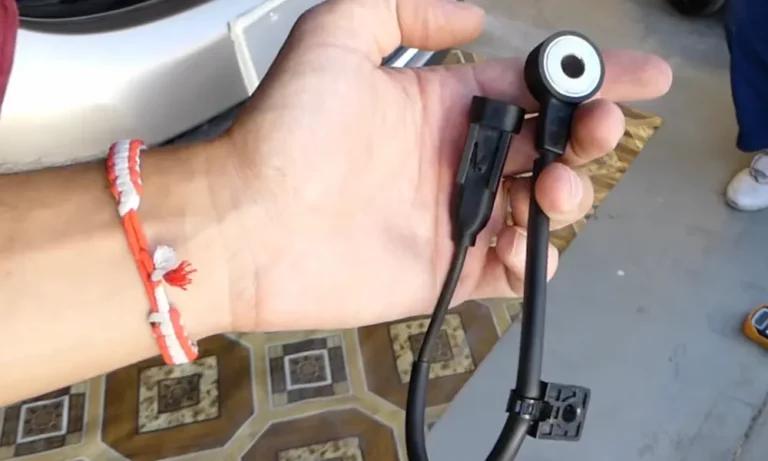
Think of the knock sensor as your engine’s ear. It’s bolted directly to the engine block and listens for abnormal combustion — that rattling “ping” sound that happens when the fuel-air mix ignites too early or chaotically.
Inside the sensor sits a piezoelectric crystal. When the engine block vibrates from knocking, that crystal generates a tiny voltage signal. Your engine control unit (ECU) reads that signal and immediately retards ignition timing to smooth things out.
Without a working knock sensor, your ECU flies blind. It can’t protect your engine from detonation — and detonation left unchecked can crack piston rings, erode cylinder heads, and cause catastrophic engine failure.
Symptoms of a Bad Honda Knock Sensor
Don’t ignore these warning signs:
- Check engine light — almost always the first signal
- Sluggish acceleration — the ECU enters a conservative “limp” mode and retards timing statically
- Worse fuel economy — sometimes a 10–15% drop
- Rough idle — especially noticeable on cold starts
- Transmission won’t shift into top gear — common on turbocharged or high-compression Honda engines
The ECU triggers a fault code when the sensor voltage exceeds 4.8V or drops below 0.2V above 2,000 RPM. Either extreme tells the computer the circuit is open, shorted to power, or shorted to ground.
Understanding Honda Knock Sensor Codes
Grab an OBD-II scanner and look for these codes:
| Code | Definition | Location |
|---|---|---|
| P0325 | Knock Sensor 1 Circuit Malfunction | Bank 1 — primary or only sensor |
| P0332 | Knock Sensor 2 Circuit Low Input | Bank 2 — V6 secondary sensor |
| P0333 | Knock Sensor 2 Circuit High Input | Bank 2 — V6 secondary sensor |
On four-cylinder Hondas (Civic, CR-V, Accord 2.4L), there’s only one sensor. On V6 models (Pilot, Odyssey, Ridgeline), Bank 1 sits on the firewall side of the engine.
Why Honda Knock Sensors Fail — Including One You’d Never Expect
Moisture and Corrosion
Road salt, slush, and water collect around the sensor’s mounting point. Corroded terminal pins raise electrical resistance, which disrupts the delicate voltage signal the ECU depends on. This is especially common in northern states.
Rodent Damage (Yes, Really)
Here’s the one that surprises most Honda owners. About 20 years ago, Honda and other automakers switched to soy-based wire insulation as part of a sustainability push. Mice, rats, and squirrels find that soy coating delicious.
The knock sensor lives in a warm, tucked-away spot — right where rodents love to nest. A single chewed wire causes an immediate P0325 code. This became so widespread it triggered federal class-action litigation against Honda.
Honda’s fix? Capsaicin-infused rodent tape (part number 4019-2317) — literally spicy tape that burns a rodent’s mouth when chewed. Wrap repaired harnesses with it after replacement.
| Rodent Deterrent | Active Agent | How to Use |
|---|---|---|
| Honda Rodent Tape | Capsaicin (chili pepper) | Half-wrap over repaired wire sections |
| Ultrasonic Repellers | High-frequency sound | Mount in engine bay |
| Peppermint Spray | Menthol/peppermint oil | Spray on underbody components |
| Physical Mesh Barriers | Wire mesh | Block entry points into engine bay |
Where Is the Knock Sensor Located on Your Honda?
Location varies significantly by engine family — and it directly affects how hard this job is.
K-Series 2.4L (Accord, CR-V, Element)
The sensor hides underneath the intake manifold runners on the engine block. You can’t see it from above. You’ve got two options:
- Top-down: Remove the battery, cooling fans, and possibly the intake manifold for clear access
- Bottom-up: Drop the undertray and reach up past the starter motor — mostly done by feel
J-Series 3.5L V6 (Pilot, Odyssey, Ridgeline)
The sensor sits in the valley between the two cylinder banks. You must remove the air intake plenum and lower intake manifold to reach it. Budget extra time — this is a several-hour job. The entire knock sensor sub-harness often needs replacement due to heat damage or rodent activity in the valley.
R-Series 1.8L and L-Series 1.5T (Civic)
The 1.8L R-series mirrors the K-series placement — behind the intake manifold. The newer 1.5L turbocharged L-series is more accessible. The sensor sits more centrally on the block and can often be reached from underneath with swivel joints and extensions — no major disassembly required.
Tools You’ll Need
Don’t start this job without the right tools. The sensor’s location makes standard wrenches nearly useless.
| Tool | Spec | Why You Need It |
|---|---|---|
| Deep Socket | 24mm or 27mm | Fits the sensor body itself |
| Standard Sockets | 8mm, 10mm, 12mm, 17mm | Splash shields, manifolds, brackets |
| Ratchet Extensions | 3″, 6″, 12″ | Reach past intake runners |
| Universal Swivel Joint | 3/8″ or 1/4″ drive | Navigate tight angles |
| Torque Wrench | Low-range (ft-lbs) | Critical for correct installation |
| Long-nose Pliers | Angled preferred | Release the electrical connector clip |
A crowfoot wrench is worth grabbing too. The plastic connector housing on some Honda sensors is wider than the hex base, and a standard deep socket won’t clear it cleanly.
Step-by-Step Honda Knock Sensor Replacement
Safety First — Before You Touch Anything
- Let the engine cool completely — burns are not worth it
- Disconnect the negative battery terminal
- If you’re working from underneath, use jack stands — never just a floor jack
Bottom-Up Method (CR-V, Element, Civic 1.8L)
- Lift the front of the vehicle and secure it on jack stands
- Remove the plastic undertray — ten-millimeter bolts plus plastic trim clips
- Locate the sensor on the front face of the block, above the oil filter near the starter
- Spray electronics cleaner on the connector if it’s caked with grime, then press the release tab and disconnect it
- Attach your 27mm deep socket to a long extension with a swivel joint
- Turn counter-clockwise to remove — this part is mostly done by feel
- Clean the mounting surface with a wire brush and mild solvent
- Thread the new sensor in by hand first, then torque to spec (see table below)
- Reconnect the harness and reinstall the undertray
Top-Down Method (V6 J-Series Models)
- Remove the engine cover, air intake system, and throttle body
- Unbolt and remove the lower intake manifold — cover the open intake ports immediately with masking tape or clean paper towels to prevent debris from entering the combustion chambers
- The knock sensor and its sub-harness are now visible in the valley
- Disconnect the harness connector and unscrew the sensor
- Clean the mounting surface thoroughly
- Install the new sensor and torque to spec
- Reassemble in reverse order — use new intake manifold gaskets
Torque Specs — Don’t Skip This
This is the most critical part of the entire job. Undertighten the sensor and it vibrates independently, creating false signals. Overtighten it and you’ll crush the internal piezoelectric crystal, destroying the new sensor immediately.
Always use a torque wrench. A compact 1/4″ or 3/8″ drive model is much easier to maneuver in tight spaces than a larger 1/2″ drive.
| Engine | Torque (lb-ft) | Torque (Nm) |
|---|---|---|
| K-Series 2.4L | 23 lb-ft | 31 Nm |
| J-Series V6 3.5L | 16 lb-ft | 22 Nm |
| R-Series 1.8L | 16–20 lb-ft | 22–27 Nm |
One more thing — don’t apply anti-seize or thread sealant unless the sensor comes with a pre-applied dry coating. Extra compounds between the sensor and the block dampen the acoustic signal and can cause the code to return immediately after a successful installation.
How to Complete the Honda Drive Cycle After Replacement
Replacing the sensor won’t automatically clear the check engine light. You’ll need to clear the code with an OBD-II scanner, then complete a specific drive cycle so the ECU can verify the repair. This matters especially in states with smog check requirements — a “not ready” monitor means an automatic emissions test failure.
Here’s Honda’s recommended drive cycle:
- Cold start: Let the engine sit for at least one hour. Start it and idle for 2.5 minutes with the A/C and rear defroster on
- Accelerate: Turn off accessories and smoothly accelerate to 55 mph at half throttle
- Cruise: Hold 55 mph for 3–5 minutes while the ECU analyzes the sensor signal
- Decelerate: Lift off the throttle and coast down to 20 mph — no brakes, no gear changes
- Repeat: Run this cycle 2–3 times until the monitor shows “complete”
What If the Code Returns After Replacement?
A persistent P0325 after a fresh sensor install points to something deeper. Check for these related issues:
- Cooling system running hot — hot spots in the cylinder head cause real detonation that the new sensor correctly detects
- Lean fuel mixture — a vacuum leak or failing MAF sensor raises combustion temps; look for P0171 (lean mixture) codes alongside P0325
- Mechanical noise mimicking knock — piston slap, a rattling timing chain, or a failing alternator bearing all produce vibrations the sensor can misread as detonation
A mechanic’s stethoscope held against different engine components while it runs will help you pinpoint localized noise sources before you assume the new sensor is defective.
Also — avoid cheap aftermarket sensors. Professional technicians consistently recommend genuine Honda OEM sensors. Discount sensors frequently have incorrect frequency tuning, and you’ll be back under the car redoing this job within weeks.
What Does Honda Knock Sensor Replacement Cost?
Here’s what you’re looking at if you take it to a shop versus doing it yourself:
| Honda Model | Parts Cost | Labor Cost | Total Estimated |
|---|---|---|---|
| Civic (4-cyl) | $87–$118 | $199–$292 | $285–$409 |
| Accord (4-cyl) | $80–$110 | $150–$265 | $230–$375 |
| CR-V (4-cyl) | $90–$120 | $150–$254 | $240–$374 |
| Odyssey (V6) | $100–$140 | $287–$420 | $387–$560 |
| Pilot (V6) | $110–$150 | $308–$460 | $418–$610 |
| Ridgeline (V6) | $120–$160 | $347–$524 | $467–$684 |
The DIY savings are real — especially on V6 models where labor alone can push $500. The four-cylinder bottom-up approach is physically awkward but manageable. The V6 top-down job is legitimately complex — new intake manifold gaskets are required, and a misaligned gasket creates a vacuum leak that causes its own set of trouble codes.
If you’ve never removed an intake manifold before, the four-cylinder models are a solid starting point. The V6 is better left to someone with experience — or at least a full afternoon and a solid repair manual in hand.