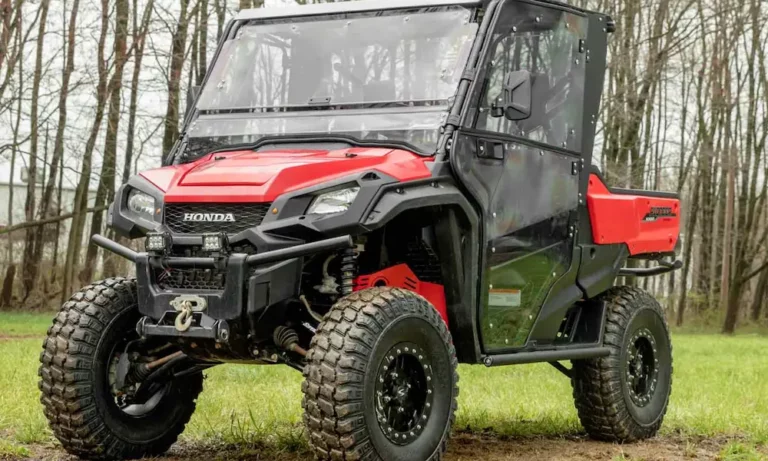
Doing your own Honda Pioneer 1000 oil change saves money and keeps your DCT transmission from turning into an expensive paperweight. But there’s a catch — this machine has two filters, two engine drain plugs, a separate sub-transmission, and a maintenance minder that won’t reset itself. Get any of it wrong and you’re looking at real damage. Read through this guide before you grab a wrench.
Why the Pioneer 1000 Oil Change Isn’t Like Other UTVs
Most side-by-sides use a CVT with a dry belt. The Pioneer 1000 runs a Dual-Clutch Transmission with wet clutch packs fully submerged in engine oil. That’s the same oil lubricating your pistons, cylinder walls, and valve train.
This matters a lot when choosing oil. The wrong lubricant doesn’t just cause extra wear — it causes the clutch plates to slip, glaze over, and eventually destroy the transmission entirely.
The Only Oil You Should Use
The 2025 Pioneer 1000 Owner’s Manual is clear on this: use oil rated API SJ or higher with a JASO MA certification. SAE 10W-30 or SAE 10W-40 both work.
Never use “energy conserving” or “resource conserving” oils. These contain friction modifiers built for car engines. In a wet-clutch system, those same friction modifiers cause clutch slippage and transmission pressure failure.
Good options include:
- Pro Honda HP4S Synthetic 10W-30 — Honda’s own recommendation
- Any AMSOIL product rated for the Pioneer 1000 SXS1000 with JASO MA certification
- Quality synthetic 10W-30 with the correct API and JASO ratings
Exact Oil Capacities (Don’t Guess)
Here’s where a lot of people get burned. Several aftermarket guides claim the Pioneer 1000 holds 6.8 US quarts. That number is wrong. Overfilling causes oil foaming, seal failure, and crankcase pressure buildup.
Use the factory-specified capacities:
| Service Type | Capacity (US Quarts) | Drain Plug Torque | Cover Bolt Torque |
|---|---|---|---|
| Engine drain only | 5.80 qt | 22 lbf·ft (30 N·m) | — |
| Engine drain + primary filter | 6.08 qt | 22 lbf·ft (30 N·m) | 9 lbf·ft (12 N·m) |
| Engine drain + both filters | 6.10 qt | 22 lbf·ft (30 N·m) | 9 lbf·ft (12 N·m) |
| Sub-trans (2016–2021 models) | 1.27 qt | 22 lbf·ft (29 N·m) | — |
| Sub-trans (2022–2026 models) | 1.22 qt | 22 lbf·ft (29 N·m) | — |
Always change both filters every service. The tiny difference in capacity between filter options isn’t worth cutting corners.
OEM Parts You’ll Need
Use genuine OEM parts to protect those aluminum threads and keep seals tight. Here’s what you need for a full service:
- Primary engine filter — Honda part #15412-HP7-A01
- DCT transmission filter — Honda part #15412-MGS-D21
- Engine filter cover O-ring — 39.8×2.2mm, part #91302-PA9-003
- DCT filter cover O-ring — 75×2.5mm, part #91301-107-000
- 14mm crush washer (oil tank drain plug) — part #94109-14000
- 12mm crush washers ×2 (oil pan plug + sub-trans drain) — part #94109-12000
One important note on crush washers: some aftermarket kits include generic 17mm washers that won’t fit the Pioneer’s 12mm and 14mm drain plugs. Don’t use them. Buy exact OEM sizes.
Step-by-Step Honda Pioneer 1000 Oil Change
Warm Up the Engine and Get Access
Run the engine for three to five minutes. Warm oil drains faster and pulls more contaminants with it. Park on a flat surface and set the parking brake.
Raise the rear cargo bed and find the plastic access panel behind the rear seats. Pull the retaining pins and remove it. Take off the oil fill cap on top of the cylinder head so the crankcase can vent properly.
Drain the Engine Oil
Position your drain pan under the engine. The Pioneer 1000 has a dry-sump system with two engine drain plugs — one drains the oil pan, one drains the integrated oil tank. Remove both with a socket wrench and let everything drain completely.
Swap the old crush washers for new ones:
- 14mm washer on the oil tank plug
- 12mm washer on the oil pan plug
Thread both bolts in by hand first to avoid cross-threading. Torque both to 22 lbf·ft (30 N·m).
Replace the Primary Engine Filter
Find the filter cover marked “ENG” on the left side of the engine block. Put shop towels underneath it, remove the three bolts, and pull the cover off.
Slide out the old filter cartridge. Don’t lose the steel spring at the back of the filter cavity — clean it and put it back in. Wipe the housing clean.
Toss the old O-ring. Fit the new 39.8×2.2mm O-ring onto the cover and coat it lightly with fresh oil. Insert the new filter with the “OUTSIDE” stamp facing outward. Set the spring back on the filter end, align the cover, and torque the bolts in a cross-pattern to 9 lbf·ft (12 N·m).
Replace the DCT Filter
The secondary filter cover is stamped “DCT” and sits right next to the engine filter. Same process — place towels underneath, remove the bolts, pull the cover.
Remove and toss the old filter and O-ring. Fit the new 75×2.5mm O-ring with a light coat of oil. Slide in the new DCT filter, reinstall the cover, and torque the bolts to 9 lbf·ft (12 N·m).
Refill the Engine Oil
Pour 6.1 US quarts of fresh SAE 10W-30 through the fill port on top of the cylinder head. Tighten the fill cap.
Start the engine and let it idle for about 30 seconds. This circulates the new oil and fills the dry filter housings. Shut it off and let the oil settle for a few minutes.
Find the dipstick access panel on the rear driver’s side floorboard. Remove the two push pins and lift the panel. Pull the dipstick, wipe it clean, then reinsert it fully without screwing it in. Pull it out again and confirm the oil level sits within the crosshatched marks. Add oil as needed.
The Sub-Transmission Oil Change
The sub-transmission runs a completely separate oil reservoir from the main engine. It needs its own oil change using the same SAE 10W-30 you just used in the engine.
Draining and Refilling
Remove the driver’s seat cushion and the protective lid underneath. Pull out the sub-transmission dipstick and fill cap to vent it. Position a drain pan below the housing.
Find the sub-trans drain bolt on the underside of the case. Don’t mix it up with the nearby engine drain plugs. Remove it, drain completely, swap the 12mm crush washer, and reinstall. Torque to 22 lbf·ft (29 N·m).
Use a long-neck funnel to add:
- 1.22 US quarts for 2022 and newer models
- 1.27 US quarts for 2016–2021 models
Check the level with the dipstick resting on the threads (not screwed in). The oil line should reach the upper hash mark. Reinstall the dipstick hand-tight, then replace the seat lid and cushion.
Reset the Maintenance Minder
After every Honda Pioneer 1000 oil change, you need to reset the electronic maintenance minder manually. The wrench icon on your dash won’t disappear on its own.
Here’s how to reset it:
- Turn the ignition key fully OFF
- Press and hold the SEL/SET switch on the instrument cluster
- While holding it, turn the ignition to ON (don’t start the engine)
- Keep holding the switch for several seconds
- The wrench icon lights up, blinks twice, then disappears
The system now tracks the next 100-hour or 600-mile service interval automatically.
How Often Should You Change the Oil?
Standard intervals work fine for casual trail riding. But the Pioneer 1000 often works hard — and hard work breaks down oil faster than any schedule assumes.
Heavy loads and slow speeds restrict airflow to the radiator. Oil temps can spike past 220°F. At that heat, viscosity breaks down, the protective film thins out, and bearing and cylinder wear accelerates. Water crossings can turn oil into a milky emulsion that clogs DCT solenoids and triggers fault codes like P1890 or P0868 — which lock your transmission into limp-home mode.
Use this as your guide:
- Light trail riding or paved roads → every 100 hours or 600 miles
- Moderate dust, occasional water crossings → every 75 hours or 450 miles
- Heavy farming, deep mud, desert heat, commercial use → every 50–60 hours
Always replace both filters, both O-rings, and all crush washers at every service — not just some of them. Reusing old crush washers is how small oil leaks turn into transmission pressure problems.
Keep the radiator fins clean between services too. Mud-packed fins cause overheating, which kills oil life faster than anything else.