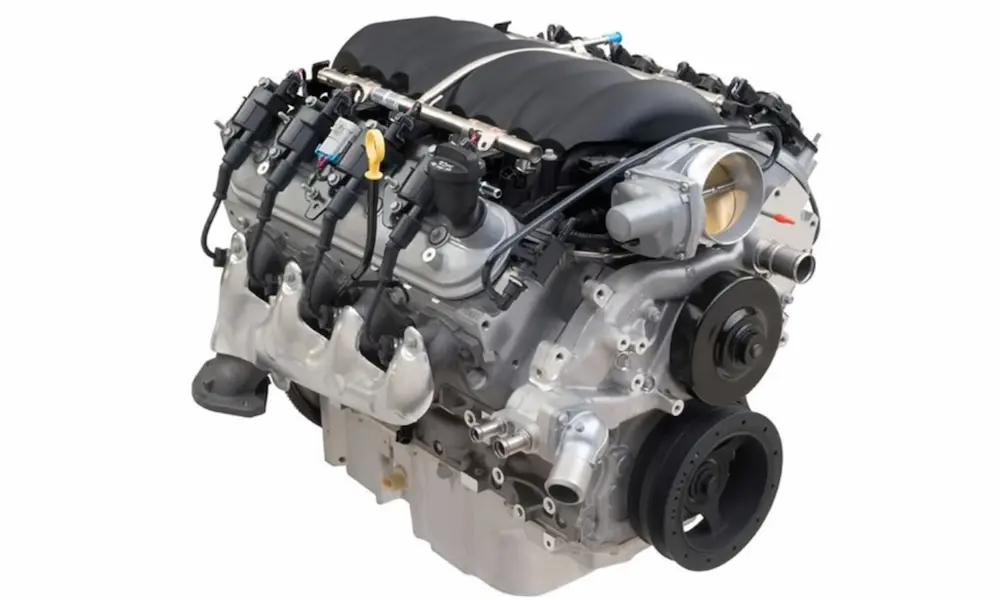
So you want to know everything about the LS3 engine specs? You’re in the right place. Whether you’re planning a swap, shopping for a Corvette, or just nerding out over one of the best V8s ever built, this guide covers it all — block, heads, cam, fuel system, and more. Stick around to the end for the crate engine breakdown and reliability notes you won’t want to miss.
What Is the LS3 Engine?
The LS3 is a 6.2-liter, naturally aspirated V8 from General Motors’ fourth-generation small-block family. It replaced the 6.0-liter LS2 and debuted in the 2008 Chevrolet Corvette. At its core, the LS3 was GM’s answer to a very specific challenge: more power, better airflow, smaller packaging, and cleaner emissions — all at once.
It delivered. The LS3 pushed out 430 horsepower in base trim and quickly became the go-to powerplant for serious performance builds.
Here’s the quick-hit spec summary before we go deep:
| Spec | Detail |
|---|---|
| Displacement | 376 cubic inches (6.2L) |
| Bore | 4.065 inches |
| Stroke | 3.622 inches |
| Compression Ratio | 10.7:1 |
| Peak Horsepower | 430–436 hp |
| Peak Torque | 424–428 lb-ft |
| Redline | 6,600 RPM |
| Firing Order | 1-8-7-2-6-5-4-3 |
| Recommended Fuel | Premium pump gasoline |
LS3 Engine Block: What’s Under the Skin
The LS3 uses a cast-aluminum block with cast-iron cylinder sleeves pressed into the bores. Aluminum keeps the weight down. The iron sleeves handle the heat and friction that bare aluminum simply can’t survive long-term.
A few things make this block stand out:
- Deep-skirt design — The casting extends below the crankshaft centerline, stiffening the bottom end significantly
- Six-bolt main caps — Four vertical bolts plus two cross-bolts per journal. This cross-bolting technique locks the caps in place and kills “main cap walk” before it starts
- Internal AFM oil passages — The block has them, but the LS3 doesn’t use them. That’s intentional. GM used the same casting for the L99 (which does use cylinder deactivation), keeping production costs down
The bore spacing sits at 4.400 inches with a deck height of 9.240 inches — numbers that matter a lot when you’re choosing aftermarket heads or planning a stroker build.
Rotating Assembly: Crank, Rods, and Pistons
The LS3’s internals are a balance between lightweight performance and production-grade durability. The whole assembly is internally balanced, so no external counterweights are needed on the balancer or flexplate.
Crankshaft
In most street applications, the LS3 runs a nodular iron crankshaft (Part Number 12597569). Nodular iron absorbs vibration well and handles the stresses of daily driving without complaint.
The Corvette Grand Sport with a manual transmission got something better: a forged-steel crankshaft. Steel forgings resist fatigue better under sustained high-load track conditions.
Both versions use a 58X reluctor wheel — a 58-tooth ring the ECM reads to track crankshaft position with precision. Earlier small-blocks used a 24X wheel. The jump to 58 teeth gives the computer far more resolution, which directly improves ignition timing accuracy at the LS3’s 10.7:1 compression ratio.
Connecting Rods and Pistons
The connecting rods (Part Number 12649190) are powdered metal, I-beam design, 6.098 inches long. They use a fractured cap — the large end is literally snapped off after forging. That broken surface can only fit back together one way, creating a perfect mating interface without any machining.
The pistons are hypereutectic aluminum, loaded with silicon to control thermal expansion. They’re flat-top with zero CC dome volume, which works with the 68cc combustion chamber to hit that 10.7:1 compression target. Full-floating wrist pins reduce reciprocating friction and hold up well at high RPM.
| Rotating Assembly Spec | Wet-Sump | Dry-Sump |
|---|---|---|
| Crankshaft Material | Nodular Iron | Forged Steel |
| Connecting Rod Style | Powdered Metal I-Beam | Powdered Metal I-Beam |
| Piston Material | Hypereutectic Aluminum | Hypereutectic Aluminum |
| Piston Style | Flat Top | Flat Top |
| Reluctor Wheel | 58X | 58X |
| Wrist Pin Diameter | 0.9431 in | 0.9431 in |
LS3 Cylinder Heads: Where the Magic Happens
The heads are the biggest reason the LS3 made such a leap over its predecessors. GM went with rectangular intake ports — the same design first seen on the high-output L92 truck engine and the LS7. Gone was the “cathedral port” shape from older small-blocks. In came a design that moves seriously more air.
Port and Combustion Chamber Specs
The intake ports (Casting Number 821) measure 257 cubic centimeters and are rectangular in cross-section. The exhaust ports are D-shaped at 87cc. The combustion chambers come in at 68cc — sized to work with the flat-top pistons for the desired compression ratio.
Valve Sizes and Materials
- Intake valves: 2.165 inches diameter, hollow-stem steel
- Exhaust valves: 1.590 inches diameter, solid-stem steel
The hollow intake stems cut valve weight without sacrificing strength. Less weight means the valve springs can snap them shut cleanly at 6,600 RPM. The exhaust valves stay solid because they need mass to conduct heat away from the valve face.
| Cylinder Head Spec | Detail |
|---|---|
| Casting Number | 821 |
| Intake Port Volume | 257cc |
| Exhaust Port Volume | 87cc |
| Combustion Chamber Volume | 68cc |
| Intake Valve Diameter | 2.165 in (hollow stem) |
| Exhaust Valve Diameter | 1.590 in (solid stem) |
| Valve Angle | 15 degrees |
Valvetrain: Camshaft, Rockers, and Springs
The LS3 runs a traditional overhead-valve pushrod setup — one cam in the block, pushrods, rockers, done. GM kept this design because it stays physically compact and sits low in the engine bay, helping with center of gravity.
Camshaft Specs
The LS3 camshaft (Part Number 12623066) is a hydraulic roller — roller lifters mean less friction on the lobes. The profile hits:
- Intake duration: 204° at 0.050″
- Exhaust duration: 211° at 0.050″
- Intake lift: 0.551 inches
- Exhaust lift: 0.525 inches
- Lobe separation angle: 117°
That 117° LSA keeps the overlap low, which helps with idle quality, emissions, and a broad, usable torque curve.
Rockers, Pushrods, and Springs
Rocker arms use a 1.7:1 ratio — every inch of pushrod movement becomes 1.7 inches at the valve. Because the rectangular intake ports push the pushrod off to one side, the intake rockers carry a 6.25mm offset. Exhaust rockers are straight.
The valve springs are beehive-shaped — wide at the base, narrow at the top. This geometry reduces mass and dampens harmonics at high RPM. Pushrods are steel, 7.385 inches long.
Induction, Fuel System, and Throttle Control
The LS3 breathes through a composite plastic intake manifold. Plastic insulates heat from the block, keeping intake charge temperatures lower. Cooler air is denser. Denser air makes more power. Simple physics.
A 90mm electronic throttle body sits on top — fully drive-by-wire. No cable connects your foot to the engine. The ECM handles everything, which makes traction control and stability systems work seamlessly.
Fuel delivery runs through port injection, with injectors (Part Number 12576341) flowing 42 lb/hr at 58 psi system pressure. GM’s installation guide specifies a fuel pump capable of maintaining 58 psi and delivering at least 45 gallons per hour. Run premium fuel — the ECM will pull timing on lower octane, and you’ll feel it in performance.
Lubrication: Wet Sump vs. Dry Sump
Oil system configuration depends entirely on which vehicle the LS3 came from.
Wet-Sump Capacities by Model
Different chassis required different oil pan designs, which changed capacities:
| Vehicle | Sump Type | Oil Capacity |
|---|---|---|
| Corvette (Base/Z51) | Wet Sump | 5.5–6.0 quarts |
| Corvette Grand Sport (Manual) | Dry Sump | 10.5 quarts |
| Camaro SS (2010–2015) | Wet Sump | 8.0 quarts |
| Chevrolet SS Sedan | Wet Sump | 8.0 quarts |
| Pontiac G8 GXP | Wet Sump | 6.0–6.5 quarts |
Dry-Sump System
The Corvette Grand Sport with a manual gearbox used a factory dry-sump setup. A two-stage pump pulls oil from a very shallow pan and routes it to a remote 10.5-quart tank. No oil slosh during hard cornering. No pump sucking air. It’s the right system for track use, and it’s genuinely impressive to see it in a factory application.
GM specifies full synthetic oil meeting the dexos standard, typically 5W-30. Track-focused builds sometimes run 0W-40.
Ignition System and Firing Order
The LS3 runs a coil-near-plug ignition setup — eight individual coils, each mounted on the valve cover directly above its cylinder. Short plug wires, minimal resistance, cleaner signal.
The firing order is 1-8-7-2-6-5-4-3, a change from the classic Chevy 1-8-4-3-6-5-7-2 sequence. GM made this switch to spread crankshaft loads more evenly, reduce harmonics, and extend durability at high RPM. It works — this engine revs smoothly right to the 6,600 RPM limit.
The E38 ECM manages everything through a 58X crank sensor and a 4X camshaft position sensor up front. That combination allows sequential fuel injection — the ECM times the spray for each cylinder individually. Spark plugs gap at 0.055 inches from the factory.
LS3 Vehicle Applications
The LS3 appeared in several high-performance GM models over nearly a decade:
| Vehicle | Years | Horsepower | Torque |
|---|---|---|---|
| Chevrolet Corvette | 2008–2013 | 430–436 hp | 424–428 lb-ft |
| Chevrolet Camaro SS (Manual) | 2010–2015 | 426 hp | 420 lb-ft |
| Pontiac G8 GXP | 2009 | 415 hp | 415 lb-ft |
| Chevrolet SS Sedan | 2014–2017 | 415 hp | 415 lb-ft |
One important note: the automatic Camaro SS used the L99, not the LS3. The L99 has cylinder deactivation and variable valve timing. If you’re shopping for an LS3-powered Camaro, you want the manual transmission car.
The 2009 Pontiac G8 GXP holds a special place — it was the most powerful Pontiac ever built, and it’s become a collector’s item now that the brand is gone.
Reliability and Common Issues
The LS3’s reputation for durability is well-earned. No variable cam timing, no cylinder deactivation solenoids, fewer moving parts overall. With regular maintenance, these engines run for hundreds of thousands of miles.
That said, there are three issues worth knowing about:
Valve seat loosening — The iron valve seats in the aluminum heads can let go if the engine overheats. Aluminum expands more than iron, and if the interference fit loosens enough, the seat drops into the cylinder. That’s usually a total engine loss. Don’t overheat it.
Camshaft bearing wear — The cam bearings need clean, pressurized oil. Old oil or frequent cold starts without warm-up wear them prematurely. Once wear starts, oil pressure drops, and things escalate fast. Change your oil on schedule with quality full synthetic.
Cylinder sleeve thickness variation — Some blocks came from the factory with sleeves bored slightly off-center. Under stock power, it’s a non-issue. Push past 600–700 horsepower with boost, and a thin-sided sleeve can crack. Most builders agree the stock block is safe to about 600–700 hp. Beyond that, upgrade the block or the sleeves.
LS3 Crate Engine Options
Chevrolet Performance sells the LS3 as a crate engine, making it one of the most popular swap engines on the market. You can drop it into a vintage Camaro, a kit car, a truck, or whatever project you’re running.
| Crate Variant | Part Number | HP / Torque | Key Feature |
|---|---|---|---|
| Standard LS3 | 19435098 | 430 / 425 | Factory cam, Camaro pan |
| LS376/480 | 19420381 | 495 / 473 | Upgraded “Hot Cam” |
| LS376/525 | 19540156 | 525 / 486 | Aggressive ASA Racing Cam |
| 6.0L LS3 Hybrid | 19434650 | 452 / 441 | Iron block, LS3 heads |
For a complete swap, you’ll also need a controller (Part Number 19354328), an electronic pedal, and a returnless high-pressure fuel system. The Camaro-style oil pan that ships with the crate engine sits deep at the rear — it’ll hit the crossmember in most older cars. GM’s Muscle Car Oil Pan Kit (Part Number 19212593) solves that problem specifically for 1960s and ’70s engine bays.
The LS376/525 is worth a mention — it idles rough and choppy like a proper race engine, but it needs a higher stall converter in automatics to work right. Plan accordingly before you order.
The LS3 engine specs tell a story of deliberate engineering choices that paid off. Rectangular ports, hollow-stem intakes, cross-bolted mains, a 58X reluctor — every decision served a purpose. The result is an engine that defined the final generation of naturally aspirated, port-injected small-block performance before GM moved to the direct-injected LT family in 2014. It can handle 1,000 horsepower with the right internals, it fits in almost anything, and the parts ecosystem is enormous. That’s why builders still reach for it first.