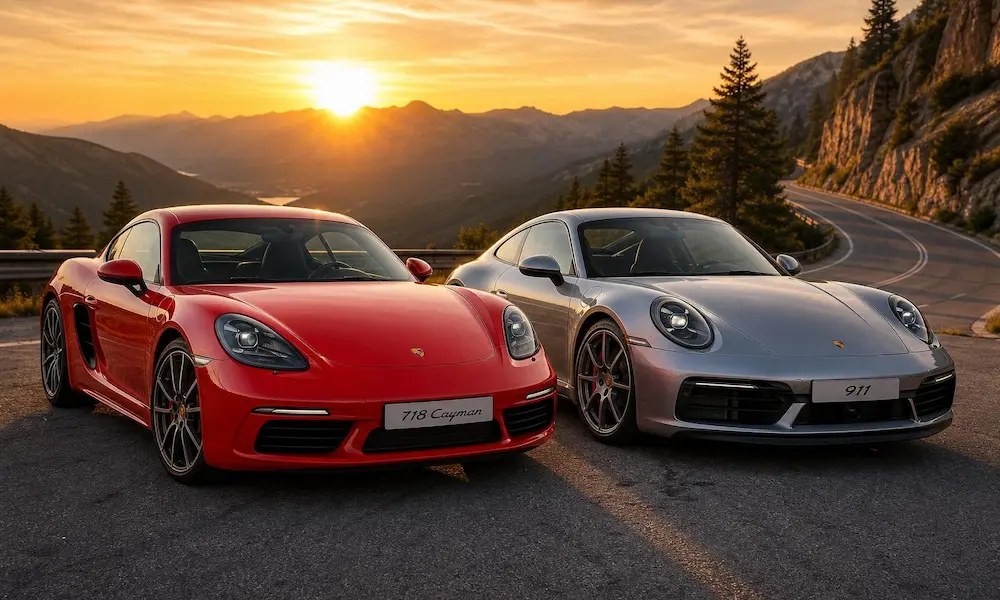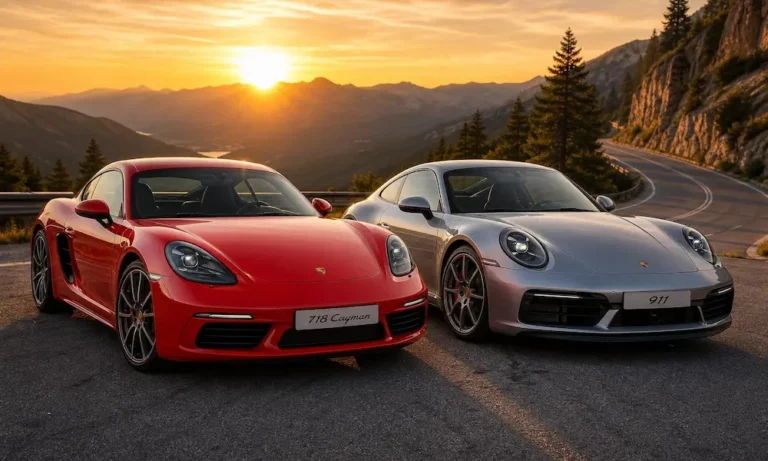
Choosing between the Porsche 718 vs 911 isn’t straightforward — both cars are brilliant, but for very different reasons. Pick the wrong one and you’ll spend years wondering “what if.” Pick the right one and every drive feels like a reward. Stick around, because this breakdown covers everything from engine physics to trunk space — and yes, we’ll tell you which one wins for your situation.
The Real Difference Starts With Where the Engine Sits
This isn’t just a spec-sheet detail. Engine placement changes everything about how a car feels, accelerates, and handles.
The 718 Cayman and Boxster use a mid-engine layout — the engine sits behind you but in front of the rear axle. That keeps the weight centered inside the wheelbase. The result? A car that rotates eagerly and feels almost telepathic through corners. Drivers describe it as a scalpel.
The 911 does the opposite. Its engine hangs behind the rear axle, putting roughly 61% of the weight over the driven wheels. That sounds scary, but it creates explosive traction under acceleration — the harder you push, the more the rear tires dig in.
Here’s the quick breakdown:
| Specification | 718 Cayman GTS 4.0 | 911 Carrera (992.2) |
|---|---|---|
| Engine Location | Mid-Rear | Rear-Rear |
| Weight Distribution | 44% Front / 56% Rear | 39% Front / 61% Rear |
| Curb Weight | 3,208 lbs | 3,354 lbs |
| Wheelbase | 97.4 inches | 96.5 inches |
| Length | 172.4 inches | 177.9 inches |
How Each Car Handles at the Limit
The 718’s balance is forgiving and predictable. Push it hard and it warns you gently before anything gets exciting. That makes it ideal for tight canyon roads and technical track days.
The 911 rewards patience. You need a “slow in, fast out” approach to extract its best. But at highway speeds, its wider track and heavier rear make it feel planted and supremely stable — like it’s on rails.
Neither is better in absolute terms. They’re just different tools for different drivers.
The 2025 Porsche 718 Lineup: Every Trim Explained
The 2025 718 is the last pure-gasoline generation of this car before Porsche transitions to electric. That makes these models increasingly collectible — especially the high-output variants.
Base Models and Style Edition
The entry-level Cayman starts at $75,400 with a 2.0-liter turbocharged four-cylinder producing 300 hp. It hits 60 mph in 4.7 seconds. The Boxster version starts at $77,600. Both use a compact turbocharger designed for snappy mid-range response. The Style Edition adds exclusive aesthetics without changing the mechanicals.
S Variants: More Punch, More Fun
The S models step up to a 2.5-liter turbo four with variable turbine geometry — 350 hp, 309 lb-ft, and a 4.2-second sprint to 60. Top speed hits 177 mph. It’s the sweet spot between daily driver and weekend weapon.
GTS 4.0: The Enthusiast’s Choice
This is where things get properly exciting. Porsche drops in a 4.0-liter naturally aspirated flat-six making 394 hp. No turbo lag. Linear power delivery all the way to the redline. It comes standard with Porsche Active Suspension Management (PASM) and a sport exhaust that sounds genuinely spectacular. Starting price: $103,300.
GT4 RS and Spyder RS: Street-Legal Race Cars
These sit at the top of the 718 food chain. A 911 GT3-derived 4.0-liter engine produces 493 hp. Zero to 60 in 3.2 seconds. Top speed approaching 196 mph. These aren’t weekend toys — they’re serious performance machines with aggressive aero and race-tuned chassis.
| 2025 718 Variant | Engine | HP | 0-60 | Top Speed | MSRP |
|---|---|---|---|---|---|
| Cayman Base | 2.0L Turbo 4 | 300 | 4.7s | 171 mph | $75,400 |
| Cayman S | 2.5L Turbo 4 | 350 | 4.2s | 177 mph | $87,900 |
| GTS 4.0 | 4.0L NA 6 | 394 | 3.8s | 179 mph | $103,300 |
| GT4 RS | 4.0L NA 6 | 493 | 3.2s | 196 mph | $170,100 |
The 2026 Porsche 911: A Major Upgrade Just Arrived
The 2026 911 (the 992.2 generation) brings a serious technology overhaul — including Porsche’s first performance hybrid system in a standard 911.
Base Carrera Models
The entry Carrera now makes 388 hp from its 3.0-liter twin-turbo flat-six — up from the previous generation. It reaches 60 mph in 3.9 seconds. Add the Carrera S and you get 473 hp with a 3.3-second 0-60. For drivers in snowy or wet climates like the Northeast or Pacific Northwest, the “4” all-wheel-drive variants add confidence without sacrificing fun.
The T-Hybrid GTS: Porsche’s Biggest Bet
The 2026 GTS introduces Porsche’s T-Hybrid system — a 3.6-liter turbocharged six paired with an electric motor inside the PDK gearbox. It’s not a plug-in hybrid. The 1.9 kWh battery charges through the engine and regenerative braking. Total output: 532 hp and 449 lb-ft of torque. Zero to 60 in 2.9 seconds.
The electric motor eliminates turbo lag by delivering instant torque before the turbocharger builds full boost. It’s the cleverest performance solution Porsche has ever built into a standard 911. Starting price: $181,000.
GT3 and Turbo S: The Extremes
The GT3 stays naturally aspirated — 502 hp from a 4.0-liter flat-six screaming to a 9,000 RPM redline. Pure, analog, magnificent. The Turbo S cranks out 701 hp and hits 60 mph in 2.4 seconds. These are cars for very serious drivers with very serious budgets.
| 2026 911 Variant | Engine | HP | 0-60 | Top Speed | MSRP |
|---|---|---|---|---|---|
| Carrera | 3.0L Twin Turbo 6 | 388 | 3.9s | 183 mph | $135,500 |
| Carrera S | 3.0L Twin Turbo 6 | 473 | 3.3s | 191 mph | $156,200 |
| Carrera GTS | 3.6L T-Hybrid 6 | 532 | 2.9s | 194 mph | $181,000 |
| GT3 | 4.0L NA 6 | 502 | 3.2s | 193 mph | $235,800 |
| Turbo S | 3.8L Hybrid 6 | 701 | 2.4s | 200 mph | $270,300 |
Daily Life: Seats, Storage, and Practicality
This is where the 718 and 911 diverge sharply in real-world usefulness.
How Many People Can You Carry?
The 718 is a strict two-seater. If you’re taller than 6’3″, the mid-engine bulkhead limits rearward seat travel — it can get cozy.
The 911 is a 2+2. Those rear seats aren’t for adults on long road trips, but they’re genuinely useful for kids, pets, or a week’s worth of groceries. Fold them flat and you get a surprising interior shelf for longer items.
Trunk Space: The 718 Actually Wins Here
This surprises most people. The 718 Cayman has two separate trunks — a 5.3 cubic-foot frunk up front and a 9.7 cubic-foot hatchback at the rear. That’s roughly 15 cubic feet total — enough for two carry-on bags and more.
The 911’s engine takes up the rear, leaving only a 4.6 to 4.8 cubic-foot front trunk. It’s a tight squeeze for a weekend away.
| Feature | 718 Cayman | 911 Carrera |
|---|---|---|
| Seating | 2 | 2+2 |
| Front Trunk | 5.3 cu ft | 4.6–4.8 cu ft |
| Rear Storage | 9.7 cu ft (hatchback) | None (engine) |
| Total Cargo | ~15.0 cu ft | ~4.6–4.8 cu ft |
| Rear Seat Utility | N/A | Foldable shelf |
Tech and Infotainment: A Clear Generation Gap
The 718 and 911 are noticeably far apart when it comes to digital features and connectivity.
The 718’s Older Setup
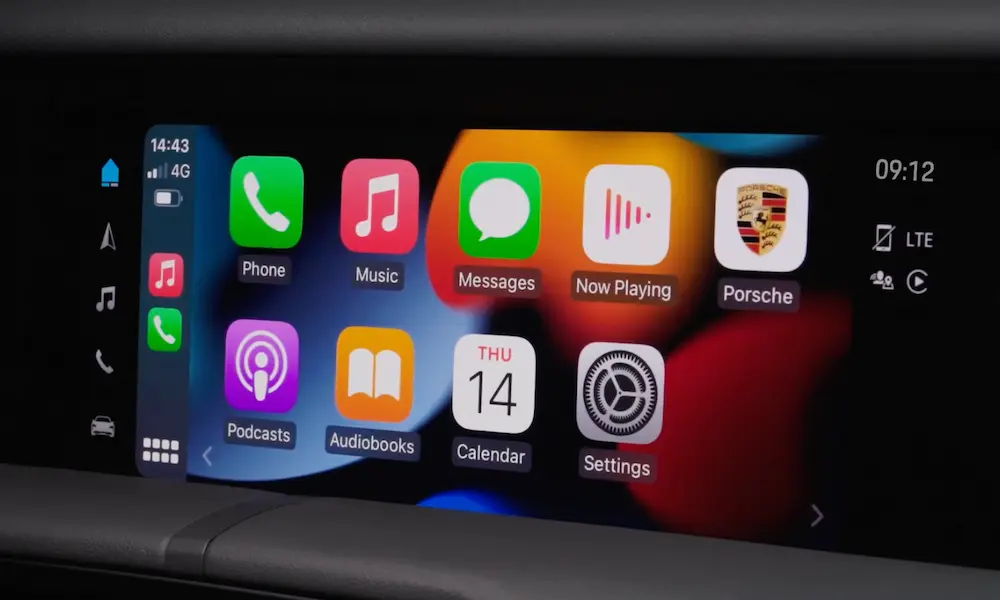
The 718 runs a 7-inch touchscreen with an older version of Porsche Communication Management (PCM). It supports wired Apple CarPlay and a standard 8-speaker audio system. The instrument cluster is mostly analog with a small 4.6-inch digital display. It works fine — but it feels dated compared to newer cars in this price range.
The 911’s Digital Cockpit
The 2026 911 is a completely different experience. A 12.6-inch curved digital instrument cluster greets you. The central 10.9-inch touchscreen runs PCM 6.0/7.0, based on Android Automotive. That means wireless Apple CarPlay, Android Auto, and over-the-air software updates. Driver profiles sync to the cloud and remember your climate settings, drive modes, and lighting preferences.
For ADAS, the 911’s newer platform supports lane-keeping assist, traffic sign recognition, ParkAssist, and optional features like InnoDrive predictive speed control and Night Vision Assist. The 718 offers parking sensors and a backup camera as standard, with limited upgrades beyond that. Purists love the 718’s relative simplicity. Tech enthusiasts will prefer the 911.
Ownership Costs: What to Budget Beyond the Sticker
Both cars require specialized Porsche maintenance. Here’s what that looks like in practice.
Service Schedules
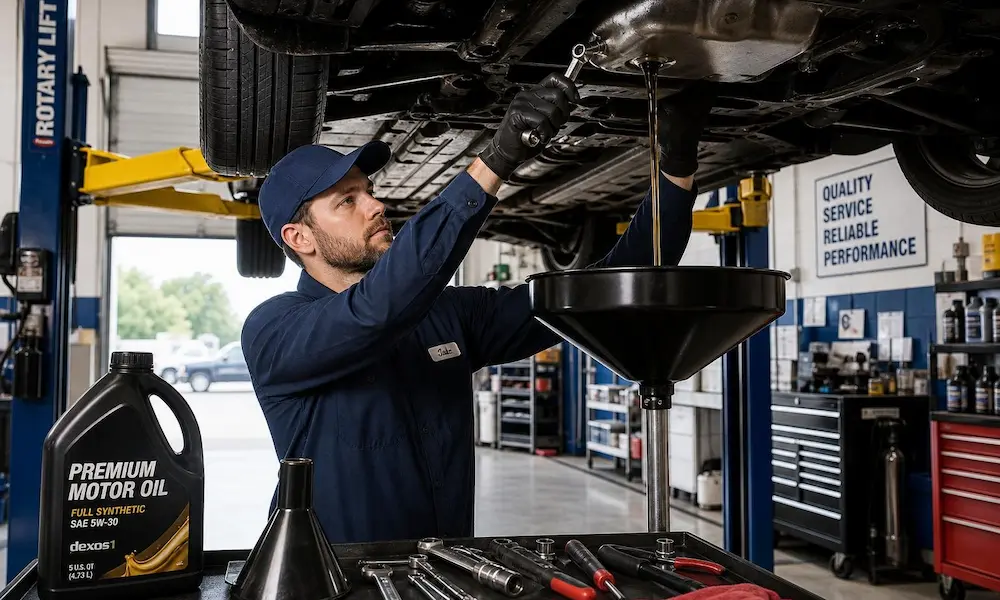
Porsche recommends servicing every 10,000 miles or 12 months, whichever comes first. A basic oil change and inspection runs $300 to $650. Larger services at 20,000 and 30,000-mile intervals add brake fluid flushes, cabin filters, and spark plug replacements.
| Service Item | Flat-4 (718 Base) | Flat-6 (718 GTS / 911) |
|---|---|---|
| Oil & Filter Change | 10,000 mi / 1 yr | 10,000 mi / 1 yr |
| Brake Fluid Flush | 20,000 mi / 2 yrs | 20,000 mi / 2 yrs |
| Spark Plugs | 30,000 mi | 30,000–40,000 mi |
| Cabin Air Filter | 20,000 mi / 2 yrs | 20,000 mi / 2 yrs |
| Tire Sealant | 40,000 mi / 4 yrs | 40,000 mi / 4 yrs |
The Porsche Scheduled Maintenance Plan (PSMP) lets you prepay for up to five years or 50,000 miles at locked-in rates — a smart hedge against rising dealership labor costs.
Resale Value
The 911 consistently outperforms most sports cars on depreciation — it’s one of the best value-holding cars in any segment. The 718 also retains value well, but the 911’s global prestige and demand give it an edge after five years. There’s an interesting twist for 2025 718 GTS and GT4 models: as Porsche moves the 718 to electric power, the last gasoline versions may actually appreciate due to collector demand.
Fuel Economy: Real-World Numbers
Neither of these cars is a Prius, but they’re respectable for their performance output.
| Model | City MPG | Highway MPG | Combined MPG |
|---|---|---|---|
| 718 Cayman 2.0L | 20–21 | 25–27 | 22–24 |
| 718 Cayman GTS 4.0 | 19 | 24 | 21 |
| 911 Carrera 3.0L | 18 | 25 | 21 |
| 911 GTS T-Hybrid | 17 | 23–24 | 19–20 |
| 911 Turbo S | 15 | 22 | 18 |
The base 718 with the 2.0-liter engine is the most fuel-efficient Porsche sports car you can buy. High-output variants like the GT4 RS and Turbo S can attract the US Gas Guzzler Tax — something worth checking before you configure either car.
So Which One Should You Buy?
Here’s the honest breakdown:
Choose the 718 if you:
- Prioritize pure driving feel and chassis balance above everything else
- Want more cargo space in a clever two-trunk layout
- Plan to track the car regularly
- Want to save $50,000+ compared to an equivalent 911
- Love the idea of owning the last gasoline 718 before it goes electric
Choose the 911 if you:
- Need occasional rear seats for kids, pets, or extra bags
- Want the most advanced tech and connectivity available from Porsche
- Plan to use it as a primary or high-frequency daily driver
- Want the prestige and resale security of the 911 nameplate
- The T-Hybrid GTS performance figures make your eyes water in a good way
The 718 and 911 are built for different versions of the same driver. One prioritizes surgical driving purity. The other offers world-class versatility wrapped in an icon. Both are extraordinary. The right choice just depends on how — and how often — you plan to drive it.