Your Porsche key fob just stopped working. Or maybe it’s getting sluggish. Either way, you’re probably wondering if it’s the battery — and if you can fix it yourself. Good news: you almost certainly can. This guide walks you through every generation, every fob style, and everything you need to know to get it done right.
What Battery Does a Porsche Key Fob Use?
Most Porsche key fobs use a CR2032 lithium coin cell battery. A few older or smaller fobs use a CR1616 instead.
The CR2032 is a Lithium Manganese Dioxide cell that outputs a steady 3 volts — double what a standard alkaline battery delivers. That extra power lets the fob transmit encrypted signals over a longer range and communicate securely with your car’s immobilizer system.
Here’s a quick comparison of the coin cells you might encounter across Porsche models:
| Battery | Diameter | Height | Voltage | Capacity |
|---|---|---|---|---|
| CR2032 | 20mm | 3.2mm | 3.0V | ~225 mAh |
| CR2025 | 20mm | 2.5mm | 3.0V | ~165 mAh |
| CR1616 | 16mm | 1.6mm | 3.0V | ~55 mAh |
| CR1632 | 16mm | 3.2mm | 3.0V | ~130 mAh |
Always double-check your specific model before buying. Installing the wrong size can damage the battery holder or leave the fob non-functional.
Where to Buy a Replacement Battery
The CR2032 is everywhere. You don’t need to order one online or visit a dealership.
- AutoZone, O’Reilly, NAPA, Advance Auto Parts — Great options if you want it today. AutoZone stocks Energizer lithium CR2032 batteries rated for extreme temperatures, which matters if you’re in Arizona or Minnesota.
- Home Depot and Lowe’s — Often carry Panasonic CR2032 batteries, which is the brand Porsche uses as OEM.
- Target and Walmart — Stock Energizer and Duracell coin cells at competitive prices, often in multi-packs.
- Amazon or eBay — If you want Panasonic OEM equivalents in bulk, eBay has two-packs with tracking for under $10.
Expect to pay $3–$6 for a single CR2032 at retail. Skip the no-name batteries — cheap cells can fail faster, especially in temperature extremes.
Signs Your Porsche Key Battery Is Dying
Don’t wait until your fob completely stops working. These are the signs it’s time to swap the battery.
Reduced range is usually the first clue. You used to unlock your car from across a parking lot. Now you need to stand right next to the door. That’s a weak battery.
Intermittent button response is another red flag — especially the trunk or hood release buttons, which require a stronger signal.
Keyless entry failures on models with Porsche Entry and Drive mean the car won’t unlock when you grip the door handle, or the engine won’t start.
Dashboard warnings tell you exactly what’s going on:
- “Key: replace battery” (Yellow) — Low voltage detected, but the fob still works. This is your cue to act soon.
- “Key not recognized in vehicle” (Yellow) — The car can’t read the fob’s signal. Battery is nearly dead, or something’s blocking the signal.
- “Driver’s Key Fault” (Red) — This is more serious. A red warning often points to a hardware fault inside the key or the vehicle’s immobilizer reader — not just a dead battery. This one warrants a closer look.
Porsche Key Battery Replacement by Model Generation
The design of Porsche keys has evolved dramatically over the decades — and so has the replacement process. Find your model below.
996 and 986 Generation (1997–2005): The Sidewinder Key
The 996-generation 911 and original Boxster used a laser-cut “sidewinder” key blade paired with a simple two-piece plastic remote head.
Steps:
- Find the small seam where the two halves of the plastic key head meet.
- Gently pry the halves apart using a small flathead screwdriver or a firm fingernail.
- Note the orientation of the old battery — the positive terminal faces up.
- Pop in the new CR2032 with the positive side facing up.
- Press the two halves together until you hear a click.
That’s it. No tools required beyond a small screwdriver.
997 and 987 Generation (2005–2012): Integrated Remote
The 997 911, 987 Boxster, and Cayman fob is slightly more weather-resistant, with a more integrated design.
Steps:
- Hold the fob with the buttons facing up.
- Find the small slot near the base of the key blade.
- Insert a thin flathead screwdriver into the slot and gently pry up the cover.
- Carefully remove any rubber weather guard inside.
- Pry out the old CR2032 and replace it — positive terminal up.
- Reassemble and press shut.
Pro tip: If the remote doesn’t respond after reassembly, try this hard reset trick from the Porsche community — briefly place the battery in the reversed position for about 10 seconds before installing it correctly. It clears a stuck logic state in the fob’s microchip.
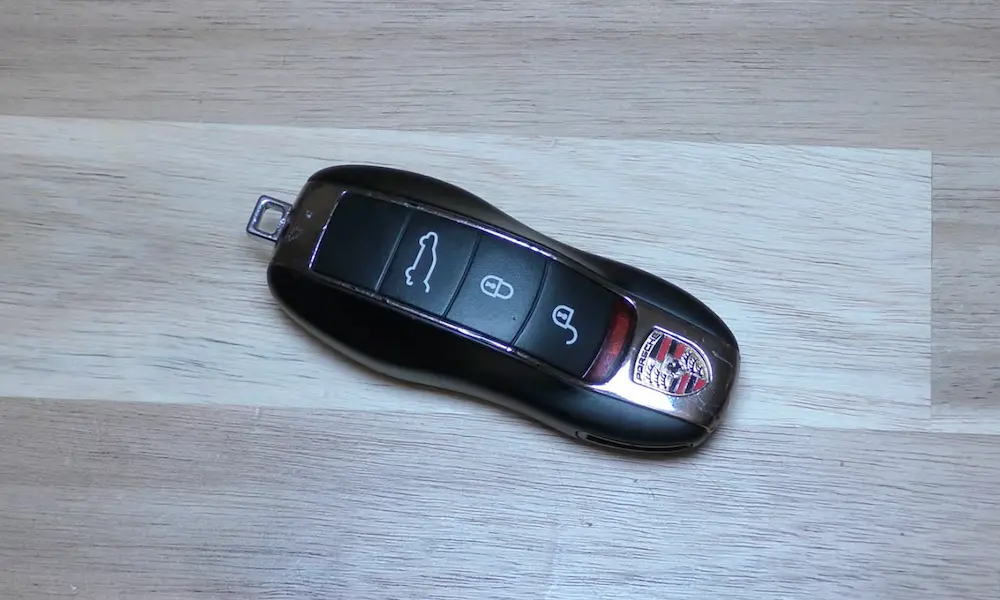
Car-Shaped Smart Fob (991, 981, 958, 971 Models, 2011–2019)
This is the iconic fob shaped like the car’s silhouette. It looks great but requires a few more steps to open. Here’s the full visual process on YouTube if you want to follow along.
Steps:
- Find the small slider at the base and pull out the mechanical emergency key blade completely.
- Use the tip of the key or your thumb to pry the two plastic side panels away from the main body — they snap off.
- In the center of the fob body, you’ll see a circular black cover with an “Open” arrow. Rotate it counter-clockwise to unlock.
- Lift the cover and swap the CR2032 — positive side facing up, toward you.
- Lock the cover by rotating it clockwise.
- Snap the side panels back in and reinsert the emergency key.
If you want to watch this done in real time, this replacement video covers it clearly.
Taycan and 2020+ Models: Modern Fob
The Taycan fob is sleeker and more compact. The battery swap process is similar to the 991-era fob but with a slightly different entry point.
Steps:
- Find the small indent or release button on the edge of the fob and press to separate the two halves.
- Look for the circular twist-off battery cover inside. Use a coin or the mechanical key blade to rotate it counter-clockwise.
- Swap the CR2032 — positive terminal facing outward (away from the circuit board).
- Lock the cover clockwise and reassemble the halves.
For 2025+ models specifically: After removing the outer casing, you’ll need a small flat-head screwdriver to pry out a secondary internal housing before accessing the battery. This step-by-step video covers the 2025 update in detail.
How to Re-Sync Your Key Fob After Replacing the Battery
Sometimes a fresh battery isn’t enough. Porsche fobs use rolling security codes, and if the fob lost power long enough — or if someone pressed the buttons repeatedly out of range — it falls out of sync with the car.
Manual re-sync steps (most models):
- Unlock the driver’s door manually using the emergency key blade.
- Get in the car and insert the key into the ignition within 15 seconds.
- Turn the ignition to “On” without starting the engine.
- Press and hold the Lock button on the remote for 5–15 seconds.
- Wait for confirmation — usually a horn chirp or a flash of the lock indicator on the dash.
This works for most Porsche models. If your fob still won’t sync, CarBuzz has a thorough rundown of key fob reprogramming techniques worth checking.
Taycan and 992: The Cup Holder Fix
Taycan and newer 992 owners sometimes see the “Key battery low” warning persist even after installing a fresh battery. The fix is oddly simple: place the key in the front cup holder or the designated center console spot and drive for a few miles.
That spot contains a low-frequency antenna that lets the car read the key’s transponder directly and verify the new voltage. The warning clears on its own once the system confirms the battery is healthy.
The Seven-Day Standby Problem (And How to Fix It)
Here’s something that trips up a lot of Porsche owners: if your car sits untouched for seven consecutive days, the remote receiver automatically shuts down to protect the 12-volt main battery.
When you come back and press the fob buttons — nothing happens. It feels like a dead battery, but it’s not. The car is just asleep.
The fix: unlock the driver’s door with the physical key blade. That mechanical action wakes the vehicle’s electronics and reactivates the remote receiver. Everything goes back to normal instantly.
Why Your Porsche Key Battery Dies Faster Than Expected
A few things can drain your Porsche fob faster than normal — and most owners don’t realize they’re doing any of them.
Proximity drain: If you keep your keys within 15–20 feet of your car at home, the fob and car stay in a constant low-level communication loop. The fob never enters sleep mode, so the battery drains faster than it should. This is also a known vector for relay theft attacks — thieves use signal boosters to relay that signal and unlock the car remotely.
The simple fix: store your keys in a Faraday bag or a small metal-lined box. It blocks the signal and your battery will last noticeably longer.
Climate effects: Extreme cold slows the chemical reaction inside the Lithium Manganese Dioxide cell, temporarily dropping voltage. That can trigger “key not recognized” warnings even with a good battery. Extreme heat does the opposite — it accelerates self-discharge. A battery that lasts two years in a mild climate might only last 12–18 months in places like Phoenix or Denver.
Best Practices for Porsche Key Battery Maintenance
Keep these habits and you’ll avoid most key fob headaches:
- Replace the battery every 12–18 months as preventative maintenance — don’t wait for warnings.
- Test the new battery with a multimeter before installing it. Anything below 3V means the cell is already partially depleted.
- Clean the battery contacts when the fob is open. A cotton swab with a tiny amount of electronic contact cleaner works perfectly.
- Know where your physical door lock is. On some models it’s hidden under a cap or integrated into the handle. Find it before you need it.
- Store keys away from the vehicle — more than 20 feet, or use a Faraday bag — to prevent passive drain and reduce theft risk.
How Much Does Porsche Key Replacement Actually Cost?
A single CR2032 battery costs $3–$6. The Porsche key battery replacement process itself takes about five minutes once you’ve done it once.
Compare that to a full key replacement at a US dealership, which typically runs $400–$800 — including hardware and programming labor. A $5 battery every year or two is genuinely one of the highest-value maintenance tasks you can do on a Porsche.
Take care of the fob you have. It’s a lot cheaper than replacing it.