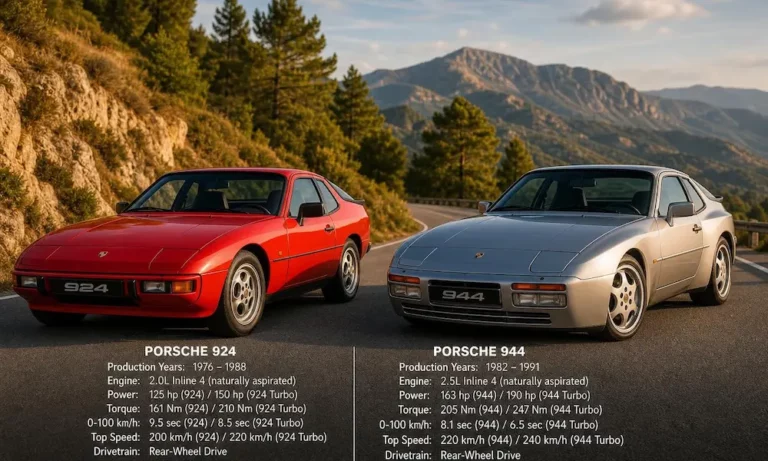
Choosing between a Porsche 924 and a 944 feels simple until you start digging. The differences go way deeper than just horsepower. This guide breaks down exactly what separates these two iconic sports cars — engines, interiors, reliability quirks, and real-world value — so you can pick the right one for your garage.
The Short Version: What’s the Core Difference?
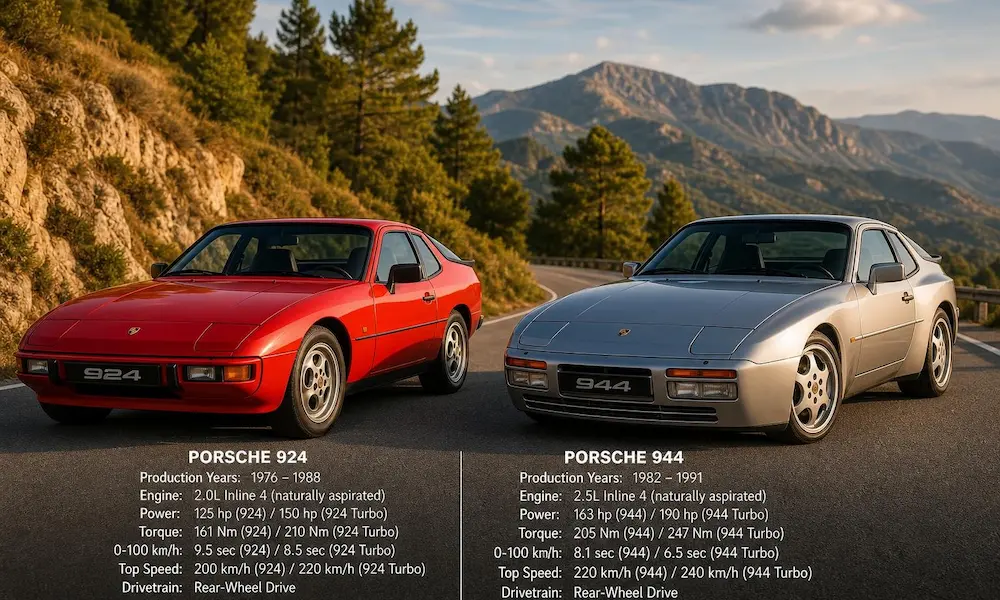
The 924 and 944 share the same DNA. Both use a front-engine, rear-transaxle layout that gives them a near-perfect 50/50 weight split. But they’re built from very different ingredients.
The 924 launched in 1976 using a Volkswagen/Audi-sourced engine and borrowed suspension parts. The 944, which arrived in 1982, replaced nearly everything with proper Porsche hardware — a bespoke engine, wider bodywork, bigger brakes, and a vastly improved interior.
Think of the 924 as the raw, honest sports car. Think of the 944 as the polished, grown-up version.
Origins: Why the 924 Started as a VW Project
The story behind these cars is fascinating. In the early 1970s, Volkswagen hired Porsche to design a modern sports coupe. The project, codenamed EA425, used as many off-the-shelf VW and Audi parts as possible to keep costs down.
Then the 1973 oil crisis hit. VW got cold feet and killed the project. Porsche, seeing exactly what they had, bought the rights back for $60 million and sold the car as a pure Porsche. Production stayed at the Audi factory in Neckarsulm, but the badge was all Stuttgart.
The 924 effectively saved Porsche from financial trouble. Without it, there might not have been a 944, a 928, or even a modern 911.
Engine Comparison: VW Parts Bin vs. Purpose-Built Porsche
This is where the Porsche 924 vs 944 debate really heats up.
The 924’s 2.0-Liter: Honest but Limited
The 924 uses the EA831 engine, a 2.0-liter inline-four jointly developed by Audi and Volkswagen. Porsche fitted it with an aluminum cylinder head and Bosch K-Jetronic fuel injection, but it was still fundamentally a workhorse motor from the Audi 100 and VW LT van.
US-market cars suffered the most. Early emission regulations strangled output down to just 95 horsepower. By 1977 that crept up to 110 hp, but it still felt underwhelming in a car wearing a Porsche badge.
The 924 Turbo, launched in 1978, helped bridge the gap with a KKK turbocharger pushing output to 143–170 horsepower depending on the year.
The 944’s 2.5-Liter: Built From Scratch
The 944’s engine is a completely different story. Porsche engineers created an all-alloy 2.5-liter four-cylinder that was essentially half of the 5.0-liter V8 from the flagship 928. It shared the same bore and stroke dimensions, just with four cylinders instead of eight.
Because a large-displacement four-cylinder naturally vibrates, Porsche licensed counter-rotating balance shaft technology from Mitsubishi. The result was an engine that ran as smoothly as many six-cylinders of the era.
US-Market Engine Numbers at a Glance
| Model Year | Model | Displacement | Horsepower |
|---|---|---|---|
| 1977–1982 | 924 Base | 1,984 cc | 110 hp |
| 1980–1982 | 924 Turbo | 1,984 cc | 143 hp |
| 1983–1985 | 944 Base | 2,479 cc | 143 hp |
| 1986–1988 | 944 Base | 2,479 cc | 147 hp |
| 1987–1988 | 924S | 2,479 cc | 150–158 hp |
| 1989 | 944 Base | 2,681 cc | 165 hp |
| 1989–1991 | 944 S2 | 2,990 cc | 208 hp |
The 944 S2’s 3.0-liter engine was the largest production four-cylinder of its era. That’s a remarkable engineering achievement that still turns heads today.
Body and Aerodynamics: Narrow vs. Wide
Stand both cars side by side and the difference is obvious.
The 924 is slim and clean, with a drag coefficient of 0.36. Its narrow body kept weight down and gave it a delicate, almost fragile appearance. US-spec cars got heavy 5-mph impact bumpers and round side-marker lights that added visual bulk — a price of compliance.
The 944 took its wide-body cues from the 924 Carrera GT, a homologation special built for Le Mans racing. Those flared arches weren’t just for looks. They let Porsche widen the track, fit larger tires, and dramatically improve grip.
Despite the wider stance, the 944 squeezed its drag coefficient down to 0.35 using a more integrated front air dam and a reshaped rear spoiler.
Both cars share the same pop-up headlights and glass hatchback silhouette. But the 944 looks purposeful where the 924 looks elegant.
Interior: Square Dash vs. Oval Dash
If you’re shopping a Porsche 924 vs 944, pay close attention to the dashboard. It tells you a lot about what era of car you’re buying.
The Early “Square” or “Porthole” Dash (Pre-1985.5)
Both the 924 and early 944s used this layout — three separate round gauge pods, a boxy center console, and switchgear lifted directly from the VW/Audi parts bin. It’s charming in a retro way, but the dashboards are notorious for cracking in hot climates, and the materials feel budget-tier.
The “Oval” Dash Revolution (1985.5 Onwards)
Mid-1985 brought the most important interior update in the transaxle Porsche’s history. Enthusiasts call it the “eighty-five-and-a-half” refresh. The changes were significant:
- A sweeping, integrated instrument cluster with four gauges in one cohesive panel
- Larger, better-positioned ventilation vents
- Redesigned door panels with integrated speakers and storage
- A more ergonomic center console and shifter position
- The fuse and relay panel moved from the driver’s footwell to the engine bay — keeping sensitive electronics away from moisture
The new interior finally felt like it belonged in a Porsche rather than a rebadged Golf. For US buyers, it also brought better standard air conditioning — essential in American summers.
Porsche 924 vs 944: Reliability and the Maintenance Reality
These cars reward careful owners and punish neglected ones. Here’s what you need to know before buying either.
Timing Belt: The Most Critical Service Item
The 944’s 2.5-liter engine is an interference design. If the timing belt snaps, the valves hit the pistons. You’re looking at thousands in engine damage. Replace it every 30,000–45,000 miles or every five years, whichever comes first.
The 944 also has a secondary balance shaft belt. If it’s incorrectly tensioned, you’ll hear a high-pitched whine and feel vibration through the cabin. Both belts get done together — always.
The DME Relay: Tiny Part, Big Headache
The Digital Motor Electronics relay is the 944’s most notorious gremlin. It controls power to both the engine management computer and the fuel pump. After decades of heat cycles, the solder joints crack internally. The result is either a no-start condition or the car suddenly dying while you’re driving.
| Symptom | Likely Cause | Fix |
|---|---|---|
| Car dies when hot, restarts later | DME relay heat-sink failure | Replace relay; carry a spare |
| No-start with fuel smell | Failed sensors or fouled plugs | Check reference sensors on bellhousing |
| No-start, no fuel pump noise | Failed DME relay or fuse | Bypass terminals 30, 87, and 87b to test |
| Heavy vibration at 3,000 RPM | Failed mounts or balance belt | Replace with OEM hydraulic mounts |
The Rubber Clutch Problem
Early 944s used a rubber-centered clutch disc designed to absorb drivetrain shock. Good idea in theory. In practice, the rubber perishes — especially in hot US climates — and leaves drivers stranded with a loud clunk and a car that won’t move properly.
Most specialists now recommend converting to a spring-centered clutch design, similar to the 944 Turbo’s setup. It lasts longer and gives you a more communicative pedal feel.
Power Steering Fluid: Use the Right Stuff
The 944’s power steering system has a non-replaceable internal filter inside the reservoir. Over time, metallic particles clog it and starve the pump of fluid. The pump whines, then fails.
The fix is straightforward — replace the plastic reservoir periodically. It’s cheap. Ignoring it leads to an expensive rack replacement.
One more critical point: use only Dexron-rated ATF, not standard power steering fluid. Regular fluid causes the ZF steering rack seals to swell and fail.
Safety: The 944 Made History
The Porsche 924 vs 944 debate takes an interesting turn when you look at safety innovations.
In 1987, the US-market 944 Turbo became the first car in the world equipped with both driver and passenger airbags as standard equipment. That’s a remarkable achievement for a small sports car in that era. By 1990, dual airbags were standard across all US-market Porsches.
US versions of both cars also came with hydraulic shock-absorbing bumpers to meet DOT’s 5-mph impact requirement. They add weight and change the car’s look compared to Euro models, but they kept insurance rates manageable.
Special Editions Worth Knowing About
924 Carrera GT: The Homologation Rocket
Built to qualify for Le Mans, the 924 Carrera GT features wide plastic fenders, a hood scoop, and 210 horsepower from its turbocharged 2.0-liter. It was never officially imported to the US, but a few arrived privately. They’re among the most collectible Porsches ever made.
1988 944 Turbo S “Silver Rose”
This car is a benchmark in four-cylinder performance. The 247-horsepower turbocharged engine, Koni adjustable suspension, and “Big Red” brakes borrowed from the 928 S4 made it genuinely fast by any standard. The first run came in Silver Rose metallic paint with a burgundy plaid Studio interior. It’s blue-chip collector material today.
1988 924S Special Edition
Only 500 were built for North America — all black with a maroon and grey interior. Porsche stripped out power windows and power steering to save weight and fitted the M030 sport suspension. It’s the most driver-focused 924 variant ever made.
Water Leaks: The Hidden Ownership Tax
Both cars have specific leak points that owners learn to manage.
The sunroof on the 924 and 944 uses four drainage tubes running through the A and C pillars. When these clog with debris, water overflows into the headliner and rear footwells. A length of nylon string trimmer line clears them easily — make it part of your routine.
More damaging is the battery tray area. If corrosion develops there, water seeps directly into the passenger footwell and soaks the DME computer located under the floorboard. On 1985.5-and-later cars, a failing seal around the external fuse box allows water to drip onto sensitive relays. Keep the scuttle drain area under the windshield clear — it prevents most of these issues.
What Are These Cars Worth in 2026?
The perception of both cars has shifted dramatically. They’re no longer “cheap Porsches.” They’re legitimate collectibles with real appreciation behind them.
The average 944 in good condition has risen roughly 75% since 2020, now sitting around $21,200. Turbo and S2 variants regularly cross $50,000 at auction.
| Model | Average Value (Good Condition) | Investment Outlook |
|---|---|---|
| 1981 924 Base | $8,500 | Affordable, steady entry point |
| 1988 924S | $12,500 | Rising, popular with autocrossers |
| 1986 944 Base | $11,500 | High volume; condition is everything |
| 1989 944 S2 | $23,000 | Highly desirable, strong reliability |
| 1988 944 Turbo S | $45,000+ | Blue-chip collector status |
Cars finished in rare colors like Silver Rose or Zermatt Silver command premiums. So do cars with the op-art “Pasha” interior. The 924S is emerging as a sleeper pick — lighter than the 944, with 944-level power in a more aerodynamically efficient body.
So, 924 or 944? Here’s the Honest Answer
Buy the 924 if you want a lighter, simpler, more affordable sports car. The maintenance is less complex, parts commonality with VW/Audi makes servicing easier, and the driving experience is genuinely rewarding. The 924S in particular offers 944 performance without the premium price tag.
Buy the 944 if you want the complete package. More power, better brakes, a superior interior, and a purpose-built Porsche engine that proves these cars aren’t just rebadged Volkswagens. The S2 is the sweet spot — it’s the most modern expression of the platform and one of the most capable sports cars of the 1980s.
Either way, you’re buying a piece of Porsche history that saved the company, proved the transaxle concept works, and still puts a grin on your face every time you hit a sweeping corner. That’s not a bad deal for any budget.