Trying to touch up your Porsche but can’t find the paint code? You’re not the first person to spend 20 minutes staring at their car in confusion. This guide covers every location, every model, and every code format — so you can find yours fast and get the right color matched the first time. Keep reading.
Why Your Porsche Paint Code Actually Matters
Your paint code isn’t just a number on a sticker. It’s the exact chemical fingerprint of your car’s factory finish.
Here’s the thing: automotive manufacturers use the same color mixture across different models under completely different marketing names. One marketing name can also have multiple distinct formulations depending on the year. Without the exact code, a body shop is basically guessing.
Modern finishes contain metallic flakes, pearlescent additives, and specific clearcoat variants. Even a tiny deviation creates a visible panel mismatch — and that tanks your car’s value fast.
Where to Find Your Porsche Paint Code Location
The honest answer? It depends on your model and year. Porsche has moved the label around a lot over the decades. Here’s exactly where to look.
Start With the Owner’s Manual
This is the easiest place and the most overlooked. Porsche prints two identical Vehicle Data Labels at final assembly. One goes in the car, one goes inside the original Guarantee and Maintenance booklet.
If the sticker on your chassis is damaged, faded, or missing, grab the booklet first. It’s usually a perfect copy of what was applied to the car.
The Front Luggage Compartment (Frunk)
On the 911, Boxster, and Cayman, check here first. The sticker hides under the front hood liner. You’ll often need to unclip the plastic tabs and pull back the side carpeting to expose the label on the inner fender well or forward bulkhead.
This is the primary location for most water-cooled 911s, Boxsters, and Caymans.
Driver’s Side B-Pillar and Door Jamb
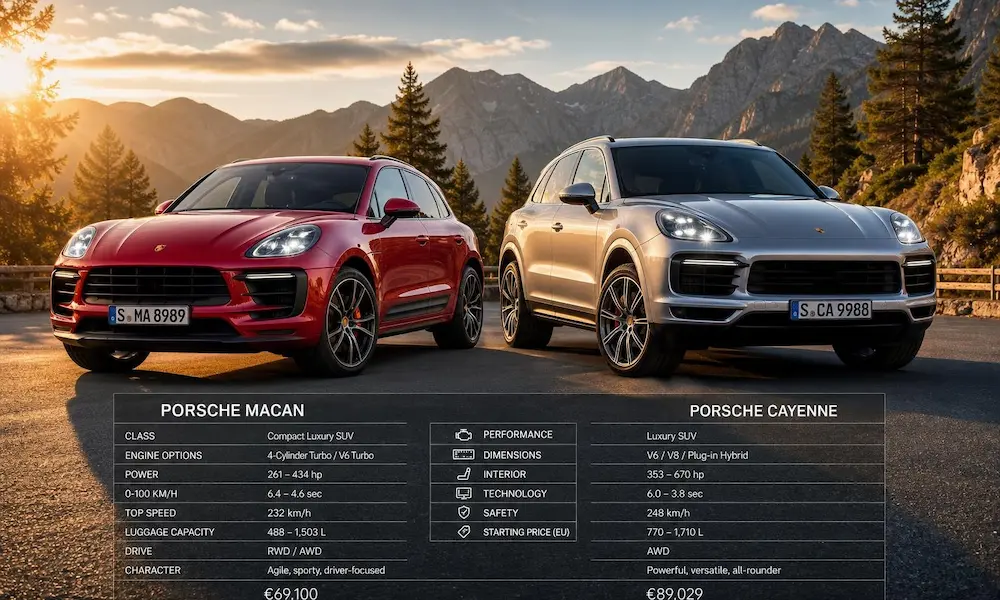
Modern Porsches — including the Macan, Taycan, and late-model 911 — use the B-pillar as the main data label spot. It’s the vertical roof support right behind your front door.
One important note: don’t confuse the paint data label with the federal safety sticker. The NHTSA-mandated compliance sticker is always on the B-pillar and shows your VIN, Gross Vehicle Weight Rating, and production date. That’s a different label. The paint code sits on a separate sticker nearby.
Spare Tire Compartment and Rear Cargo Area
For the Cayenne and Panamera, lift the trunk carpet and look next to or beneath the spare tire well. Because this area is protected from sunlight and heat, labels here are often in excellent condition — even on older cars.
Engine Bay and Firewall
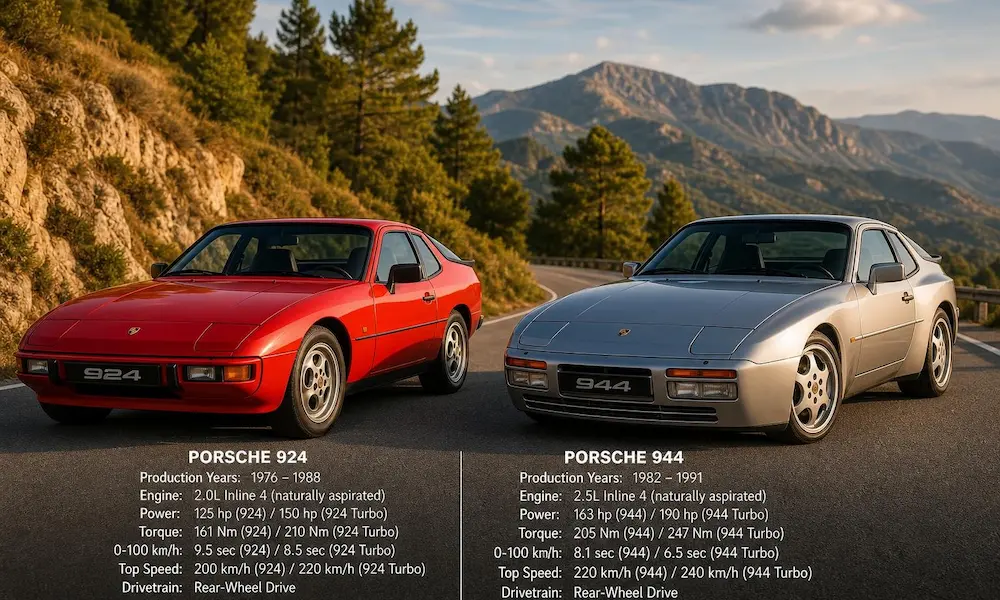
On the classic 924, 944, 928, and 968, plus older air-cooled 911s, check the engine bay. The code is stamped on a metal plate or foil sticker on the firewall, radiator support, or strut tower. Fair warning: engine bay labels often suffer from heat, oil, and harsh degreasers. They can be rough to read on unrestored cars.
The Missing Label Problem: A US-Specific Issue
Here’s something that catches a lot of US owners off guard. Porsche no longer applies the Vehicle Data Label at the factory. Instead, labels ship loose with the car inside the plastic bag containing the front license plate bracket.
If you’re in a state without a front plate requirement, that bag likely got thrown away — label and all. If your sticker is missing, check the owner’s manual first. If that’s gone too, contact Porsche Cars North America with your VIN.
Quick Reference: Porsche Paint Code Location by Model
| Model | Generation | Primary Location | Backup Location |
|---|---|---|---|
| 911 (F-Model) | 1963–1973 | Driver’s A-pillar / door hinge | Engine bay firewall |
| 911 (G-Series) | 1974–1989 | Underside of front hood | Driver’s door jamb |
| 911 (964/993) | 1989–1998 | Front hood underside | Service booklet |
| 911 (996/997) | 1999–2012 | Frunk beneath carpet | Inner rear panel / booklet |
| 911 (991/992) | 2012–Present | Frunk trim or B-pillar | Service booklet |
| Boxster/Cayman (986/987) | 1997–2012 | Frunk liner / spare tire area | Service booklet |
| Boxster/Cayman (981/718) | 2013–Present | B-pillar / driver door latch | Frunk bulkhead under carpet |
| Cayenne | All | Spare wheel well / cargo panel | Service booklet |
| Macan | All | Driver’s B-pillar | Front compartment / under hood |
| Panamera | All | Trunk side panel / under spare | Passenger footwell |
| Taycan | All | Driver’s door jamb / B-pillar | Front boot (frunk) |
How to Read the Paint Code Once You Find It
Finding the label is step one. Reading it correctly is step two — and this is where most people make expensive mistakes.
Look for “LACKNR./INNENAUSST.”
On the Vehicle Data Label, the paint code sits on a line labeled “LACKNR./INNENAUSST.” — German shorthand for “Paint No./Interior.” The paint code appears on the left side of that line. The interior trim code is on the right, separated by a forward slash.
So if you see C9X / AZ, that means Jet Black Metallic paint with a standard black interior.
What the “L” Prefix Means
Many Porsche paint codes start with “L.” This letter comes from the German word “Lack,” meaning paint, inherited from the broader Volkswagen Group. When you order touch-up paint or give a code to a body shop, drop the “L.” The chemical formula they need is everything after it.
- LC9A → body shop needs C9A (Pure White)
- L84A → body shop needs 84A (Guards Red)
- LM7W → body shop needs M7W (Meteor Gray Metallic)
Paint Code vs. Sales Code: Don’t Mix These Up
This is the most common mistake that causes repair disasters.
A sales code is a two-character string used when ordering a car. It’s what appears on your window sticker. A paint code is the multi-character string the factory robots and chemical suppliers actually use to mix the paint.
Giving a body shop your sales code instead of your paint code means they can’t mix the right color — full stop.
Here’s what that looks like in practice:
| Color Name | Sales Code (Window Sticker) | Actual Paint Code |
|---|---|---|
| Guards Red | G1 | L84A / 84A |
| Carrara White | B4 | LB9A / B9A |
| Jet Black Metallic | 2T | LC9X / C9X |
| Carmine Red | 0L | LM3C / M3C |
| Volcano Grey Metallic | 2H | LM7R / M7R |
| Chalk / Crayon | 3H | LM9A / M9A |
Two Codes on the Sticker? Here’s Why
Sometimes you’ll spot two codes separated by a forward slash — like M7Z/U2. The first code is the manufacturer’s chemical paint code. The second is the internal sales or order code. Both are correct. The body shop needs the first one.
Can You Find the Paint Code Using Your VIN?
Sort of — but not directly. The VIN doesn’t contain the paint code itself. Standard VIN decoders will show your model year, engine, and country of origin. They won’t spit out a paint formula.
What your VIN does is unlock Porsche’s internal build database. Give it to an authorized dealer or contact Porsche Cars North America, and they can pull your original build sheet — including the exact paint code applied on your car’s production day.
For classic cars, you’d request a Porsche Certificate of Authenticity or a Classic Technical Certificate based on original Kardex records.
What “L999” on Your Sticker Means
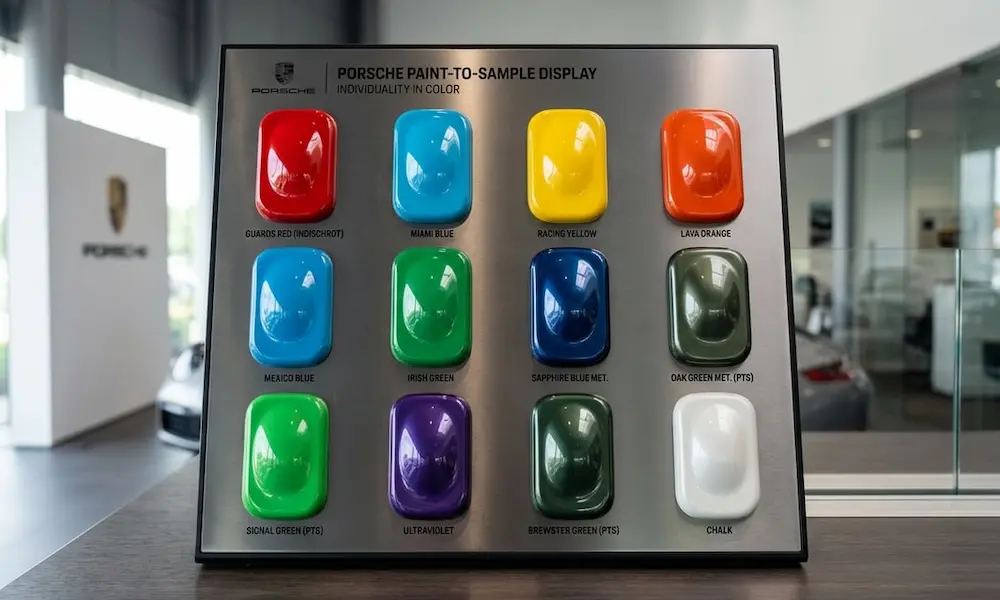
If your Vehicle Data Label shows L999, 999, or 89 as the paint code, your car was ordered through Porsche’s exclusive Paint to Sample (PTS) program.
This means the color is a custom commission. The sticker tells you nothing about the actual color. To find the real formula:
- Contact Porsche Cars North America with your VIN and ask for the build sheet — it’ll list the custom color name and internal formulation reference.
- Use a digital spectrophotometer — a body shop can scan a clean, polished section of your existing paint to analyze its exact wavelength and recreate the formula digitally.
Porsche now offers over 160 pre-approved PTS colors, including legendary shades like Rubystar, Acid Green, and Aubergine. Fully custom colors outside that list can take up to 11 months to approve and can cost over $25,000 on GT models.
One More Thing About Paint Matching
Finding the right code is the starting point — not the finish line.
Even with the correct code in hand, a freshly mixed paint will look different from your aged factory finish. Years of UV exposure, acid rain, and washing dull and shift the original color. Red and yellow solids are especially vulnerable to fading. A good painter uses the code as a baseline, then tints the mixture to match your car’s current state.
Also worth knowing: plastic bumpers and aluminum panels behave differently when painted. Even with the same code applied to both, slight optical variance is normal due to different thermal properties and static electricity during application. A quality body shop will account for this and blend accordingly.
Find the label, read the right code, and hand the paint code — not the sales code — to whoever’s doing the work. That’s how you get a match that actually looks factory-correct.