Thinking about hooking up a trailer to your Forester? You’ve got questions — how much can it actually tow, what hardware do you need, and does the Wilderness trim really make that big a difference? This guide breaks down every piece of the Subaru Forester tow package puzzle, from transmission cooling to wiring, so you can tow with confidence.
How Much Can a Subaru Forester Tow?
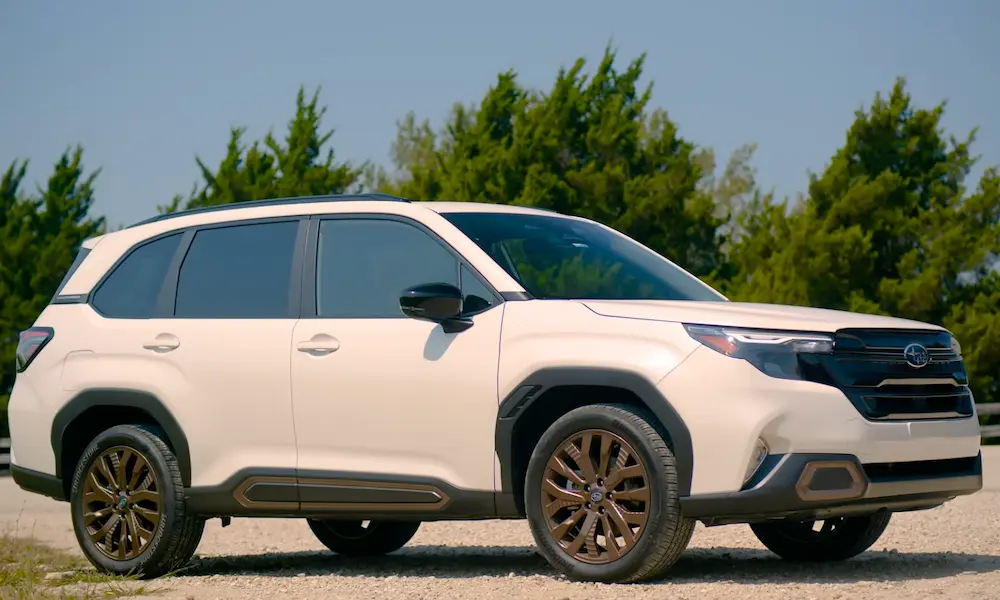
The answer depends heavily on which trim you drive. Standard Forester trims cap out at 1,500 pounds, a limit that’s been consistent since 2014. The Wilderness trim changes the game entirely.
Here’s the full picture across every generation:
| Model Year | Generation | Standard Trim (lbs) | Wilderness Trim (lbs) |
|---|---|---|---|
| 1997–2002 | First | 2,000 | N/A |
| 2003–2013 | Second/Third | 2,400 | N/A |
| 2014–2021 | Fourth/Fifth | 1,500 | N/A |
| 2022–2024 | Fifth | 1,500 | 3,000 |
| 2025 | Sixth | 1,500 | 3,000 |
| 2026 | Sixth | 1,500 | 3,500 |
The drop to 1,500 pounds in 2014 wasn’t a mistake. Subaru switched to the Lineartronic CVT, and that transmission runs hot under load. Until engineers solved the heat problem, 1,500 pounds was the safe ceiling for most trims.
Why the Wilderness Trim Tows So Much More
The single biggest reason the Wilderness out-tows every other Forester trim is a dedicated external transmission oil cooler — part number 45510SJ000. Standard trims cool their CVT fluid through a heat exchanger shared with the engine’s radiator. That’s fine for everyday driving, but it gets overwhelmed fast when you’re pulling a trailer uphill.
CVT fluid that climbs above 250°F loses viscosity. Once that happens, the transmission’s internal components lose protection. The Wilderness-specific cooler mounts separately behind the front grille, giving CVT fluid its own dedicated cooling pathway. That hardware difference is why the Wilderness can safely double the towing capacity of a Sport or Limited trim.
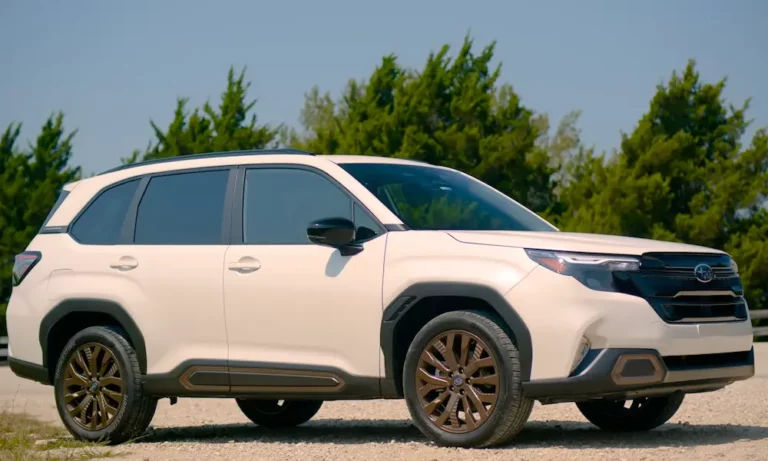
The 2026 Wilderness goes further, bumping capacity to 3,500 pounds. That extra 500 pounds comes from a revised final-drive ratio, longer coil springs, retuned shock absorbers, and 9.3 inches of ground clearance. The revised AWD center differential also locks up faster, which helps when you’re pulling from a stop on gravel or mud.
What About the Hybrid Forester?
Interesting situation here. The 2025–2026 hybrid Forester pairs the 2.5-liter Boxer with an electric motor, pushing combined output to 194 horsepower and 199 lb-ft of torque. More torque sounds great for towing, right?
Subaru still caps the hybrid at 1,500 pounds. The limiting factor isn’t power — it’s the weight of the battery pack, which eats into the Gross Vehicle Weight Rating and leaves less room for tongue weight and passengers. The hybrid CVT also has its own thermal constraints distinct from the standard unit.
| Metric | Standard 2.5L | 2.5L Hybrid | 2026 Wilderness |
|---|---|---|---|
| Horsepower | 180 HP | 194 HP | 180 HP |
| Torque | 178 lb-ft | 199 lb-ft | 178 lb-ft |
| Towing Capacity | 1,500 lbs | 1,500 lbs | 3,500 lbs |
Understanding Weight Ratings Before You Tow
Before you hitch anything up, you need to know three numbers.
GVWR (Gross Vehicle Weight Rating): The maximum your Forester can weigh with everything inside — passengers, cargo, gear, and the downward tongue weight of the trailer. For the 2025 Forester, that’s 4,901 pounds.
Tongue Weight: The downward force the trailer hitch puts on the receiver. Keep it at 10–15% of your trailer’s total weight. A 1,500-pound trailer means a maximum of 150 pounds on the hitch.
Why trim level matters for payload:
| 2025 Trim | Curb Weight (lbs) | Payload for Passengers/Gear/Tongue |
|---|---|---|
| Base | 3,510 | 1,391 lbs |
| Premium | 3,569 | 1,332 lbs |
| Sport | 3,611 | 1,290 lbs |
| Limited | 3,613 | 1,288 lbs |
| Touring | 3,664 | 1,237 lbs |
| Wilderness | 3,620 | 1,281 lbs |
A fully loaded Touring with four adults and camping gear burns through payload fast. If you carry four adults averaging 175 pounds each plus 150 pounds of gear, that’s 850 pounds gone — leaving only 387 pounds for trailer tongue weight. Stay within these numbers or you’re asking for handling problems and potential component failure.
OEM vs. Aftermarket: Which Tow Hitch Should You Buy?
Subaru doesn’t bolt a tow hitch onto the Forester at the factory. It’s an accessory installed at the port or dealership. That means you’ve got choices.
Subaru OEM Hitch (L101SSL001)
The OEM hitch replaces the rear bumper beam entirely rather than bolting underneath the frame. This design pushes pulling forces directly through the main chassis rails, which is structurally superior. It also preserves ground clearance since it doesn’t hang below the bumper.
Curt/Draw-Tite Aftermarket
These Class III hitches often carry a 3,500-pound rating — more than the Forester’s actual limit. The Curt C13409 hangs 2 to 2.5 inches below the bumper, which reduces departure angle noticeably. That’s a real concern if you take the Wilderness off-road.
EcoHitch by Torklift
This option mimics the OEM approach. It replaces the bumper beam and stays hidden behind the fascia, maintaining up to 9.3 inches of ground clearance. It also uses a 2-inch receiver versus the OEM’s 1.25-inch, which gives you more versatility for bike racks and cargo carriers.
| Feature | Subaru OEM | Curt Aftermarket | Torklift EcoHitch |
|---|---|---|---|
| Receiver Size | 1.25″ or 2″ | 2″ | 2″ |
| Ground Clearance Impact | Highest | Lower (under-hung) | High |
| Structure | Replaces bumper beam | Bolts to frame bottom | Replaces bumper beam |
| Estimated Cost | $450–$700 | $200–$350 | $380–$500 |
One important heads-up: Installing any tow hitch on a 2025 or 2026 Forester disables the foot-activated Hands-Free Power Rear Gate. The hitch receiver blocks the proximity sensors behind the rear fascia. You’ll need to use the key fob or the gate button instead.
Wiring Your Forester for Towing
The Forester comes pre-wired for a 4-pin flat connector. The OEM wiring harness (H771SSL100) plugs into a terminal already in the rear cargo area — no splicing needed.
Standard 4-pin color coding:
- White: Ground (return path to negative battery)
- Brown: Running lights and tail lamps
- Yellow: Left turn and brake signal combined
- Green: Right turn and brake signal combined
The Forester uses a three-wire system internally (separate brake and turn bulbs). Since most trailers use a two-wire system, the included converter blends these signals without back-feeding current into the ECU.
Upgrading to 7-Pin for Electric Trailer Brakes
Subaru requires trailer brakes on anything over 1,000 pounds. Electric brake systems need a 7-pin connector and an in-cab brake controller. Subaru doesn’t offer a factory 7-pin harness for the Forester, so you’ll need a conversion kit.
The installation requires running a 10 or 12-gauge power wire from the battery to the rear, protected by a 30-amp circuit breaker. If you’d rather skip the hardwiring, the Curt Echo Bluetooth brake controller plugs into a 7-pin adapter and lets you adjust brake force from your phone.
Aerodynamics: The Frontal Area Limit Nobody Talks About
Here’s something most buyers miss. Subaru recommends a maximum frontal area of 30 square feet for any trailer pulled by the Forester.
Frontal Area = Width × Height
A 5-foot-wide by 4-foot-tall utility trailer gives you 20 square feet — well within limits. A full-height travel trailer at 7.5 feet wide and 8 feet tall? That’s 60 square feet of frontal area. Even if it weighs under 1,500 pounds, drag at highway speeds forces the engine to produce maximum torque constantly, cooking the CVT fluid fast.
Towing Safety Systems You Need to Understand
Trailer Stability Assist (TSA)
Standard on all 2024–2026 Foresters, TSA detects trailer sway through yaw sensors. When it notices rhythmic side-to-side oscillation, it:
- Applies individual wheel brakes to counter the yaw
- Reduces engine torque by adjusting throttle or timing
- Increases brake pressure to the trailer if a controller is connected
EyeSight and Towing Don’t Always Mix
Switch these off before you back up or hit the road:
- Blind-Spot Detection (BSD) and Rear Cross-Traffic Alert (RCTA): These sensors will read your trailer as an approaching vehicle and throw constant false warnings. Use the lower-left dash switch to deactivate them.
- Reverse Automatic Braking (RAB): The system will trigger an emergency stop the moment you shift into reverse with a trailer attached. Turn this off via the touchscreen before reversing.
Hitch Installation: What It Actually Costs
Installing an OEM hitch takes 2.5 to 4.5 hours at a dealership. The process involves lowering the exhaust, trimming heat shields, and threading bolts through the unibody frame rails using a fish-wire method. On 2025 and 2026 models, the rear bumper sensors make professional installation of the OEM hitch the smarter call.
| Installation Source | Labor Time | Estimated Total Cost |
|---|---|---|
| Subaru Dealer | 3.0–4.5 hours | $750–$1,350 |
| U-Haul / Independent | 1.0–2.0 hours | $300–$550 |
| DIY (Home Garage) | 2.0–4.0 hours | $200–$450 |
Check out the U-Haul installation video for 2019–2024 Foresters if you’re thinking about the DIY route — it shows the fish-wire bolt method step by step.
Maintenance: Towing Counts as “Severe Driving”
Subaru classifies towing as severe use. That changes your maintenance schedule significantly.
If you tow regularly:
- CVT fluid: Despite “lifetime” labeling, plan for a drain-and-fill every 24,000 to 30,000 miles
- Differential fluid: Inspect front and rear for metal shavings and clarity after heavy tow sessions
- Engine oil: Drop to a 3,000 to 5,000-mile change interval instead of the standard 6,000 miles
Towing in temperatures above 90°F or on sustained mountain grades doubles the stress on CVT fluid. The Wilderness trim handles this better thanks to its dedicated cooler — but no Forester trim is completely immune to the physics of sustained high-load towing.
Is the Subaru Forester Tow Package Worth It?
For light-duty towing — a jet ski, a small utility trailer, a pop-up camper — any Forester trim with the standard tow package gets the job done. For anything pushing 2,000 pounds or beyond, the Wilderness trim isn’t just recommended, it’s the only Forester engineered to handle it safely.
The 2026 Wilderness at 3,500 pounds puts the Forester in territory that used to belong exclusively to the larger Outback and Ascent. That’s a genuine achievement for a compact unibody SUV — and it’s built on real engineering, not just a badge change.