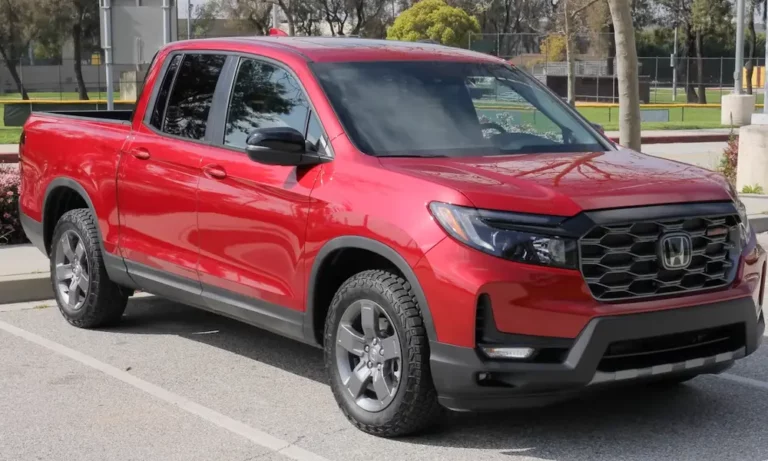
Thinking about buying a Honda Ridgeline but not sure if it’ll hold up? You’re asking the right question. The answer depends heavily on which year you’re looking at — and a few specific ones can really sting your wallet. Read to the end and you’ll know exactly which years to grab and which to skip.
What Makes the Ridgeline Different From Other Trucks
The Ridgeline isn’t built like a traditional pickup. It uses a unibody construction — the same approach Honda uses on the Pilot and Odyssey — instead of the ladder frame you’ll find under a Tacoma or Colorado.
That matters for reliability because:
- Less rattling over time. Body-on-frame trucks flex under stress. That flex causes squeaks, panel gaps, and vibrations after years of use. The Ridgeline’s integrated design stays tight longer.
- Fully independent rear suspension. Most trucks use a solid rear axle. The Ridgeline doesn’t, which reduces shock loads on drivetrain components during everyday driving.
- Composite truck bed. Steel beds rust, especially in salt-belt states. The Ridgeline’s composite bed resists dents, scratches, and corrosion without any special treatment.
| Feature | Honda Ridgeline | Toyota Tacoma | Chevrolet Colorado |
|---|---|---|---|
| Chassis | Unibody | Body-on-Frame | Body-on-Frame |
| Rear Suspension | Fully Independent | Solid Axle | Solid Axle |
| Bed Material | Composite | Sheet Molded Composite | Steel |
| Corrosion Resistance | High | Low (frame rust history) | Moderate |
Are Honda Ridgelines Reliable? Here’s What the Data Says
RepairPal gives the Ridgeline a 3.5 out of 5.0, ranking it 6th out of 7 midsize trucks. That sounds rough — but dig into the numbers and the picture changes.
- Average annual repair cost: $502. That beats the midsize truck average of $548 and the all-vehicle average of $652.
- Unscheduled shop visits: 0.2 times per year. Less frequent than most competitors.
- Severe repair probability: 12%. This is the weak spot. When something goes wrong, it can be expensive — tied mostly to specific problem years.
J.D. Power scores tell a similar story:
| Category | 2024 Score | 2025 Score |
|---|---|---|
| Quality & Reliability | 84/100 | 82/100 |
| Resale Value | 89/100 | 86/100 |
| Dealership Experience | 84/100 | 83/100 |
That resale value score stands out. Buyers pay a premium for used Ridgelines because they expect the truck to keep running well past 150,000 miles. The market has spoken.
First-Generation Ridgeline Reliability (2006–2014): Year by Year
The first-gen Ridgeline had a bumpy start. Honda ironed out the problems over time, but the 2006 model is one you want to avoid entirely.
The 2006 Problem: Cylinder 4 and the “Strawberry Milkshake of Death”
Two failures made the 2006 Ridgeline notorious:
1. Cylinder #4 engine failure. The J35A9 V6 engine had a machining flaw that caused the fourth cylinder to fail prematurely — often around 100,000 miles. A full engine replacement cost owners close to $3,000.
2. Radiator-to-transmission coolant mixing. The internal transmission cooler inside the radiator corroded at the fittings. When the fittings failed, engine coolant mixed with transmission fluid and destroyed the clutch packs inside the transmission. Enthusiasts called this the “Strawberry Milkshake of Death” — and it’s exactly as bad as it sounds.
When Did the First Gen Get Good?
Honda fixed the major issues with the 2009 facelift. By 2010, the Ridgeline had entered its most reliable phase. The 2013 model year hit an 86/100 J.D. Power score — one of the highest in the midsize truck segment that year.
| Model Year | Reliability | Primary Risk |
|---|---|---|
| 2006 | ❌ Avoid | Cylinder 4 failure, transmission coolant mix |
| 2007 | ⚠️ Caution | Engine misfires, radiator corrosion |
| 2008 | ⚠️ Caution | A/C compressor failure, heater blower issues |
| 2009 | ✅ Recommended | First improved facelift year |
| 2010 | ✅ Highly Recommended | Mostly paint/trim issues only |
| 2011 | ✅ Recommended | Suspension wear at high mileage |
| 2012 | ✅ Recommended | Minor interior glitches |
| 2013 | ✅ Highly Recommended | Peak first-gen — 86/100 J.D. Power |
| 2014 | ✅ Recommended | Dated infotainment; mechanically solid |
Second-Generation Ridgeline Reliability (2017–Present)
The second-gen brought more power, better safety tech, and a new set of headaches — mostly tied to the 6-speed automatic transmission used from 2017 to 2019.
The 6-Speed Torque Converter Shudder (2017–2019)
The most common complaint from 2017–2019 owners is a noticeable shudder between 20 and 45 mph during acceleration. The culprit? Premature transmission fluid breakdown that caused the torque converter clutches to engage roughly.
Honda issued TSB 23-078, which extended the torque converter warranty and required a triple fluid flush plus a software update. It helped — but these years still need more aggressive transmission maintenance than Honda’s Maintenance Minder suggests. Most owners in the community recommend changing the ATF every 20,000 miles.
Fuel Injector Failures (2017–2019)
A manufacturing defect left debris inside the high-pressure fuel injectors on some 2017–2019 models. The debris caused injector wear or clogging, triggering “Emissions System Problem” warnings and misfires. Honda extended the warranty on these injectors to 10 years or 150,000 miles — recognition that this was a factory problem, not owner neglect.
The 9-Speed Fixes Everything (2020–Present)
For 2020, Honda replaced the 6-speed with a ZF-sourced 9-speed automatic. This transmission handles the 3.5L V6’s torque profile better and doesn’t suffer from the same fluid degradation issues.
Some owners note the 9-speed can feel clunky in slow stop-and-go traffic or show a slight delay shifting from Reverse to Drive. These are software quirks, not mechanical failures. Long-term durability data on the 9-speed is strong. The 2020 and 2024 models show very low complaint rates.
| Feature | 6-Speed (2017–2019) | 9-Speed (2020–Present) |
|---|---|---|
| Source | Honda In-House | ZF Friedrichshafen |
| Major Issue | Torque converter shudder | Minor shifting delays |
| Warranty Extension | Yes (torque converter) | None needed |
| Maintenance Demand | High | Moderate |
| Towing Confidence | Lower | Higher |
The J-Series V6: Still the Right Engine Choice
Every Ridgeline runs a naturally aspirated 3.5L J-Series V6. That’s increasingly rare in a segment moving toward turbocharged four-cylinders. For long-term reliability, it’s actually a big advantage.
Turbo engines run hotter and at higher pressure. Over 200,000 miles, that adds maintenance complexity — intercoolers, turbo seals, boost lines. The Honda V6 avoids all of that.
One thing to know: The J-Series uses a timing belt, not a timing chain. You must replace it every 100,000 miles or 7 years. Along with the water pump and tensioner, this service runs $1,000–$1,500. Skip it and a snapped belt causes catastrophic engine damage. Budget for it and it’s just routine maintenance.
The Variable Cylinder Management (VCM) system — which shuts off three cylinders during light cruising — can put extra stress on active motor mounts. Some owners report early mount failure and install “VCM Muzzlers” to deactivate the system and prevent long-term vibration issues.
Key NHTSA Recalls You Should Know About
Recalls aren’t always a red flag. They show the manufacturer caught a problem and fixed it. But you need to verify these are complete before buying used.
- NHTSA 24V-321: Affects 187,290 units from 2020–2024. The tailgate harness fatigues in cold weather, killing the rearview camera. Honda replaces the entire harness.
- NHTSA 23V-858: High-pressure fuel pump can fail in 2020 models, causing unexpected engine stall. A deforming impeller is the cause. Honda proactively replaces these.
- NHTSA 23V-751: A crankshaft machining error on some 2020 models causes connecting rod bearing wear and potential engine seizure. Critical to verify this recall is resolved before buying a 2020.
- NHTSA 24V-064: Passenger seat weight sensor can short-circuit on 2020–2022 models, causing the SRS light to illuminate and compromising airbag function.
Always run a VIN check on NHTSA’s database before purchasing any used Ridgeline.
How Does the Ridgeline Stack Up Against the Competition?
Honda Ridgeline vs. Toyota Tacoma
The Tacoma wins on off-road toughness and resale value. Its body-on-frame design handles abuse better when you’re overloading the bed or crawling over rocks. But as a daily driver on pavement, the Ridgeline is actually more reliable. No solid rear axle means fewer driveline maintenance headaches. No transfer case means fewer heavy components to fail.
Honda Ridgeline vs. Chevrolet Colorado
The Colorado has struggled with reliability consistently. RepairPal data puts average annual repair costs at $599 for the Colorado versus $502 for the Ridgeline. The new turbocharged engine in the 2024–2025 Colorado is powerful, but it doesn’t have the long-term track record of Honda’s V6.
| Metric | Honda Ridgeline | Toyota Tacoma | Chevrolet Colorado |
|---|---|---|---|
| RepairPal Score | 3.5/5.0 | 3.5/5.0 | ~2.0/5.0 |
| Annual Repair Cost | $502 | $478 | $599 |
| Towing Capacity | 5,000 lbs | 6,500 lbs | 7,700 lbs |
| Engine Type | NA V6 | Turbo-4 | Turbo-4 |
| AWD System | i-VTM4 | Part-Time 4WD | Part-Time 4WD |
Can a Ridgeline Hit 200,000 Miles?
Yes — and then some. iSeeCars data identifies the Ridgeline as one of the vehicles most likely to reach 250,000 miles, with an estimated lifespan of around 248,669 miles under average maintenance conditions.
The unibody structure actually helps here in an unexpected way: a 20-year-old Tacoma might still run great but have a structurally compromised rusted frame. A 20-year-old Ridgeline is more likely to keep its structural integrity intact.
Because the Ridgeline shares so many parts with the Honda Pilot and Odyssey, independent mechanics know this platform well. You’re not stuck paying dealer rates for specialized repairs.
The Best and Worst Honda Ridgeline Years — Quick Summary
Best years to buy:
- 2013 — Peak first-gen reliability; 86/100 J.D. Power
- 2020–2025 — ZF 9-speed transmission; low complaint rates; strong recall resolution
Buy with caution (need verified maintenance history):
- 2017–2019 — Capable trucks but require transmission fluid attention and fuel injector warranty verification
Avoid:
- 2006 — Cylinder 4 failures and the “Strawberry Milkshake of Death” make this one too risky unless you have documented proof of a complete engine and radiator replacement
The Honda Ridgeline isn’t the toughest truck on paper — it can’t tow as much as a Colorado or go as deep off-road as a Tacoma. But if you want a truck that handles like a car, survives daily commuting with minimal fuss, and holds its value, the right Ridgeline year is genuinely one of the smartest buys in the midsize segment.