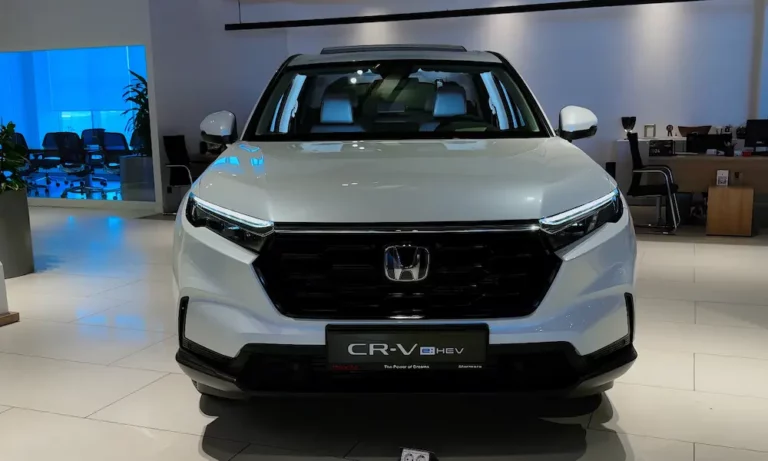
Thinking about towing with your Honda CR-V? You’ve got questions — like what’s actually included, what you need to buy, and whether your hybrid can pull that jet ski. This post covers all of it, from tow ratings to tongue weight to the quirky hands-free tailgate problem nobody warns you about. Read to the end — there’s a detail about hybrid models that catches a lot of buyers off guard.
What Is the Honda CR-V Towing Package, Exactly?
Here’s the first thing to understand: Honda doesn’t sell a standalone “towing package” that upgrades your engine or transmission. What they offer is called the Utility Package — a bundle of dealer-installed accessories that makes your CR-V tow-ready and more versatile overall.
The Utility Package typically includes:
- Trailer hitch receiver — the actual mounting hardware
- Roof rails and crossbars — for bikes, kayaks, or cargo boxes
- Running boards — easier entry when your roof rack is loaded up
- Seatback protectors — plastic shields for when you fold the rear seats down
Notice that the wiring harness isn’t always bundled in. You’ll often need to source the trailer hitch harness separately. It plugs into a factory connector in the cargo area, so at least the wiring is already there waiting for you.
Honda CR-V Towing Capacity: Gas vs. Hybrid
This is where buyers get tripped up. Your trim level directly determines your towing capacity — and the difference between gas and hybrid is significant.
| Model Year Range | Gas Max Towing | Hybrid Max Towing | Payload Range |
|---|---|---|---|
| 2004–2016 | 1,500 lbs | Not Available | 850 lbs |
| 2017–2022 | 1,500 lbs | 1,000 lbs | 850–1,106 lbs |
| 2023–2025 | 1,500 lbs | 1,000 lbs | 850–1,106 lbs |
| 2026 | 1,500 lbs | 1,000 lbs | TBD |
The gasoline CR-V (LX, EX, EX-L trims) tows up to 1,500 pounds. That covers a small utility trailer, a personal watercraft, or a lightweight teardrop camper without breaking a sweat.
The hybrid CR-V (Sport, Sport-L, Sport Touring) tops out at 1,000 pounds. That’s a 33% reduction compared to its gas sibling.
Why the difference? The hybrid battery pack and electric motors add considerable weight to the vehicle itself. That extra mass eats into the Gross Combined Weight Rating — the total weight ceiling the chassis can safely handle. Less room in that budget means a lower trailer rating.
Gas vs. Hybrid Powertrain Specs (2025 Model Year)
| Feature | 1.5L Turbo Gas | 2.0L Two-Motor Hybrid |
|---|---|---|
| Horsepower | 190 hp | 204 hp (combined) |
| Torque | 179 lb-ft | 247 lb-ft |
| Transmission | CVT | E-CVT |
| Max Towing | 1,500 lbs | 1,000 lbs |
| Drive Options | 2WD or AWD | 2WD or AWD |
The hybrid actually produces more torque, which usually helps with towing. But torque alone doesn’t set the rating — chassis limits and thermal management do.
The Hardware You Actually Need to Tow
The CR-V’s factory receiver hitch for 2023–2026 models is Part 08L92-3A0-100. It uses a 1.25-inch receiver and mounts directly to the unibody frame. No drilling required.
Here’s every component you need to go from “zero” to “towing”:
| Component | Function |
|---|---|
| Trailer hitch receiver | Bolts to the frame; accepts the drawbar |
| Trailer hitch harness | Powers your trailer’s lights |
| Drawbar (ball mount) | Slides into the receiver; sets the trailer height |
| Retaining pin and clip | Keeps the drawbar from sliding out while driving |
| Hitch ball | The pivot point your trailer coupler connects to (1-7/8″ or 2″ sizes) |
Don’t skip the retaining pin. It’s a small part, but Honda’s own documentation lists it as essential safety hardware.
The Hands-Free Tailgate Problem (And the Fix)
If you own a Sport Touring Hybrid, there’s a catch nobody talks about at the dealership. That trim has a hands-free power tailgate with a kick sensor behind the rear bumper. Installing a standard hitch blocks that sensor completely. Your kick-to-open feature stops working.
Honda’s fix is the Hands-Free Access Trailer Hitch Adapter (Part 08U59-3A0-100). This adapter relocates the sensor so it can “see around” the hitch. It’s not optional if you want both features to work.
The installation is involved. Technicians need to pull the rear bumper, several interior trim panels, and the rear under-cover. Plan to leave your CR-V at the dealership for this one.
Tongue Weight: Get This Wrong and Things Get Ugly
Tongue weight is the vertical force your trailer puts on the hitch ball. Honda targets 10% of the total trailer weight as the ideal tongue load.
Here’s why it matters:
- Too much tongue weight → rear of the CR-V sags, front tires lose grip, steering gets vague, front braking suffers
- Too little tongue weight → trailer is tail-heavy, prone to sway, especially when passing trucks or driving in crosswinds
The practical fix: load 60% of your cargo toward the front of the trailer and 40% toward the rear. Then physically check the tongue load. A simple tongue weight scale costs around $20 and takes the guesswork out.
For trailers over 1,000 pounds, Honda requires a separate trailer braking system. Use an electric brake controller — never tap into the CR-V’s hydraulic brake lines. Honda explicitly warns against that in the owner’s manual, and for good reason. It can take down your vehicle’s brakes with it.
How the CR-V’s Safety Systems Help When Towing
The CR-V isn’t just mechanically capable — its electronics actively help manage a trailer. Here’s what’s working in your favor:
- Vehicle Stability Assist (VSA): Detects trailer sway and corrects it by applying individual wheel brakes and adjusting engine torque
- Real-Time AWD: On AWD models, it proactively pushes power to the rear wheels when it senses a trailer load during acceleration
- Hill Start Assist: Holds the vehicle on a grade so you don’t roll backward when starting with a trailer behind you
- Brake Assist: Maximizes braking force instantly in an emergency, accounting for the added momentum of your trailer
These systems don’t expand your towing capacity — but they make towing within the rated limits noticeably safer.
Towing in Mountains and Hot Weather
The CR-V’s CVT and hybrid E-CVT generate significant heat under load. In extreme environments, that heat becomes the main threat to long-term reliability.
High altitude: Reduce your combined vehicle-plus-trailer weight by 2% for every 1,000 feet above sea level. Thinner air means less combustion efficiency and reduced cooling capacity.
Long descents: Use the “B-Range” on hybrids or shift the CVT to “S” or “L” to get engine braking. This takes heat off your friction brakes. If you see a “Transmission Hot” warning, pull over, leave it in idle, and wait. Driving through that warning can cause permanent damage.
Frequent towing: Honda classifies towing as a severe service condition. That means shorter fluid change intervals. Use only genuine Honda HCF-2 fluid for gas models or HEVF-Type 1 for hybrids. Mixing in the wrong fluid type accelerates wear.
In extreme cases — regular mountain towing in 100°F+ heat — some owners add an auxiliary air-cooled transmission cooler. Honda doesn’t require it for the 1,500-pound rating, but it’s cheap insurance.
OEM Hitch vs. Aftermarket: Which Should You Buy?
Both work. The choice comes down to priorities.
Genuine Honda hitch (08L92-3A0-100):
- MSRP around $412
- No drilling into the frame — uses factory mounting points
- Covered under Honda’s 3-year/36,000-mile accessory warranty when dealer-installed
- Sits tighter to the bumper for a cleaner look
Aftermarket options (Curt, Draw-Tite):
- A Curt Class 3 hitch with a 2-inch receiver runs around $165
- A 2-inch receiver opens up more accessory compatibility (heavy-duty bike racks, etc.)
- Doesn’t increase towing capacity beyond the factory limit — ever
Neither option makes the CR-V tow more than it’s rated for. The physics don’t change with a bigger receiver.
How Does the CR-V Compare to the Competition?
The CR-V holds its own for light-duty towing. But it doesn’t have an adventure trim with a boosted rating like some competitors do.
| Vehicle | Standard Max Towing | Best Available Rating |
|---|---|---|
| Honda CR-V (Gas) | 1,500 lbs | 1,500 lbs (no upgrade) |
| Honda CR-V (Hybrid) | 1,000 lbs | 1,000 lbs (no upgrade) |
| Toyota RAV4 | 1,500 lbs | 3,500 lbs (Adventure/TRD) |
| Subaru Forester | 1,500 lbs | 3,000 lbs (Wilderness) |
| Ford Escape | 1,500 lbs | 3,500 lbs (2.0L EcoBoost) |
If you need to tow a larger enclosed camper regularly, Honda positions the Passport or Pilot (up to 5,000 pounds) as the right step up. For a jet ski, a small boat, or a weekend utility trailer, the CR-V handles it cleanly.
Break-In Period and Ongoing Maintenance
Don’t tow anything for the first 600 miles on a new CR-V. Honda’s break-in guidelines require the pistons, transmission belts, and brake pads to seat properly before you put them under towing stress.
After that, if you tow regularly, keep up with:
- Hitch mounting bolts: Check torque and look for corrosion at every oil change
- Brake fluid: DOT 3 fluid absorbs moisture over time, which lowers its boiling point — a real problem when your brakes are working overtime with a trailer
- Tire pressure and wear: The extra rear load accelerates tire wear; keep pressures at the cold settings on your door jamb and check your spare (it’s a compact T155/90D17)
The honda crv towing package works best when the whole system gets attention — not just the hitch hardware, but the fluids, tires, and electronics that support it.