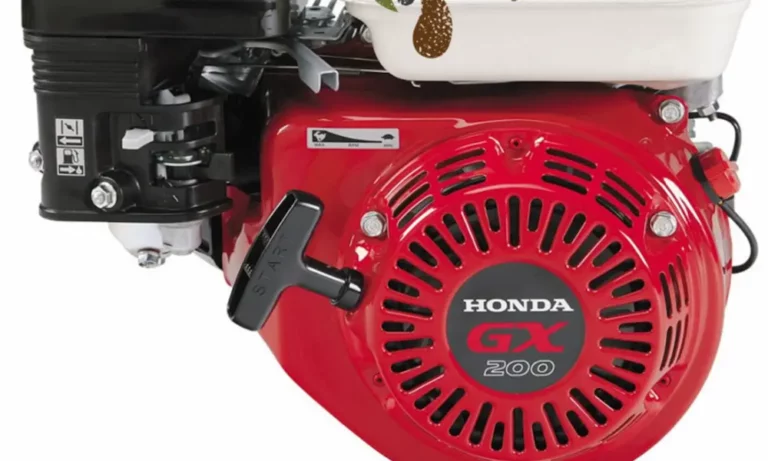
Got a Honda GX200 and not sure how much oil it actually needs? Too little and you’ll seize it. Too much and you’ll foam it. Either way, you’re looking at a wrecked engine. This guide covers the exact Honda GX200 oil capacity, the right oil to use, how often to change it, and a few tricks that keep your engine running strong for years. Stick around — the gearbox section alone could save you a costly repair.
The Honda GX200 Oil Capacity at a Glance
The Honda GX200 holds exactly 0.60 liters of engine oil. That’s about 0.63 US quarts, 0.53 Imperial quarts, or roughly 20.2 fluid ounces.
This isn’t a rough estimate. It’s a precision spec built around how the engine lubricates itself. Go over or under and you’re asking for trouble.
Here’s a quick reference:
| Measurement Unit | Standard Engine | 1/2 Reduction | 1/6 Reduction |
|---|---|---|---|
| Liters | 0.60 | 0.15 | 0.50 |
| US Quarts | 0.63 | 0.16 | 0.53 |
| Imperial Quarts | 0.53 | 0.13 | 0.44 |
| Fluid Ounces | 20.2 | 5.07 | 16.9 |
If your engine has a reduction gearbox attached, those are separate oil systems with their own capacities. More on that below.
Why the Oil Capacity Matters More Than You Think
The GX200 doesn’t use a pressurized oil pump like a car engine. Instead, it relies on a splash lubrication system — a small “dipper” on the connecting rod dips into the oil reservoir as the crankshaft spins. It flings oil up as a fine mist, coating the cylinder walls, piston pin, camshaft, and valvetrain.
That system only works when the oil level sits in the sweet spot.
Too low: The dipper misses the oil surface, especially on an incline. Metal touches metal, temperatures spike, and you get a seized engine.
Too much: The crankshaft has to plow through a pool of liquid instead of mist. That causes:
- Power loss
- Higher fuel consumption
- Foamy oil that can’t form a protective film
- Bearing failure even with a “full” tank
One real-world note worth knowing: Reddit users report that during a standard oil change, the engine typically takes between 0.50 and 0.55 liters to hit the upper dipstick mark — because some old oil always stays trapped in the crankcase. Always use the dipstick as your final check, not a measuring cup.
What Oil Does the Honda GX200 Take?
Honda specifies a high-detergent, premium quality four-stroke motor oil meeting API service classification SJ or higher. The go-to viscosity for most conditions is SAE 10W-30.
Here’s how to choose based on where you work:
| Temperature Range | Recommended Viscosity | Best For |
|---|---|---|
| -20°C to 40°C | 10W-30 | Universal — use this if unsure |
| 10°C to 40°C+ | SAE 30 | Hot climates, heavy summer loads |
| -30°C to 0°C | 5W-30 | Cold weather starts |
| 0°C to 40°C | 10W-40 / 15W-40 | Specialized industrial use |
For most people running a pressure washer, generator, or water pump, 10W-30 is your default choice and it works year-round in most climates.
Synthetic vs. Conventional Oil
Both are fine as long as they meet API SJ spec. That said, synthetic oil wins in heavy-duty conditions. If your GX200 runs a commercial pressure washer or a generator for hours on end at full throttle, synthetic oil handles the heat better — it has higher shear stability and a higher flash point. For light or occasional use, conventional oil does the job just fine.
Don’t Forget the Reduction Gearbox Oil
Here’s where a lot of owners get caught out. If your GX200 has a reduction gearbox — common on cement mixers, tillers, and heavy-duty pumps — that gearbox has its own separate oil system.
- 1/2 reduction (with centrifugal clutch): 0.15 liters. Check with the dipstick.
- 1/6 reduction: 0.50 liters. Check using the side oil-level bolt — oil should be flush with the bolt hole.
These are tiny volumes. A small leak or missed service can destroy a gearbox fast. Treat them like a separate engine for maintenance purposes — same discipline, different intervals.
Honda GX200 Oil Change Schedule
The GX200 runs hot. It’s air-cooled, which means it doesn’t have water circulating around the engine block to keep temperatures in check. That heat degrades oil faster than you’d expect.
Here’s the official maintenance timeline:
| Service Point | Action | Why It Matters |
|---|---|---|
| Every use | Check oil level | Prevents dry-run damage |
| First 20 hours | Full oil change | Clears metal particles from break-in wear |
| Every 100 hours / 6 months | Full oil change | Removes oxidized oil and spent additives |
| Every 50 hours (harsh conditions) | Full oil change | Necessary in dusty or high-heat environments |
| Every 300 hours / annually | Valve clearance check | Keeps combustion seal tight |
The 20-hour break-in oil change is non-negotiable. As the piston rings seat against the cylinder walls during those first hours, they release microscopic metal particles into the oil. If you leave that oil in, those particles act like sandpaper on your crankshaft bearings. Change it early, and the engine should run strong for thousands of hours.
How to Change the Oil the Right Way
It’s a simple job, but a few details make a big difference.
- Run the engine for a few minutes first. Warm oil is thinner and flows out more completely, taking more contaminants with it.
- Park on a level surface. The GX200 has a splash system — if the engine tilts during filling, your dipstick reading will be off.
- Don’t thread the dipstick in when checking. Just set it on top of the fill hole and read it. Threading it in can give a false high reading.
- Replace the drain bolt washer. A worn washer leads to slow leaks. A fresh washer costs almost nothing and prevents a lot of headaches.
- Fill slowly and check with the dipstick. Add oil in small increments near the end to avoid overfilling.
The Honda Oil Alert System: What It Does and Why It Matters
Most GX200 engines include Honda’s Oil Alert system — a float switch inside the crankcase that cuts the ignition when oil drops below a safe level. The engine stops and won’t restart until you add oil.
This system is particularly useful for equipment that vibrates or tilts, like a plate compactor or portable pump. A sharp tilt can shift the oil away from the dipper, and the Oil Alert catches that before damage happens.
For anyone doing diagnostics: if the engine stops suddenly and there’s no spark at the plug, check the oil level first. If oil is fine and there’s still no spark, the float switch or wiring harness may be the culprit. It’s a simple short-circuit check, but the oil level is always step one.
How the Air Filter Affects Your Oil
This connection surprises a lot of people. A dirty or damaged air filter lets dust past the piston rings and into the crankcase. Once that happens, your clean oil turns into an abrasive paste that grinds down bearings fast.
The GX200 comes with several air cleaner options:
| Air Filter Type | Maintenance Task | Interval |
|---|---|---|
| Dual-element (foam + paper) | Clean foam / replace paper | Every 50 / 300 hours |
| Oil-bath filter | Replace oil (60 cm³ / 2 oz) | Every 50 hours |
| Cyclone pre-cleaner | Clean pre-cleaner | Every 50 hours |
If you’re running the oil-bath air cleaner, that tiny 60 cm³ reservoir needs its own regular oil changes. Neglect it and dirty oil in the cleaner can get drawn into the intake.
Also watch the carburetor sediment cup. A stuck float lets raw fuel seep past the piston rings into the oil. That thins the oil dramatically and kills its lubrication ability. Clean the sediment cup every 100 hours to prevent this.
GX200 Oil Capacity vs. Other Honda GX Engines
Curious how the GX200 stacks up against the rest of the GX lineup?
| Engine | Displacement | Oil Capacity | Power (Net) |
|---|---|---|---|
| GX120 | 118 cc | 0.56 L | ~2.8 HP |
| GX160 | 163 cc | 0.58 L | ~4.0 HP |
| GX200 | 196 cc | 0.60 L | ~5.8 HP |
| GX270 | 270 cc | 1.1 L | ~8.5 HP |
| GX390 | 389 cc | 1.2 L | ~11.7 HP |
The GX200 sits at the top of Honda’s small-block range. It produces the most power while still running on just 0.60 liters of oil. That makes it efficient — but it also means the margin for error is smaller than on larger engines. A slight drop in oil level hits a GX200 harder than it hits a GX390. Stay on top of your levels.
Running the GX200 at High Altitude
Operating above 1,500 meters (5,000 feet)? Air-cooled engines run hotter up there because thinner air provides less cooling. Thinner air also causes the engine to run rich, which pushes unburned fuel past the rings and into the oil.
If you’re regularly working at elevation, check your oil more often for darkening or a fuel smell. Consider a high-altitude carburetor jet kit and shorten your oil change intervals to 50–75 hours to keep oil quality in check.
Quick-Reference Oil Maintenance Checklist
Before you wrap up, here’s your go-to checklist for keeping the GX200 in top shape:
- ✅ Check oil level before every use — engine level, dipstick resting (not threaded) in the hole
- ✅ Change oil at 20 hours for a new engine
- ✅ Change oil every 100 hours or 6 months under normal conditions
- ✅ Switch to a 50-hour interval in dusty, hot, or high-load environments
- ✅ Use SAE 10W-30, API SJ or higher, for most conditions
- ✅ Service the reduction gearbox oil separately — don’t skip it
- ✅ Clean or replace the air filter on schedule to protect the oil
- ✅ Check the sediment cup every 100 hours to prevent fuel dilution
- ✅ Replace the drain bolt washer at every oil change
The GX200 is built to last — and with 0.60 liters of the right oil changed at the right time, it genuinely will.