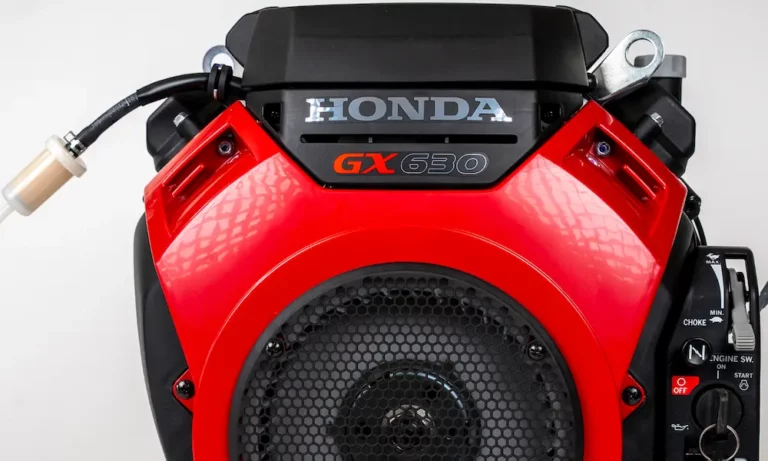
Getting the oil capacity wrong on your Honda GX630 can turn a reliable workhorse into an expensive repair job. Whether you’re doing a routine oil change or just topped off a pressure washer mid-season, this guide walks you through the exact specs, the right oil to use, and how to keep this V-twin running strong for years.
What Is the Honda GX630 Oil Capacity?
The Honda GX630 oil capacity depends on whether you’re replacing the oil filter at the same time.
According to the official Honda GX630 engine specs, here’s what you need:
| Service Type | Liters | US Quarts | Imperial Quarts |
|---|---|---|---|
| Oil change only (no filter) | 1.5 L | 1.59 qt | 1.32 qt |
| Oil change + new filter | 1.7 L | 1.80 qt | 1.50 qt |
That extra 0.2 liters matters. The spin-on filter holds a small amount of oil, so when you swap it out, the crankcase needs a bit more to compensate. Always top up to the upper dipstick mark after filling.
Don’t Confuse It with Similar Models
Here’s a common mistake people make: assuming the GX630 shares oil capacity with Honda’s other V-twin engines. It doesn’t.
- The iGX700 with electronic fuel injection takes 1.9 liters (2.0 US qt) with a filter change
- The vertical-shaft GXV630 also requires 1.9 liters with a filter
The difference comes down to shaft orientation. Horizontal and vertical crankshaft engines position the sump differently, which changes how much oil the pump needs to stay submerged under load. Always double-check your exact model number before you pour.
What Oil Should You Use in a Honda GX630?
The GX630 runs a full-pressure lubrication system — not the old splash-and-pray setup found in smaller engines. This pump-driven system pushes oil to every critical surface, including the overhead valve train and crankshaft journals. It needs the right oil to do its job.
Honda specifies a multi-grade oil meeting API Service Classification SJ or later. Modern SN or SP-rated oils exceed that standard and offer better protection against deposits and oil consumption.
Choosing the Right Viscosity for Your Climate
| Oil Grade | Temperature Range (°C) | Temperature Range (°F) |
|---|---|---|
| SAE 10W-30 | -20°C to 40°C+ | -4°F to 104°F+ |
| SAE 5W-30 | -30°C to 0°C | -22°F to 32°F |
| Synthetic 5W-30 | -30°C to 40°C+ | -22°F to 104°F+ |
| SAE 30 | 10°C to 40°C+ | 50°F to 104°F+ |
SAE 10W-30 is the go-to choice for most operators. It flows fast during cold starts to protect the valve train, then holds its weight at operating temps. If you’re running this engine hard in hot climates — think commercial landscaping in midsummer — synthetic 5W-30 is worth the extra cost. Synthetics handle thermal breakdown better and stay effective longer under sustained high loads.
Honda GX630 Oil Change Schedule
The GX630’s maintenance documentation lays out a clear schedule. Stick to it.
| Interval | Task | Why It Matters |
|---|---|---|
| Before every use | Check oil level | Catches drops before they cause damage |
| First 20 hours | Change oil | Removes break-in metal particles |
| Every 100 hours / 6 months | Change oil | Purges acidic combustion by-products |
| Every 200–300 hours / annually | Replace oil filter | Keeps filtration media effective |
Why the First Oil Change Is Non-Negotiable
The 20-hour break-in oil change isn’t just a suggestion. During the first few hours of operation, the piston rings seat against the cylinder walls, and gears shed microscopic metal particles. That initial oil carries all of that debris suspended in it.
The GX630 uses cast iron cylinder sleeves — a premium feature that extends engine life — but those sleeves need clean oil to perform. Skip the 20-hour change and you’re circulating abrasive particles through a brand-new engine.
How Often Should You Replace the Oil Filter?
Honda’s documentation gives a range of 200–300 hours or annually, depending on which manual you reference. For commercial use, replace it every 200 hours or at every other oil change. Here’s why: the filter has an internal bypass valve that opens when the filter element clogs. When it bypasses, unfiltered oil flows straight through the engine. That’s the opposite of what you want.
How to Check the Oil Level Correctly
This part trips people up. The GX630 dipstick check has one key rule that most owners get wrong.
Follow these steps from the official Honda GX630 owner’s manual:
- Park on level ground and switch the engine OFF
- If the engine ran recently, let it idle for 1–2 minutes, then stop it and wait 2–3 minutes for oil to drain back into the sump
- Remove the oil filler cap/dipstick and wipe it clean
- Reinsert the dipstick — but don’t screw it in
- Pull it out and read the level
- If it’s below the upper mark, add oil until it reaches the top
The “don’t screw it in” step is critical. Threading it in gives you a false low reading every time, and you’ll end up overfilling. Overfilling is just as bad as underfilling in a forced-feed system — excess oil foams under pressure, and foam doesn’t lubricate.
Oil Drain Plug and Filter Torque Specs
Under-tightening causes leaks. Over-tightening strips threads in the aluminum block. Use a torque wrench.
| Component | N·m | ft·lb |
|---|---|---|
| Oil drain plug bolt | 45 N·m | 33 ft·lb |
| Oil filter cartridge | 12 N·m | 9 ft·lb |
| Oil pressure switch | 9 N·m | 6.6 ft·lb |
Always replace the drain plug sealing washer at every oil change. That washer costs almost nothing and prevents slow leaks that are easy to miss until they cause a real problem.
How Honda’s Oil Alert® System Works
The GX630 comes standard with Honda’s Oil Alert® system — an electronic failsafe that stops the engine before oil starvation causes irreversible damage.
Here’s the sequence:
- Oil drops below the safe level threshold
- A red Oil Alert indicator light activates
- The system grounds the ignition circuit and stops the engine
- The engine won’t restart until you bring the oil back up to the upper dipstick mark
The engine switch stays in the ON position during all of this. So if your GX630 shuts down suddenly and won’t restart, check the oil before you start chasing fuel or ignition problems. It’s the first thing to rule out.
Some GX630 models pair the Oil Alert system with an hour meter, which makes it easy to track your maintenance intervals precisely.
Oil Alert Is a Safety Net, Not a Maintenance Strategy
Don’t let the Oil Alert system give you a false sense of security. By the time it triggers, your oil level is already dangerously low. Catching that condition during a pre-operation dipstick check costs you 30 seconds. Catching it after the engine shuts down on the job costs you time, productivity, and potential engine wear.
What Happens When Your Air Filter Affects Your Oil
Here’s a connection most people miss: a clogged air filter can contaminate your oil.
When the air filter on the GX630 gets restricted, the carburetor runs rich — it dumps extra fuel into the combustion chamber. Some of that unburned fuel slips past the piston rings and into the crankcase. This is called fuel dilution, and it thins the oil, reducing its ability to protect the crankshaft journals and cam lobes.
The GX630 maintenance guide recommends more frequent checks in dusty environments — construction sites, farms, gravel operations. Check the foam pre-filter and the paper main element regularly. A clean air path means complete combustion, and complete combustion means cleaner oil that lasts its full service interval.
GX630 Engine Specs at a Glance
Understanding the engine’s performance envelope helps you appreciate why proper lubrication matters so much.
| Specification | Detail |
|---|---|
| Displacement | 688 cc (41.97 cu-in) |
| Max. Horsepower | 20.8 HP (15.5 kW) @ 3,600 rpm |
| Max. Torque | 35.6 ft·lb (48.3 N·m) @ 2,500 rpm |
| Compression Ratio | 9.3:1 |
| Idle Speed | 1,400 ± 150 rpm |
| Intake Valve Clearance | 0.08 ± 0.02 mm |
| Exhaust Valve Clearance | 0.10 ± 0.02 mm |
That 9.3:1 compression ratio generates real heat. The oil doesn’t just reduce friction — it carries heat away from the piston skirts and connecting rod journals. That’s why viscosity grade and change intervals matter as much as they do on this engine.
Quick Reference: Honda GX630 Oil Capacity Summary
- Without filter change: 1.5 L / 1.59 US qt
- With filter change: 1.7 L / 1.80 US qt
- Recommended oil: SAE 10W-30, API SJ or later (synthetic 5W-30 for demanding conditions)
- Oil change interval: Every 100 hours or 6 months
- First change: At 20 hours
- Filter replacement: Every 200–300 hours or annually
- Drain plug torque: 45 N·m / 33 ft·lb
- Filter torque: 12 N·m / 9 ft·lb
Follow these specs, respect the break-in oil change, and use quality oil that meets Honda’s API standards. The GX630 is built to last — give it what it needs and it will.