You’re shopping for a Wrangler, but you’re worried about what it’ll cost at the pump. Smart. The Jeep Wrangler’s fuel economy isn’t just about numbers on a sticker—it’s about understanding what you’ll actually get in the real world. Let’s break down the facts so you can make an informed decision.
The Official Numbers: 2025 Jeep Wrangler MPG by Engine
Here’s what the EPA says you’ll get with each powertrain option.
2.0L Turbocharged Four-Cylinder: The Efficiency Champion
The 2.0-liter turbocharged engine delivers the best gas mileage among conventional powertrains. It produces 270 horsepower and 295 pound-feet of torque—more twist than the V-6.
Official EPA ratings:
- 2-Door: 20 city / 23 highway / 21 combined MPG
- 4-Door: 20 city / 22 highway / 21 combined MPG
This turbo-four comes exclusively with an 8-speed automatic transmission. On paper, it’s your best bet for saving fuel without going hybrid.
3.6L Pentastar V-6: The Workhorse
The 3.6-liter V-6 remains standard on most trims. It cranks out 285 horsepower and 260 pound-feet of torque. It’s the only engine you can get with a 6-speed manual.
Official EPA ratings:
- 2-Door Manual: 17 city / 23 highway / 19 combined MPG
- 4-Door Manual: 16 city / 22 highway / 19 combined MPG
- 4-Door Automatic: 18 city / 23 highway / 20 combined MPG
The automatic transmission gives you a 2-MPG bump in city driving over the manual. That’s significant if you’re stuck in traffic regularly.
6.4L HEMI V-8: The Rubicon 392
The Rubicon 392 packs 470 horsepower and 470 pound-feet of torque. It’ll rocket to 60 mph in 4.5 seconds. But it’s thirsty.
Official EPA ratings:
- 13 city / 16 highway / 14 combined MPG
This is an emotional purchase, not a practical one. You’re trading fuel economy for raw power.
Wrangler 4xe Plug-In Hybrid: The Complicated Option
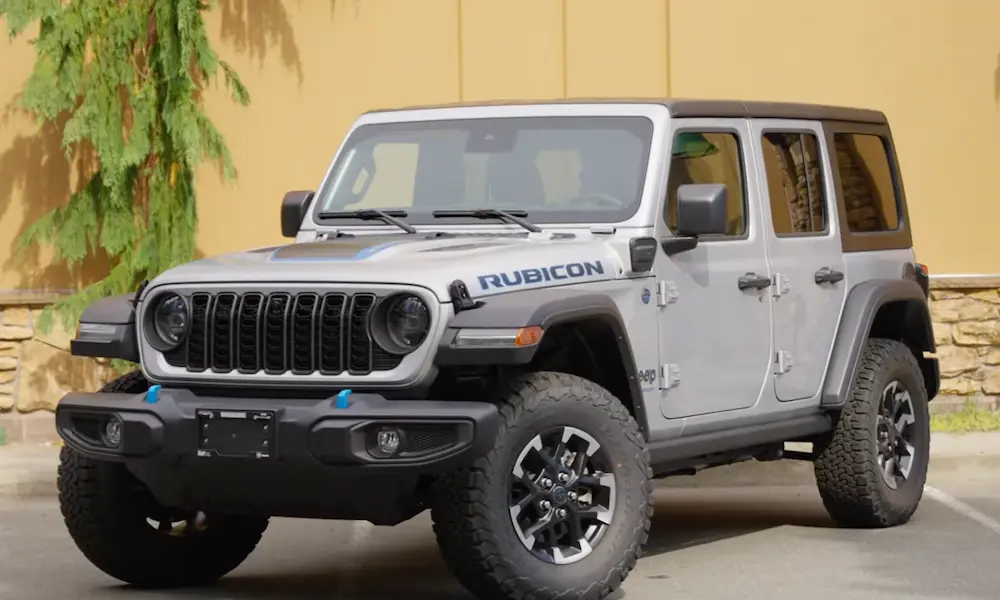
The Wrangler 4xe combines a 2.0L turbo engine with electric motors and a battery pack.
Official EPA ratings:
- 49 MPGe combined (using electric and gas)
- 20 MPG combined (gas-only after battery depletes)
- 21 miles of all-electric range
Here’s the catch: that 49 MPGe number only happens when you charge daily and drive short distances. If you don’t plug it in, you’re hauling around hundreds of pounds of battery and getting worse mileage than the regular 2.0L turbo.
What the Sticker Won’t Tell You: Real-World Performance
EPA ratings are useful for comparison, but they don’t reflect what you’ll actually see. Here’s why Jeep Wrangler gas mileage drops in the real world.
The Brick Factor: Aerodynamics at Highway Speeds
Wranglers have the aerodynamics of, well, a brick. That flat grille and vertical windshield look great but create massive drag at highway speeds.
The EPA highway test doesn’t account for sustained 75-80 mph cruising. Owners report fuel economy “drops exponentially” above 65 mph. One V-6 owner with mostly highway miles averaged just 17.4 MPG—far below the 23 MPG highway rating.
The difference between city and highway ratings is smaller on a Wrangler than on most vehicles. That’s because aerodynamic drag becomes the dominant factor at speed, overwhelming any efficiency gains from steady cruising.
The Rubicon Penalty: What the EPA Ignores
Here’s something wild: the EPA gives identical fuel economy ratings to a base Sport and a Rubicon—even though they’re fundamentally different vehicles.
Base Sport configuration:
- Highway-terrain tires
- 3.45 “economy” axle ratio
- Lighter overall weight
Rubicon configuration:
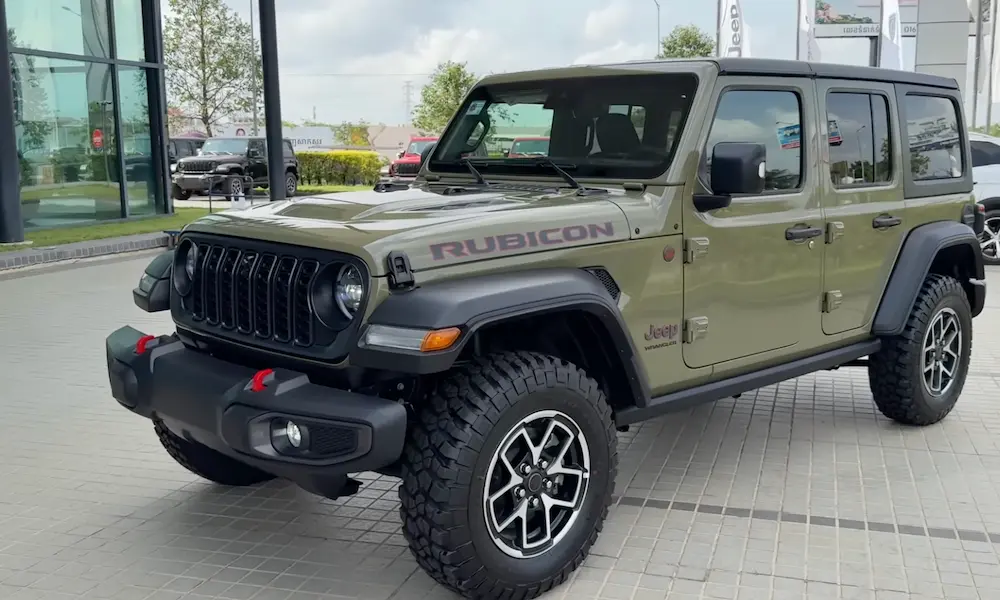
- Heavy 33-inch all-terrain tires
- Aggressive 4.10-4.88 axle ratios
- Additional off-road hardware
Those bigger, heavier tires add rotational mass and rolling resistance. The taller axle ratios force your engine to spin faster at any given speed. Real-world reports show this “Rubicon Penalty” costs 1-4 MPG compared to the sticker.
If you’re buying a Rubicon or any off-road trim, mentally subtract at least 2 MPG from official ratings.
The Gearing Paradox: Why Bigger Isn’t Always Worse
Here’s where it gets interesting. Common wisdom says higher numerical axle ratios (like 4.56) always hurt fuel economy. Not true.
Put 35-inch tires on a Wrangler with “economy” 3.45 gears, and your engine lugs at low RPMs, straining to turn those massive tires. The transmission constantly hunts for the right gear. It’s inefficient.
Re-gear to 4.56, and the engine runs at a higher but more efficient RPM. It’s under less strain. The transmission stays in 8th gear. Some owners report gaining 1-3 MPG on the highway after re-gearing with larger tires.
The lesson: it’s not just about the numbers—it’s about matching your gearing to your tire size and driving conditions.
Engine Showdown: 2.0L Turbo vs. 3.6L V-6 in Practice
On paper, the 2.0L turbo wins. In reality, it’s more nuanced.
Real-World 3.6L V-6 Reports
Owners consistently report 16-18 MPG in mixed driving. Highway-only trips might hit 19-20 MPG at best. City driving often dips to 15-16 MPG.
The V-6 delivers predictable, if modest, fuel economy. What you see is what you get.
Real-World 2.0L Turbo Reports
Stock 2.0L turbos can hit their EPA numbers if you drive conservatively. But here’s the rub: turbocharged engines are highly sensitive to throttle input.
Drive gently, and you’ll see 20-21 MPG. “Put your foot in it,” and fuel economy plummets below the V-6’s numbers. One owner with 35-inch tires reported 16 MPG around town—identical to modified V-6s.
The 2.0L turbo rewards discipline. If you have a heavy foot, the V-6 might actually be more efficient.
The 4xe Deep Dive: Understanding MPGe vs. Reality
The Wrangler 4xe’s fuel economy story has three distinct chapters, depending on how you use it.
Scenario 1: The Daily Charger (40+ MPG)
You commute less than 21 miles each way. You plug in every night. You operate almost entirely on electric power.
What owners report:
- 40+ MPG equivalent
- 800-1,000 miles on a single tank of gas
- Gas engine rarely runs
This is the ideal use case. The 49 MPGe rating becomes reality. But it requires religious charging habits and short daily drives.
Scenario 2: The Highway Tripper (15-22 MPG)
You take a road trip. The 21-mile electric range depletes in the first 20 minutes. You spend the next several hours driving a very heavy hybrid on gas alone.
What owners report:
- 15-17 MPG at 75 mph
- 21.5-22.5 MPG at 50-55 mph
- Hand-calculated 17.4 MPG on pure gasoline
The 4xe weighs significantly more than gas-only Wranglers due to batteries and electric motors. On long highway trips, it’s actually less efficient than the standard 2.0L turbo or 3.6L V-6.
Scenario 3: The Non-Charger (20 MPG)
You bought the 4xe for its torque and power but can’t or won’t charge regularly.
What you’ll get: Around 20 MPG combined—the EPA’s gas-only rating.
This is worse than the standard 2.0L turbo’s 21 MPG. You’re paying a fuel penalty for carrying depleted batteries everywhere.
Jeep Wrangler Gas Mileage vs. The Competition
How does the Wrangler stack up against its rivals?
2025 Ford Bronco Comparison
| Vehicle | Base Engine | V-6 Option | High-Performance |
|---|---|---|---|
| Wrangler | 2.0L Turbo: 21 MPG combined | 3.6L V-6: 20 MPG combined | 6.4L V-8: 14 MPG combined |
| Bronco | 2.3L Turbo: 20 MPG combined | 2.7L Turbo V-6: 17 MPG (w/ Sasquatch) | 3.0L V-6 Raptor: 15 MPG combined |
The Wrangler edges out the Bronco in base-engine efficiency. The Wrangler’s naturally aspirated V-6 significantly outperforms the Bronco’s turbo V-6, especially when both are equipped with off-road packages.
The Bronco has no plug-in hybrid or V-8 competitor to the Wrangler’s specialty models.
2025 Toyota 4Runner Comparison
| Vehicle | Base Engine | Highway MPG |
|---|---|---|
| Wrangler | 2.0L Turbo: 21 combined (20 city / 22 highway) | 22 MPG |
| 4Runner | 2.4L Turbo: 21 combined (19 city / 25 highway) | 25 MPG |
The redesigned 4Runner matches the Wrangler’s combined rating at 21 MPG. But look at the split: the 4Runner delivers 3 more MPG on the highway thanks to better aerodynamics.
The “brick factor” costs the Wrangler on sustained highway drives. The 4Runner’s modern shape cuts through air more efficiently.
What About the Discontinued EcoDiesel?
The 3.0-liter EcoDiesel V-6 was discontinued after 2023, but it’s worth mentioning for used Wrangler shoppers.
EPA ratings:
- 22 city / 29 highway / 25 combined MPG
Real-world reports often matched or exceeded these numbers. Owners saw 24-26 MPG in city driving and 29 MPG on highway trips.
The EcoDiesel was the undisputed range and efficiency champion. Its absence leaves a significant gap for long-haul drivers that the 4xe doesn’t fill.
Making Sense of the Numbers: Buying Advice
Here’s what you need to know before signing the paperwork.
Best Gas-Only Option: 2.0L Turbo (With Caveats)
The 2.0L turbo wins on paper with 21 MPG combined. But this advantage only holds if you drive conservatively.
If you frequently use the turbo’s power, you’ll see worse mileage than the V-6. The naturally aspirated 3.6L delivers more consistent (though lower) baseline economy.
Best Overall MPG: Wrangler 4xe (If You Fit the Profile)
The 4xe’s 49 MPGe is real—but only for owners who:
- Commute less than 21 miles each way
- Charge every night without fail
- Do most driving locally
Highway-heavy drivers or non-chargers will see 15-20 MPG, worse than gas-only models.
Rubicon Buyers: Ignore the Sticker
Official EPA ratings don’t account for off-road tires and aggressive gearing. Subtract 2-4 MPG from any published figure if you’re buying a Rubicon, Willys, or modified Wrangler.
Speed Matters More Than You Think
Jeep Wrangler gas mileage is uniquely sensitive to speed. Cruise at 65 mph, and you’ll hit decent numbers. Push to 75-80 mph, and watch your range plummet.
This isn’t just a Wrangler thing—it’s physics. But the brick-like aerodynamics make it more pronounced than in most vehicles.
The Bottom Line on Jeep Wrangler Gas Mileage
The Wrangler’s fuel economy isn’t a single number—it’s a complex equation involving powertrain, trim, speed, modifications, and driving style.
Don’t trust the sticker alone. Factor in the “brick factor” for highway driving, the “Rubicon penalty” for off-road trims, and the charging reality for the 4xe.
The 2025 4Runner offers better highway efficiency. The 2025 Bronco presents different trade-offs. But if you want a Wrangler, you’re buying it for what it is—an icon with compromises built in.
Just make sure you’re clear-eyed about what those compromises mean for your wallet at the pump.