Got a Keihin carburetor in your hands and no idea which model it is, what the codes mean, or whether it’s even genuine? This guide covers everything — from finding the stamp to decoding every character. Read to the end, because the authenticity section alone could save your engine.
Why Keihin Carburetor Identification Actually Matters
Grabbing the wrong rebuild kit wastes money. Installing a counterfeit carb destroys engines. Misreading a date code leads to incorrect jetting.
Keihin carburetor identification isn’t just a paperwork exercise. It’s how you confirm you have the right unit, the right parts, and a genuine product before anything goes wrong.
Keihin builds several distinct carburetor families, each with different throttle valve designs, stamping locations, and decoding systems. Understanding which family you’re dealing with is the first step.
The Core Keihin Carburetor Families
Before you find any numbers, you need to identify the family. Each one solves a different engineering problem.
CV and CVK: Constant Velocity Carburetors
The CV family dominates street motorcycles, cruisers, and touring bikes. Instead of a cable directly lifting the slide, a butterfly valve modulates intake vacuum. That vacuum acts on a rubber diaphragm, which lifts the slide automatically.
The result? Smooth throttle transitions, lower emissions, and better fuel economy across varying loads.
The Keihin CV40 — a 40mm constant velocity unit — was the OEM standard on Harley-Davidson motorcycles from 1988 through 2006. The CVK32 served Ural motorcycles from 2000 onward, designed specifically to meet EPA guidelines.
FCR and FCR-MX: Flatslide Racing Carburetors
The FCR uses a bearing-supported mechanical flat slide with a direct cable connection. No vacuum delay. No diaphragm. Just immediate throttle response.
That’s why it became the industry standard for four-stroke racing dirt bikes, high-performance ATVs, and sportbikes. The words “FLAT CR” molded into the top cover cap identify a genuine slant-body FCR on sight.
PWK, PJ, and PWM: Two-Stroke Performance Carburetors
Two-stroke engines need high intake velocity and fast pressure recovery. The PWK series delivers this with a D-shaped flat slide that reduces turbulence compared to round-slide designs.
The PWM takes it further with a shorter body and a lighter slide for faster response at high RPM. The Air Striker variant adds cast guide wings in the intake bell, pushing air directly over the needle jet at low throttle openings.
PE and PD: Round-Slide Utility Carburetors
The PE carburetor uses a chrome-plated brass round slide. It’s built for small-displacement off-road bikes and utility engines that need mechanical simplicity and tuneability over outright performance.
The PD is the OEM version — same internal design, but cast with vehicle-specific mounting flanges and cable brackets.
Here’s a quick-reference summary of every family:
| Carburetor Family | Typical Application | Throttle Valve Type | ID Mark Location |
|---|---|---|---|
| CV / CVK | Street cruisers, touring bikes | Diaphragm vacuum slide + butterfly | Side of body adjacent to accelerator pump, above float bowl |
| FCR / FCR-MX | Four-stroke racing, performance ATVs | Bearing-supported mechanical flat slide | Engraved on lower body; “FLAT CR” on top cap |
| PWK | Two-stroke motocross, off-road racing | D-shaped flat slide | Stamped below cast “PWK” logo |
| PE / PD | Light utility, vintage small-displacement | Chrome-plated brass round slide | Stamped above float bowl gasket line |
| Butterfly (Non-CV) | Vintage Harley-Davidson (1976–1987) | Cable-driven butterfly throttle plate | Mounting flange (1976–78) or right choke-cable side (1979–87) |
Where to Find the Identification Stamp
Location varies by family and production era. Stampings resist heat, vibration, and fuel exposure because they’re engraved directly into the cast body — but you need to know exactly where to look.
CV40 (Harley-Davidson / Kawasaki): Check the side of the aluminum body adjacent to the accelerator pump linkage, just above the float bowl gasket surface. Road debris doesn’t reach it there, and it stays visible with the carb installed.
Honda Gold Wing multi-carb arrays: Location changed with every generation:
- GL1000: Top of the mounting flange
- GL1100: Left side of the carburetor body
- GL1200: Inside walls of the carburetor bodies
- GL1500: Exterior stamp on the main bodies
Vintage Harley-Davidson butterfly carburetors (non-CV): Check the mounting flange for 1976–1978 models. For 1979 and later, look above the float bowl on the right choke-cable side.
PE, PWK, and FCR off-road carbs: The stamp sits directly above the float bowl on the main metal body.
Decoding the Alphanumeric Codes
Finding the stamp is half the job. Understanding what it says is where the real identification happens.
Harley-Davidson CV40 Code Structure
The CV40 uses a two-part coding system. The primary serial number (like 27231-98) puts the Keihin part number first and the design introduction year last. So -98 means the design launched in 1998.
Above the float bowl sits a secondary code with three components:
| Code Segment | Format | What It Tells You |
|---|---|---|
| Primary Serial Number | XXXXX-YY (e.g., 27231-98) | Base Keihin model + design introduction year |
| Set Mark | First 4 characters (e.g., B83A) | Proprietary OEM tuning and application code |
| Revision Code | Single letter (e.g., B, C) | Engineering running changes — critical for parts matching |
| Date Code | Final 3 characters | Exact calendar manufacture date |
The revision code is especially important. A B or higher on certain CV carbs means it has an interference-fit float pin pedestal — a design change that fixed float pin migration and fuel flooding issues on earlier units.
Vintage Harley-Davidson Butterfly Carburetor Codes (1976–1987)
Each stamped code maps to a specific production year, venturi size, and jetting configuration:
| Stamped Code | Production Years | Venturi Diameter | Main Jet | Slow Jet | Key Feature |
|---|---|---|---|---|---|
| B50A | Late 1976 | 38 mm | 140 | 100 | No low-speed rubber plug hole |
| B50B / B50C | 1977–1978 | 38 mm | 140 | 100 | Drilled connector hole between main and slow wells |
| B83A / B83B | 1979 | 34 mm | 165 | 65 | Redesigned accelerator pump, fast idle cam |
| B83D | 1980 | 34 mm | 165 | 65 | Factory-sealed to comply with Clean Air Act |
| B83E | Early 1981–Early 1982 | 34 mm | 160 | 68 | Dual-cable throttle assembly added |
| B83G | Late 1982 | 34 mm | 150 | 68 | Leaner mid-range calibration |
| B83H / B83K | 1983–1985 | 34 mm | 160 | 52 | Black rubber cap on evaporative port |
Honda Gold Wing Carburetor Codes
Gold Wing codes are model-year specific and tie directly to emissions management:
- GL1000 (1975–1979): Codes 755A through 771A, stamped on the flange top
- GL1100 (1980–1983): VB48A and VB48C, stamped on the left body side
- GL1200 (1984–1987): VD53A through VD55D (California versions), stamped inside the bodies
- GL1500 (1988–1998): Multiple VD codes, stamped on external body surfaces
Decoding Keihin Jet Needles
Each character in a needle code represents a precise physical dimension. Take R1467NS as an example:
| Character(s) | Parameter | Meaning |
|---|---|---|
| R | Total length | 65 mm |
| 14 | Primary taper angle | 1 degree 40 minutes |
| 67 | Straight section diameter | 2.67 mm |
| N | Clip groove position | ½ step richer than a P clip needle |
| S | Profile marker | Design iteration identifier |
How to Measure Throat Size Correctly
External dimensions don’t tell you the internal bore size. Keihin uses identical external housings across different bore diameters to cut manufacturing costs. Visual identification alone will mislead you.
Follow this process:
- Use a digital or dial caliper. Rulers and tape measures aren’t precise enough for carburetor work. This tutorial covers the technique.
- Measure from the engine side, not the air filter side. The intake bell tapers outward. Measuring there gives you a larger, wrong number.
- Find the narrowest point where the throttle slide travels. That’s the true nominal bore.
- Record both vertical and horizontal diameters if the bore looks elliptical — some Keihin bores are deliberately shaped that way to boost airflow velocity at partial throttle.
- Don’t measure the outer spigot. That’s always larger than the internal bore.
Slide Cutaway Calibration
The cutaway angle on the bottom of the slide controls the mixture from ⅛ to ¼ throttle. A higher cutaway number means more air — leaner mixture. A lower number richens it up.
Keihin’s official slide chart maps every part number to its body size and available cutaway options:
| Carburetor Family | Body Size | Slide Part Number | Available Cutaways |
|---|---|---|---|
| FCR | 32–33 mm | N501-2000 | 05, 10, 15, 20, 25, 30, 35 |
| FCR | 35–41 mm | N502-03×00 | 05, 10, 15, 20, 25, 30, 35 |
| PWK | 28 mm | W1520-2Jx-9900 | 0.0 through 8.0 |
| PWK | 36–39 mm | N502-1702 | 3, 4, 5, 6, 7, 8, 9, 55, 65, 75 |
| PJ | 38 mm | N502-2300-01 | 00 through 85 |
FCR Slant-Body vs. FCR-MX: What’s Actually Different
These two look similar but they’re not interchangeable. The slant-body FCR has an angled slide path, an external air cut-off valve, and a hot-start button mounted to the body. “FLAT CR” molded into the top cap confirms it’s genuine.
The FCR-MX uses a vertical slide path with everything integrated — hot-start system, deceleration ACV, and enclosed linkage. It also has a non-removable intake bell, while many slant-body units use a bolt-on adapter ring.
Tuning difference: slant-body FCRs generally need slightly richer pilot jetting because of differences in air velocity and pilot fuel jet design. The FCR-MX accelerator pump diaphragm also has an integrated metal stop that limits the fuel squirt duration.
How to Spot a Counterfeit Keihin
Fake Keihin carburetors are everywhere, especially PWK and FCR clones. They’re made from inferior alloys, have poorly machined fuel circuits, and use incorrectly sized jets. The engine runs lean, idles erratically, and risks serious damage.
Here’s exactly what separates a genuine Keihin from a counterfeit:
| Physical Feature | Genuine Keihin | Counterfeit Clone |
|---|---|---|
| Country of manufacture | Japan — cast or stamped on body | China — often marketed as “Japanese technology” |
| Serial number finish | Light, precise, uniform imprint | Dark, deeply laser-etched, or crudely engraved |
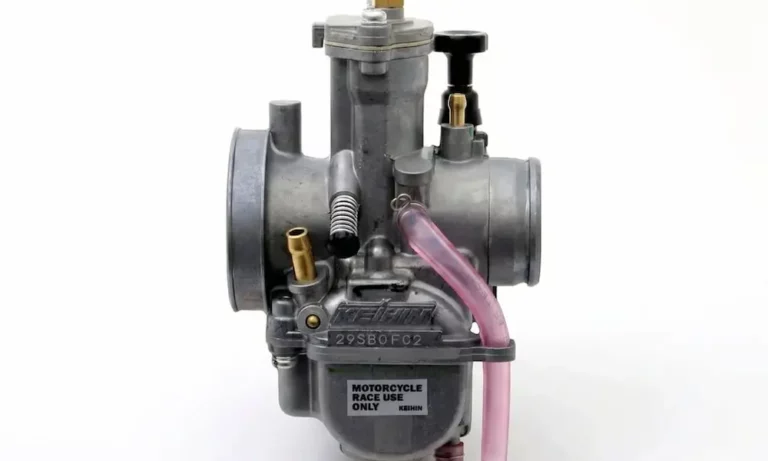
| Vent and overflow hoses | Flexible, dark pink, marked “PLAS TECH” | Rigid, clear, light pink, or yellow — no branding |
| Body decal | “Motorcycle Race Use Only” below Keihin logo | Missing, generic, or misspelled “Sudco” decal |
| Quality control paint marks | Visible paint dots (black, green, orange) on screws and linkage | Completely absent |
| Internal jets and needles | Stamped with Keihin logo and precise size rating | Unmarked brass, rough finish, wrong sizing |
Pay particular attention to the serial number. On a genuine PWK, it’s a light, clean imprint directly below the cast “PWK” logo. Counterfeits laser-etch theirs deep and dark — it looks bold, but that’s actually the giveaway.
The paint dots matter too. Every genuine Keihin leaves the Japanese factory with quality control paint marks on inspected components. No dots means no Japanese quality inspection — full stop.
Float Height: The Final Verification Step
Float height calibration ties the identification process together. Once you’ve confirmed your model, you need to verify the float sits at the correct height before the carb goes back on the engine.
Tilt the carburetor until the float tab just makes contact with the spring-loaded float valve pin — without compressing it. That’s your measurement position. If adjustment is needed, carefully bend the metal tab.
Getting this wrong floods the engine or starves it of fuel. Getting it right means the identification work you’ve done actually translates into a properly running machine.