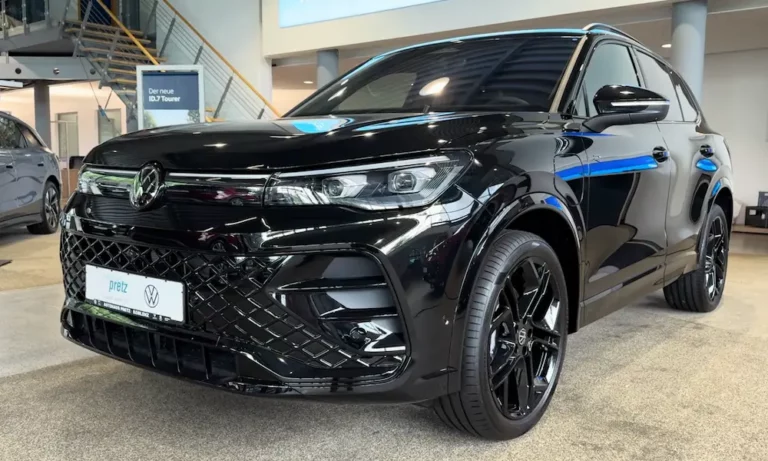
Wondering what to put in your VW Tiguan’s tank? You’ve probably stared at the pump wondering if that premium button is worth pressing. I’ve compiled everything you need to know about fueling your Tiguan, from official recommendations to real-world performance insights.
Regular Unleaded is VW’s Official Recommendation
The simple answer: Volkswagen officially recommends regular unleaded gasoline (87 AKI) for most Tiguan models, including the newer 2025 version.
This isn’t just casual advice. It’s straight from Volkswagen’s technical documentation for the 2.0L turbocharged TSI engine found in recent models. Even dealership guides confirm that regular unleaded is the standard recommendation.
The Confusing Fuel Door Sticker Mystery
Have you noticed the “91” on your fuel door and panicked? You’re not alone.
The confusion stems from different octane rating systems:
- North America uses AKI (Anti-Knock Index)
- Europe and Canada use RON (Research Octane Number)
That “91 RON” sticker you see is equivalent to 87 AKI (regular fuel) in North America. Many Tiguan owners report confusion when seeing this sticker, mistakenly thinking their vehicle requires premium fuel.
Can Premium Fuel Improve Your Tiguan’s Performance?
The Tiguan’s 2.0L TSI engine uses a turbocharger, which does make the fuel question a bit more interesting.
Potential Benefits of Premium Fuel
Some drivers have reported these improvements with premium (91+ AKI) fuel:
- Improved Fuel Economy: One 2018 Tiguan owner tracked 30 MPG with premium fuel versus 25 MPG with regular during highway driving, according to real-world comparisons.
- Better Power Response: The turbocharger can potentially deliver power more efficiently with premium fuel, especially under heavy loads.
- Knock Prevention: Premium fuel has a higher resistance to engine knock, which might benefit the turbocharger during demanding driving conditions.
The Reality Check
Before you commit to spending more at the pump:
- Factory Setting: Your Tiguan’s engine is calibrated for 87 AKI fuel from the factory.
- Modern Engine Technology: Today’s engines have knock sensors that adjust timing automatically, reducing the historical advantages of premium fuel.
- Cost Analysis: At roughly $0.30–$0.50 more per gallon, premium fuel adds about $5–$8 per tank. Unless you see significant performance improvements, this cost rarely justifies itself for daily driving.
Tiguan Fuel Requirements by Model Year
Volkswagen has maintained consistent fuel recommendations across Tiguan generations, but there are some nuances:
2015–2021 Models
- Fuel doors often specify “91 RON” (equivalent to 87 AKI)
- Owner’s manuals clarify that higher octane offers minimal benefits in stock engines
- Forum discussions confirm regular fuel is appropriate
2022–2025 Models
- Standardized recommendations for 87 AKI
- Updated ECU programming to minimize knock risk with regular fuel
- The 2025 Tiguan’s revised 2.0L engine produces 201 hp (up 17 hp from 2024) but maintains identical fuel requirements according to Volkswagen’s specifications
Special Circumstances: When Premium Might Make Sense
There are specific situations where premium fuel might be worth considering:
1. If You’ve Modified Your Tiguan
Aftermarket ECU tuning often requires premium fuel. For instance, Unitronic’s Stage 1 ECU tuning explicitly requires 91 AKI to unlock additional horsepower. Running regular fuel with performance tunes can cause engine knock and potential damage.
2. When Towing or Hauling Heavy Loads
Under high-stress conditions like towing, mountain driving, or carrying heavy cargo, premium fuel might provide more knock resistance and potentially smoother performance.
3. High-Altitude Considerations
In high-altitude areas like Colorado, where 85 AKI is marketed as “regular,” Volkswagen recommends using 87 AKI (mid-grade) due to reduced air density. The thinner air at altitude partially compensates for lower octane, helping maintain performance similar to sea-level conditions.
Real-World Performance Comparison Table
To help you make an informed decision, here’s what Tiguan owners report when comparing fuel types:
| Performance Aspect | Regular (87 AKI) | Premium (91+ AKI) | Worth the Upgrade? |
|---|---|---|---|
| Fuel Economy (Highway) | 25 MPG (average) | 27-30 MPG (varies) | Maybe, if you drive mostly highway |
| Acceleration Feel | Standard | Slightly more responsive | Noticeable to enthusiasts only |
| Engine Smoothness | Good | Marginally better | Minimal difference |
| Cost per Mile | Lower | Higher (unless efficiency gain offsets price) | Rarely cost-effective |
| Cold Weather Start | Good | Good | No difference |
The Economics: Is Premium Fuel Worth It?
Let’s break down the cost-benefit analysis:
- Cost Premium: $0.30–$0.50 per gallon = approximately $5–$8 extra per tank
- Potential Mileage Improvement: 2-5 MPG (based on owner reports)
- Break-Even Point: For premium fuel to pay for itself with a 3 MPG improvement, gas prices would need to be below $4.00/gallon if driving 15,000+ miles annually
For most drivers using their Tiguan for regular commuting, the economic case for premium fuel simply doesn’t add up.
Common Questions About Volkswagen Tiguan Fuel
Will regular gas damage my Tiguan’s turbo engine?
No. Volkswagen designed the Tiguan to run on regular (87 AKI) fuel. The engine’s knock sensors adjust timing to prevent damage. Dealership experts confirm there’s no evidence linking regular fuel to engine problems in properly maintained Tiguans.
What happens if I mix premium and regular in my Tiguan?
Mixing fuels is perfectly safe. The resulting octane will be somewhere between the two grades. Your Tiguan’s engine management system will adjust accordingly. Many drivers gradually transition between fuel types this way.
Does premium fuel improve gas mileage enough to justify the cost?
Rarely. While some drivers report 2-5 MPG improvements, the price differential usually outweighs these gains. The exception might be if you frequently drive at highway speeds for long distances, where the efficiency improvements are most noticeable.
What about ethanol content in gasoline?
The Tiguan is designed to handle gasoline with up to 10% ethanol (E10), which is standard in most US pumps. Higher ethanol blends like E15 or E85 are not recommended unless specifically stated in your owner’s manual.
Best Practices for Fueling Your Volkswagen Tiguan
- Follow the manual: Volkswagen engineered your Tiguan for regular 87 AKI fuel, so this should be your default choice.
- Consider your driving habits: Highway cruisers might see more benefit from premium than city drivers.
- Try both and track results: If curious, track your actual mileage with a full tank of each fuel type under similar driving conditions.
- Use quality fuel: Choose reputable gas stations with high turnover regardless of octane level. Fuel quality varies more between stations than between octane grades at the same station.
- Don’t overfill: Stop when the pump clicks off to prevent fuel system damage and environmental hazards.
The Volkswagen Tiguan delivers its designed performance with regular unleaded gasoline. While premium fuel might offer marginal benefits in specific circumstances, most drivers won’t notice enough difference to justify the extra cost. Your Tiguan was built to run efficiently and reliably on 87 AKI fuel, giving you one less thing to worry about during your ownership experience.